TL;DR
- In the first four months of 2026, 68.01 percent of Google searches ended without a click, which reshapes how you measure organic performance (Fishkin, 2026).
- 72.9 percent of pages in Google's top 10 are more than 3 years old, and the average number 1 page is 5 years old, so ranking durability rewards patience (Ahrefs, 2025).
- Google's AI Overviews now have over 2.5 billion monthly active users, making AI features a major distribution layer (Pichai, 2026).
- The average Google Ads CPC in 2026 is $5.42, which is more than twice what it was 10 years ago, strengthening the case for non-auction organic acquisition (WordStream, 2026).
- Google states that SEO best practices remain relevant for AI features, with no additional requirements to appear in AI Overviews or AI Mode (Google, n.d.-a).
An SEO strategy is a long-term approach to earning organic search visibility that compounds authority, traffic, and durable rankings over months and years rather than days.
In 2026, patience matters more than ever. Search behavior has shifted toward zero-click results and AI-mediated answers; paid clicks keep getting more expensive, and the pages that win top rankings tend to be years old.
If you want a durable SEO ranking, strong SEO content, and visibility inside Google's newest AI experiences, the fundamentals of an on-page SEO strategy built around user-intent SEO are still the foundation. This is not a sprint. It is compounding interest. At BusySeed, we help brands build these resilient organic growth engines so you can stop renting visibility and start owning it.
Why Is SEO Structurally a Long-Term Investment in 2026?
SEO is a long-term investment because Google's rankings favor pages that have accumulated age, authority, and trust over time. The data on pacing is direct (Ahrefs, 2025):
- Top rankings skew older: 72.9 percent of pages in Google's top 10 are more than 3 years old.
- The top spot takes time: the average number-1-ranking page is 5 years old.
- New content rarely jumps the line: Only 1.74 percent of newly published pages rank in the top 10 within a year.
These numbers tell you almost everything about pacing. Fresh content rarely leaps to the front page, and the pages that hold position have usually earned it over multiple years.
Google itself frames the impact of SEO as gradual. In its SEO Starter Guide, Google explains that every change you make takes time to be reflected. You will likely want to wait a few weeks to assess whether your work has had beneficial effects (Google, n.d.-g).
For broader algorithmic learning, the timeline stretches further. Google's core updates documentation outlines the following expectations (Google, n.d.-e):
- Short-term adjustments: After improvements, some changes may take a few days to take effect.
- Long-term validation: It could take several months for its systems to learn and confirm that the site as a whole is producing helpful, reliable, people-first content.
For industry experts, none of this should be surprising, but it does reframe budgeting conversations. An SEO strategy that gets abandoned after a single quarter never gives Google's systems the time they need to confirm quality signals. The compounding effect shows up later and keeps working while you sleep.
How Have Zero-Click Searches Changed What SEO Ranking Means?
Zero-click searches are Google queries that end without the user clicking through to any website, and they now dominate the results page.
The data reveals a massive shift in how people consume search results:
- Current zero-click rate in the US: In the first four months of 2026, 68.01 percent of Google searches in the US ended without a click (Fishkin, 2026).
- Global zero-click rate: Similarweb echoes this trend on a broader scale, reporting a 68 percent zero-click rate globally (Similarweb, 2026).
- The historical jump: For comparison, a study found that just under 60 percent of US searches ended without a click from September 2022 to May 2024 (Fishkin, 2024).
- Open web traffic: Out of every 1,000 Google searches in the US, only 360 clicks go to the open web (non-Google-owned and non-Google-ad properties) (Fishkin, 2024).
What does this mean for your SEO ranking? A number 1 position no longer guarantees the click volume it once did. Visibility and clicks have decoupled.
If you are still reporting SEO success purely by sessions, you are measuring a shrinking slice of the value. The presence of your brand, your answer, and your citation on the results page carries weight even when no click follows.
That is why the definition of a ranking win in 2026 has to expand to include impressions, SERP feature presence, and branded demand. This is exactly why our team at BusySeed builds zero-click reporting frameworks for our clients, ensuring leadership sees the true ROI of your organic footprint.
How Do AI Overviews and AI Mode Fit Into Your SEO Strategy?
AI Overviews and AI Mode are Google's generative AI experiences that answer queries directly inside Search, and they are now enormous distribution channels rather than experiments.
Google reported massive adoption of its generative AI features:
- AI Overviews now boasts over 2.5 billion monthly active users (Pichai, 2026).
- AI Mode has surpassed 1 billion monthly users, with queries more than doubling every quarter since launch (Reid, 2026).
The reassuring part for anyone who has invested in an on-page SEO strategy is that Google does not treat generative AI as a separate discipline. To understand and optimize for these new features, keep these core principles top of mind:
- No additional requirements: Google states plainly that standard SEO best practices remain relevant. There are no special requirements or hidden tricks to appear in AI Overviews or AI Mode (Google, n.d.-a).
- Basic eligibility: To appear as a supporting link, a page simply needs to be indexed and eligible to display a regular snippet (Google, n.d.-a).
- Search Console reporting: One practical note is that, to be displayed in generative AI features, a site must be included in the Search generative AI features reporting in Search Console.
- How answers are generated: Under the hood, Google explains that AI Overviews and AI Mode may use query fan-out, issuing multiple related searches to develop a comprehensive response (Google, n.d.-f).
- Accuracy still relies on you: Google warns on its AI Overviews help page that AI responses may include mistakes (Google, n.d.-b). SEO content still matters heavily as the reliable, human-verified source these systems draw from.
Treating generative visibility as an extension of solid SEO, rather than a set of separate tricks, remains the sound approach.
If you are unsure how your current assets perform in these new environments, BusySeed can run an AI-readiness audit to ensure your content is structured for maximum visibility in generative AI, complementing our full suite of digital marketing services.
Why Does Rising Paid Search Cost Strengthen the Case for SEO?
Paid search is auction-driven, so its cost climbs as competition rises. On the other hand, organic SEO is not pay-per-click, making it strategically valuable in the long term.
The 2026 WordStream and LocaliQ benchmarks (based on 13,474 US-based search ad campaigns running from April 1, 2025, to March 31, 2026) provide a clear picture of the current paid search landscape (WordStream, 2026):
- Average CTR: 6.64 percent.
- Average conversion rate: 8.18 percent.
However, the trend line is the real story. Costs have climbed significantly over the last decade (WordStream, 2026):
- The 10-year CPC trend: CPC is more than twice what it was 10 years ago, jumping from $2.32 to an average of $5.42.
- Rising cost per lead: The average cost per lead rose from $59.18 in 2016 to $66.69 in 2026.
Paid search still delivers immediate visibility, and it belongs in most media plans. But every year you rent that visibility, the rent goes up. SEO builds an asset you own.
This is not an argument to abandon paid. It is an argument for balance. Paid buys speed today; SEO buys durability tomorrow. The two work best together, and the compounding nature of organic search is what tips the long-term math in its favor.
Does SEO Still Matter When Google Is So AI-Heavy?
Yes, SEO still matters because Google still controls the overwhelming majority of US search distribution. As of June 2026, Google held 86.72 percent of the US search engine market share across all devices (StatCounter, 2026). When one platform routes that much discovery, foundational SEO remains the single highest-leverage channel for discovery.
Vendor research supports organic's continued primacy. BrightEdge's 2025 reporting highlights two key realities about the current search landscape (BrightEdge, 2025):
- Organic still dominates traffic: From January to August 2025, AI search accounted for less than 1 percent of referral traffic, while organic search remained the primary driver, delivering the majority of conversions.
- Authority feeds AI visibility: 34 percent of AI citations come from PR and media coverage, serving as a useful reminder that off-page authority signals directly influence AI visibility.
The quality of AI-referred traffic is worth watching even though the volume is small. Adobe reported that during the 2025 holiday season, retail AI referrals had bounce rates that were 33 percent lower than those of non-AI traffic.
Adobe's 2025 holiday season data revealed massive growth in retail AI referrals (Adobe, 2025):
- Higher revenue per visit: AI-driven revenue per visit was 32 percent higher than non-AI traffic, up 254 percent year-to-date.
- Massive traffic spikes: GenAI-driven retail traffic increased 693 percent year over year in that period.
It may be small today, but it is growing fast and shows greater intent when it arrives.
SEO vs Paid Search: A Direct Comparison for 2026
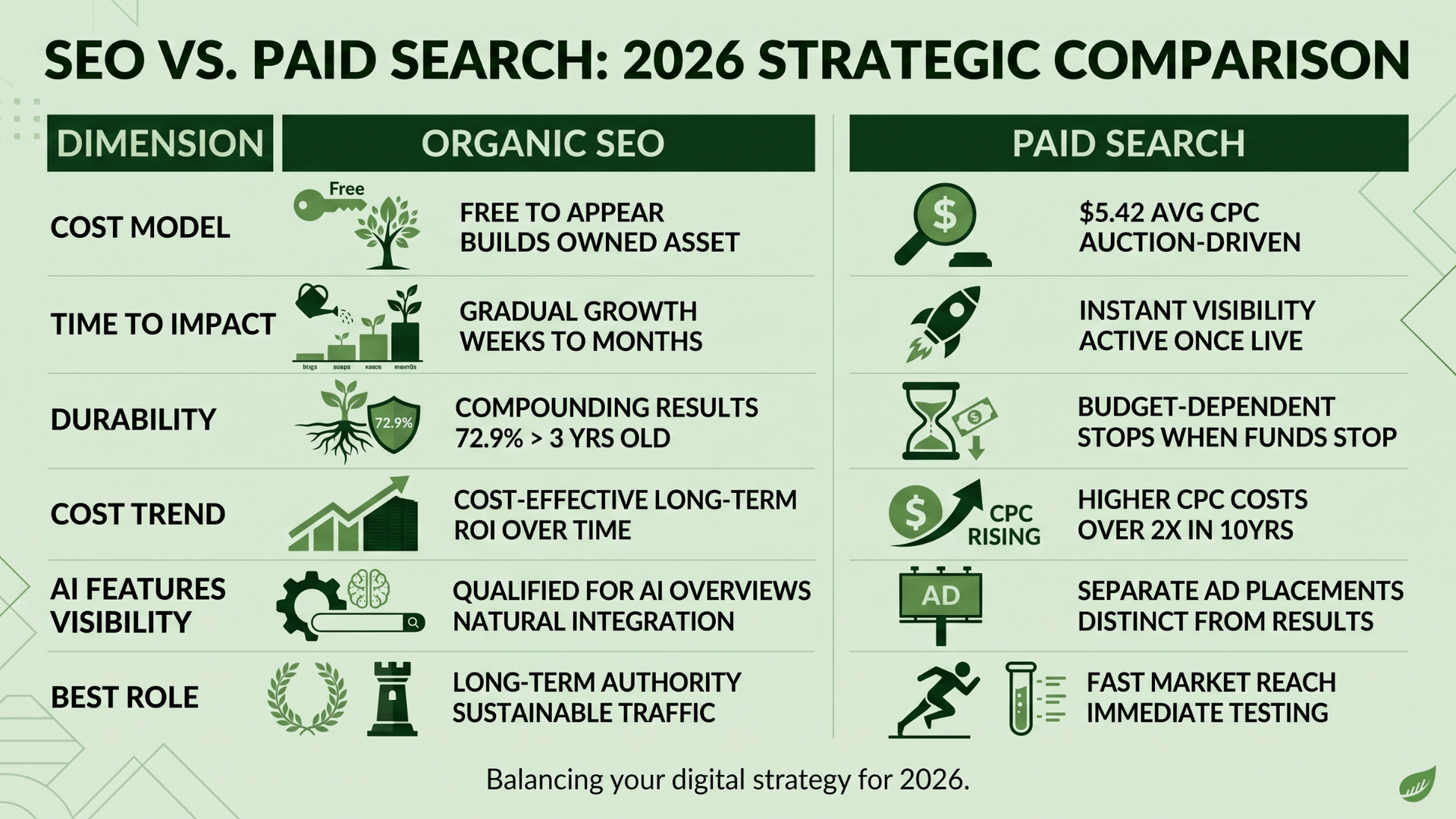
The table below outlines how organic SEO and paid search compare across the dimensions that matter most for a long-term plan. Both belong in a mature program; the difference is what each one buys you.
| Dimension | Organic SEO | Paid Search |
|---|---|---|
| Cost model | Non-auction; no cost to appear in results per Google's Search Essentials | Auction-driven; average CPC of $5.42 in 2026 |
| Time to impact | Weeks to months, and often longer per Google's guidance | Immediate visibility once live |
| Durability | Compounds: 72.9 percent of the top 10 pages are 3+ years old | Stops the moment the budget stops |
| Cost trend | Investment builds an owned asset | CPC is over twice what it was 10 years ago |
| AI features visibility | The same best practices qualify pages for AI Overviews and AI Mode | Separate ad placements |
| Best role | Long-term authority and durable traffic | Fast reach and testing |
What Should You Measure When Traffic Falls but Visibility Rises?
When impressions climb but clicks fall, you should shift from a clicks-only scorecard to a visibility-aware one that captures the value zero-click searches create. With 68 percent of Google searches ending without a click, a declining session count can coexist with rising brand exposure and demand (Similarweb, 2026).
Classic SEO reporting tracks sessions, clicks, and conversions. That still matters, but it undercounts modern value.
A zero-click-aware approach adds impressions, SERP feature visibility, branded demand lifts, and assisted conversions to your broader SEO strategy.
For AI visibility within Google, Search Console documents where AI features are counted and how to measure them. Your reporting should include that layer as well to accurately reflect the true impact of your SEO ranking.
For teams asking about the top tools for scoring content effectiveness without visible clicks, the honest, research-backed answer is to lean on Search Console's impression and AI feature reporting.
Then, pair it with branded search demand and assisted conversion tracking. These measure the influence of your SEO content, even when the click never happens.
An 8-Step Long-Term SEO Strategy Checklist for 2026
Use this actionable checklist to build an on-page SEO strategy that holds up through zero-click behavior, AI features, and rising paid costs. Every step is grounded in Google's own documentation.
- Confirm indexing eligibility baselines. Meet Google's technical requirements: crawlable, HTTP 200 responses, and indexable content. Indexing is never guaranteed, so treat this as the minimum bar.
- Adopt Search Essentials as your framework. Structure your program around Google's Search Essentials, which organizes guidance into technical requirements, spam policies, and key best practices (Google, n.d.-c).
- Audit against spam policies. Validate your content plan against Google's spam policies, especially those targeting scaled content abuse, which targets pages made primarily to manipulate rankings rather than help users.
- Build for AI features without special markup. Google confirms that no additional optimizations beyond foundational SEO are required to appear in AI Overviews and AI Mode (Google, n.d.-a). Focus on indexable, snippet-eligible pages.
- Apply Google's generative AI guidance as SEO, not hacks. Follow the AI optimization guide, remembering that generative features are rooted in core ranking systems and use RAG and query fan-out.
- Prioritize user-intent SEO. Map each target query to the intent behind it, informational or transactional, so your SEO content answers the real question a fan-out search might issue.
- Set realistic timelines and governance. Expect a few weeks to assess changes per Google's SEO Starter Guide, and potentially several months for broader algorithmic learning.
- Report on visibility, not just clicks. Track impressions, SERP feature presence, branded demand, and AI feature reporting in Search Console alongside sessions and conversions.
If managing these eight steps feels overwhelming, we have the tools to help. You can brush up on the fundamentals using our SEO Basics resource guide, or let our team handle the heavy lifting by exploring our specialized SEO services.
How Should You Split Budget Between SEO and Paid Search?
You should fund paid search for speed and testing while funding SEO as the compounding asset that lowers acquisition cost over time.
Because paid is auction-driven and its average CPC now sits at $5.42, per-click costs tend to rise as competition increases (WordStream, 2026).
SEO carries no per-click charge. As your organic footprint grows through a well-executed on-page SEO strategy, your blended cost of acquisition can fall.
A practical framing: use paid to capture the transactional demand you need to convert this quarter. Then, use SEO to build both transactional and informational visibility.
In zero-click categories, properly mapping search behavior to your user-intent SEO strategy is crucial. Informational visibility is often the only presence you can win, and it feeds both AI Overviews and AI Mode.
The split is rarely all-or-nothing. It is a portfolio decision that shifts toward organic as your content asset matures. While many marketing agencies in New York City focus strictly on short-term paid wins, navigating this holistic shift is where BusySeed excels; we help marketing teams dynamically reallocate budgets, ensuring paid search covers your short-term gaps while your long-term SEO builds unstoppable momentum.
Your Next Best Move
SEO in 2026 is a compounding asset in a market where clicks are scarcer, AI answers are everywhere, and paid visibility keeps getting pricier. The evidence is consistent: older pages hold the top spots, Google's own timelines run to months, AI features reward the same fundamentals, and organic still drives the bulk of conversions. The teams that measure visibility honestly, invest steadily, and build SEO content worthy of citation are the ones positioned to win the long game.
If you are searching for the best digital marketing agency in NYC to balance paid acquisition with a compounding on-page SEO strategy, let's talk. At BusySeed, we can help you audit your technical foundations, map user intent, and build high-authority SEO content that search engines and AI models trust. Connect with us here to build your end-to-end long-term organic growth engine. We're ready to help.
Frequently Asked Questions
1. How long does SEO take to show meaningful results in 2026?
Plan in months and quarters, not days. Google's SEO Starter Guide advises waiting a few weeks to assess whether changes have had beneficial effects, and its core updates guidance notes it can take several months for its systems to confirm a site is producing helpful content. Given that 72.9 percent of top 10 pages are over 3 years old, durable results reward sustained effort (Ahrefs, 2025).
2. What makes a digital marketing service effective for long-term organic growth?
An effective service pairs technical SEO, high-quality SEO content, and AI search readiness into a single strategy rather than treating them separately. Since Google confirms the same best practices power AI features, a unified program is efficient.
3. How do we get included as a supporting link in AI Overviews or AI Mode?
Make sure your page is indexed and eligible to show a snippet, because Google states there are no additional requirements beyond foundational SEO to appear. Confirm your site is included in the Search generative AI features reporting in Search Console. Strong, well-structured SEO content that answers query fan-out is your best path in.
4. Do we need AEO or GEO, or is it still just SEO for Google?
For Google specifically, it is still SEO. Google's own AI optimization guide states that generative AI features are rooted in core Search ranking systems, so no separate technical discipline is required for eligibility. GEO becomes a useful lens for prioritizing authority and answer quality as an extension of SEO rather than a separate practice.
5. Best case studies on the financial impact of outdated SEO practices: where can teams find this data?
The strongest data points in this research come from the rising cost of paid search and the age advantage of established pages. WordStream's 2026 benchmarks show CPC has more than doubled over a decade, illustrating the cost of relying on paid rather than building organic assets (WordStream, 2026), while Ahrefs' ranking age study shows how neglected content struggles to reach the top 10 (Ahrefs, 2025).
Works Cited
- Adobe. AI-Sourced Traffic Insights 2025. Adobe Business, 2025.
- Ahrefs. How Long Does It Take to Rank in Google?. Ahrefs Blog, 2025.
- BrightEdge. Industry Report September 2025: AI Search Visits Surging. BrightEdge, 2025.
- Fishkin, Rand. In 2026, Less than One Third of Google Searches Still Send a Click. SparkToro, 2026.
- Fishkin, Rand. 2024 Zero-Click Search Study. SparkToro, 2024.
- Google. AI Features and Your Website. Google Search Central, n.d.-a.
- Google. AI Overviews. Google Search Help, n.d.-b.
- Google. Google Search Essentials. Google Search Central, n.d.-c.
- Google. Google Search Technical Requirements. Google Search Central, n.d.-d.
- Google. Google Search's Core Updates. Google Search Central, n.d.-e.
- Google. Optimizing Your Website for Generative AI Features on Google Search. Google Search Central, n.d.-f.
- Google. SEO Starter Guide. Google Search Central, n.d.-g.
- Google. Spam Policies for Google Web Search. Google Search Central, n.d.-h.
- Pichai, Sundar. Sundar Pichai I/O 2026 Keynote. The Keyword, Google, 2026.
- Reid, Elizabeth. Search I/O 2026 Updates. The Keyword, Google, 2026.
- Similarweb. Zero-Click Marketing: The SEO Strategy for a World Where Most Searches Skip Your Site. Similarweb Blog, 2026.
- StatCounter. Search Engine Market Share in the United States of America. StatCounter Global Stats, 2026.
- WordStream. Google Ads Benchmarks 2026. WordStream, 2026.