TL;DR
- Higher Logic's Association Email Benchmark Insights for 2026 states that "relevance consistently beats volume" and reports that 51% of surveyed members say they already receive too many messages.
- Omnisend's 2025 Ecommerce Marketing Report analyzed 24 billion emails and found automated messages drove 37% of email-driven sales while making up just 2% of total email volume.
- Intuit Mailchimp's “Breaking Through Peak Season Noise” report found that segmented and personalized Black Friday Cyber Monday 2025 emails produced an 11% higher average order value, $166 versus $150.
- Google's Email Sender Guidelines require SPF or DKIM from every sender, add DMARC and one-click unsubscribe above 5,000 daily messages, and require spam rates to stay below 0.30%.
Email marketing is the practice of sending commercial or informational messages to a permission-based subscriber list, and in 2026 the test it has to pass is simple: does the message give the person a concrete reason to act right now? Crowded inboxes, privacy features that obscure opens, and stricter sender rules at Gmail and Yahoo have all raised the floor.
More sends no longer buy more attention. Timeliness, specificity, a useful payload beyond a discount, and clean deliverability do. The evidence below comes from platform datasets, association benchmarks, and the mailbox providers themselves, and it points in one direction: relevance, not volume, is what gets your email marketing campaigns opened and clicked.
What Makes Email Marketing Worth Opening In 2026?
An email is worth opening when it arrives at a moment that matters to the recipient and offers something specific they can use, and the data proves that targeting outperforms frequency. Higher Logic's Association Email Benchmark Insights for 2026 states plainly that "relevance consistently beats volume," noting that engagement growth did not keep pace with the rising volume of association emails sent between 2022 and 2025.
The fatigue is measurable. In the same Higher Logic member research, 51% of respondents said they receive too many messages. In the same dataset, sends to lists of fewer than 500 contacts reached open rates near 48% and click rates above 8%, with performance declining as list size grew. That is association data, not a universal law, and it does not mean capping every list at 500. It does demonstrate how tightly targeting and engagement move together.
Revenue tells the same story. Intuit Mailchimp's “Breaking Through Peak Season Noise” report found that among customers with connected ecommerce stores, emails using segmentation and personalization during Black Friday Cyber Monday 2025 generated an 11% higher average order value, $166 against $150. Yet of the 44 billion-plus emails analyzed, just over 6 billion used personalization. Most sends still skipped it, which makes email marketing personalization an execution gap rather than a saturated tactic.
BusySeed is a United States digital marketing agency, founded and led by CEO Omar Jenblat, that builds and manages revenue-focused lifecycle email programs covering campaign strategy, segmentation, automation, and store or CRM integrations. We measure email in revenue per send rather than open rates, which is the same shift the benchmark data keeps pointing toward to maximize customer retention.
What Are The Recommended Tools For Humanizing Automated Emails?
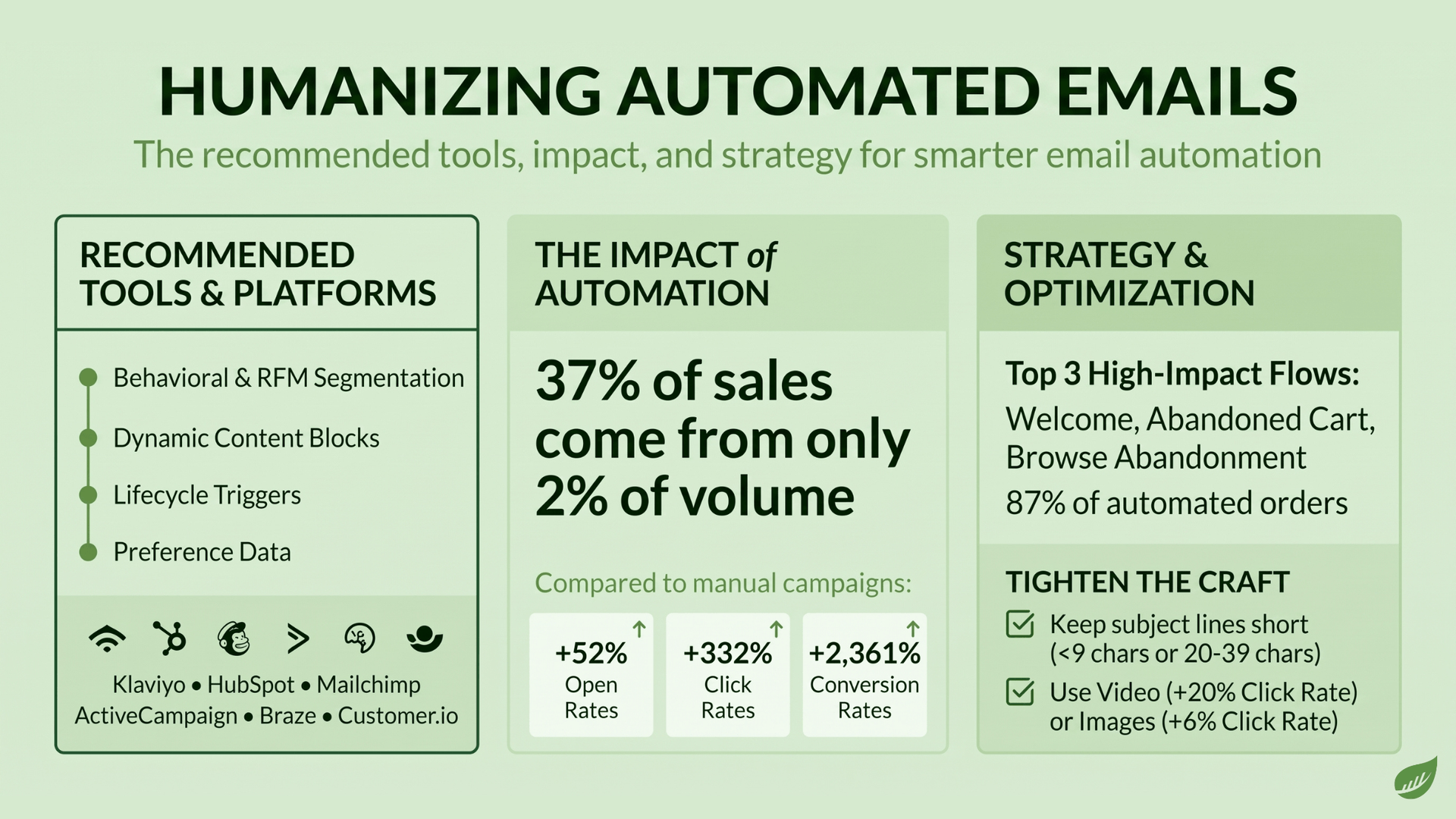
The recommended tools for humanizing automated emails are the ones that let a message respond to an individual's behavior rather than a calendar: behavioral and RFM segmentation, dynamic content blocks, lifecycle triggers, and preference data held in your own CRM. Platforms including Klaviyo, HubSpot, Mailchimp, ActiveCampaign, Braze, and Customer.io all support that pattern, and our team builds across all six while clients keep ownership of their accounts and data.
The commercial case for triggered sending is unusually clear. Omnisend's 2025 Ecommerce Marketing Report analyzed 24 billion emails from 2024 and found automated messages generated 37% of email-driven sales from only 2% of volume.
When compared to manual broadcast email marketing campaigns, automated flows delivered massive performance multipliers:
- 52% better open rates
- 332% higher click rates
- 2,361% better conversion rates
Ultimately, one in three people who clicked an automated message purchased, compared with one in 18 who clicked a scheduled one.
Humanizing starts with order of operations. Abandoned-cart, welcome, and browse-abandonment emails accounted for 87% of all automated orders in that dataset, so those three flows deserve attention before another promotional blast joins the calendar. Intuit Mailchimp's “Breaking Through Peak Season Noise” report found that campaigns using an abandoned-cart block produced a 36% higher open rate during BFCM 2025.
Then tighten the craft. Higher Logic's Association Email Benchmark Insights for 2026 found subject lines under nine characters produced the highest open rates, with 20 to 39 characters also performing strongly, while most association emails still ran past 40 characters.
In the same Intuit Mailchimp report covering more than 1 billion emails, video produced a 20% higher click rate, and images produced 6%. True email marketing personalization goes beyond just inserting a first name. Email automation that sounds human is really automation that arrives with context.
Recommended AI Email Marketing Services For Privacy-Conscious Businesses
AI-driven email services suit a privacy-conscious business when they run on first-party consent data, keep account and data ownership with the client, and report on clicks and conversions rather than inferred opens. Any AI tool for automating email with strong privacy protections has to assume that open tracking is partially blind, because on Apple devices it already is.
Apple's Use Mail Privacy Protection on iPhone Guide states that the privacy protection feature hides the recipient's IP address and prevents senders from seeing if you have opened the email message they sent you.
Higher Logic's Association Email Benchmark Insights for 2026 makes the operational point: clicks have become the more meaningful engagement metric because privacy features, email-client changes, and automated image loading all distort open data. Its benchmark averages were a 33.54% open rate against a 2.68% click rate.
Because of this distortion, you should treat open rates as directional only, never as proof of human attention. Instead, judge revenue-led programs on:
- Clicks and click-through rates
- Conversion rates
- Revenue per recipient
- Repeat purchases and actions tied to customer retention
Privacy-respecting infrastructure matters as much as the metric set. Suppression and consent management keep unsubscribed and inactive contacts out of future sends, list hygiene reduces complaints, and permission-based segmentation means personalization draws on data the subscriber knowingly gave you.
Those are the controls we build into client programs alongside dynamic email marketing personalization, and they are the ones worth auditing in any vendor demo. A service that can only prove value through open rates is measuring something the inbox no longer reliably reports.
What Are The Best AI Email Marketing Tools For Ethical Practices?
The best AI tools for ethical email practices are the ones that make consent, easy exits, and authenticated sending the default rather than a settings page nobody visits. Ethical practice in email is also legal practice, and in the United States the rules are specific.
Google's Email Sender Guidelines require strict authentication for all senders, with specific rules for those exceeding 5,000 messages per day to Gmail accounts:
- Authentication Protocols: Large senders must use SPF, DKIM, and DMARC, maintain valid DNS records, and use TLS.
- One-Click Exits: Senders must support one-click unsubscribe with a clearly visible unsubscribe link in the message body.
- Spam Thresholds: Senders must keep spam rates in Postmaster Tools strictly below 0.30%.
Google warns that unauthenticated mail may be marked as spam or rejected outright. Yahoo's Sender Best Practices similarly call for a functioning List-Unsubscribe header on all marketing and subscribed messages.
Furthermore, the FTC's CAN-SPAM Act Compliance Guide for Business applies to all commercial messages (including B2B) and dictates strict opt-out management:
- Clear Opt-Outs: Senders must offer a highly visible way to unsubscribe.
- 10-Day Rule: Unsubscribe requests must be honored within 10 business days.
- 30-Day Window: The opt-out mechanism must remain active for at least 30 days after the email is sent.
The FTC also cautions that an ongoing commercial relationship does not make a message transactional; subscribers and members keep the right to opt out of marketing. Compliance language is worth a legal review before you publish it, particularly if you send across state or international lines.
How Should You Evaluate Email Marketing Software Enterprise Rates?
Enterprise email software rates are typically quoted against contact count, send volume, and feature tier, and vendors negotiate rather than publish them, so the only fair way to evaluate a quote is against the revenue and retention the program produces. Price the platform per dollar returned, not per contact stored.
Three numbers make that math easier:
- Omnisend's 2025 Ecommerce Marketing Report proves automated email drives 37% of sales from just 2% of volume. This means the automation feature set, not the broadcast capacity, is usually where enterprise value sits.
- Intuit Mailchimp's “Breaking Through Peak Season Noise” report proves an 11% average order value lift from segmentation and personalization, giving you a revenue-side input for modeling a tier upgrade.
- Google's Email Sender Guidelines set a 5,000 messages per day threshold, which means most enterprise senders inherit DMARC, TLS, and one-click unsubscribe obligations. Because of this, deliverability engineering belongs in the total cost, not in a footnote.
Architecture also belongs in the evaluation. A healthy portfolio of email marketing campaigns requires three distinct types:
- Broad Scheduled Campaigns: Used to carry major announcements and company launches.
- Segmented Campaigns: Used to deliver high relevance to a specifically defined group.
- Behavioral Automation: Uses email automation to handle signup, browse, cart, renewal, and post-purchase moments based on real-time actions.
A portfolio of all three beats replacing one with another, and the software licensing you need should follow that mix rather than a sales deck.
BusySeed's email marketing campaigns are built the same way, with promotional and lifecycle mapping, offer and send-time planning, revenue goals set per campaign, and deliverability work covering SPF, DKIM, and DMARC setup, list hygiene, sender-reputation monitoring, and spam and placement testing. You can see how that fits together on our email service page. Whatever platform you license, clients should retain ownership of the account and the data inside it.
Bringing It Home
Email marketing in 2026 is no longer a numbers game. When your communication strategy relies on sheer volume, fatigue sets in and engagement plummets. Targeted relevance converts because it aligns with the exact moment of need. Automation rewards highly personalized triggers, and operations win when you prioritize deliverability and privacy first. Refining your lifecycle logic remains the most reliable path to higher average order values, steadier revenue growth, and long-term customer retention.
Want an expert to pressure-test your email strategy and prioritize the highest ROI moves? Talk to BusySeed. We will audit your current setup, build a practical retention roadmap, and pilot the changes that matter most right now. Connect with us here if you would like us to rebuild your email outreach strategy end to end. We are ready to help.
FAQs
Q1) What tools do you recommend for humanizing automated emails?
Start with behavioral and RFM segmentation, dynamic content, and lifecycle triggers inside a platform like Klaviyo, HubSpot, Mailchimp, ActiveCampaign, Braze, or Customer.io. Build welcome, browse-abandonment, and abandoned-cart flows first, since those three made up 87% of automated orders in Omnisend's 2024 data. Keep subject lines short; Higher Logic found lines under nine characters performed best.
Q2) What are the recommended AI email marketing services for privacy-conscious businesses?
Choose email marketing services that run on first-party consent data, include suppression and consent management, and report on clicks and conversions instead of inferred opens. Apple's Mail Privacy Protection hides recipient IP addresses and blocks open detection, so open rate is directional only. Higher Logic's benchmark averages, a 33.54% open rate against a 2.68% click rate, show why clicks carry more signal.
Q3) What are the best AI tools for ethical email practices?
The ethical baseline is authentication, one-click unsubscribe, and prompt opt-out handling. Google requires SPF or DKIM from all senders and adds DMARC plus one-click unsubscribe above 5,000 daily messages to Gmail. The FTC requires commercial senders, including B2B, to honor opt-outs within 10 business days and keep the mechanism live for at least 30 days.
Q4) What are the top AI tools for email marketing automation with strong privacy protections?
Look for automation that fires on consented first-party behavior, honors suppression lists across every flow, and gives you account and data ownership. Strong privacy protections also mean measuring outcomes that survive open-tracking loss: clicks, conversion rate, revenue per recipient, and repeat purchase. Yahoo expects a functioning List-Unsubscribe header on marketing mail, and automated flows must respect it too.
Q5) How are email marketing software enterprise rates structured?
Enterprise rates are generally negotiated around contact count, send volume, and feature tier rather than listed publicly. Judge a quote against program revenue, remembering that automation drove 37% of email-driven sales from 2% of volume in Omnisend's dataset. Factor in deliverability requirements, since senders above the 5,000-messages-per-day limit in Google's guidelines must maintain DMARC, TLS, and spam rates under 0.30%.
Works Cited
- Apple. Use Mail Privacy Protection on iPhone. Apple Support, n.d.
- Federal Trade Commission (FTC). CAN-SPAM Act: A Compliance Guide for Business. FTC, 2023.
- Google. Email sender guidelines. Gmail Help, 2024.
- Higher Logic. Association Email Benchmark Insights for 2026. Higher Logic, 2026.
- Intuit Mailchimp. Breaking Through Peak Season Noise. Mailchimp, 2025.
- Omnisend. 2025 Ecommerce Marketing Report. Omnisend, 2025.
- Yahoo. Sender Best Practices. Yahoo Sender Hub, n.d.