
TL;DR
- 6sense's 2024 Buyer Experience Report surveyed 2,509 recent B2B buyers and found 81% had already picked a winner before speaking with a sales representative, with the first 70% of the journey spent building a shortlist.
- In Edelman's 2025 Trust Barometer Special Report, 88% of respondents called best quality, good value for the money, and being a brand they trust important or a deal breaker, placing trust alongside price.
- G2's 2024 Buyer Behavior Report states 31% of surveyed buyers name public product-review websites as their most consulted source, up from 13% in 2021 and 23% in 2023.
- Zendesk's 2025 CX Trends Report found 63% of consumers would switch after one bad experience, up nine points year over year, while Qualtrics XM Institute's Five Years of Loyalty Research proves emotion is the strongest loyalty driver.
Brand trust is a buyer's confidence that a company will do what it says it will do, and in crowded categories it decides deals that price alone cannot settle. When two providers show similar features, similar timelines, and similar quotes, the tiebreaker in the decision-making process is usually something the buyer found on their own: a review thread, a response time, a page that answered the question before anyone asked for an email address.
This piece looks at what the 2024 and 2025 buyer research actually shows about how preference forms, how customer behavior is shifting, what signals carry weight, and where smaller firms have real room to win. If you need an expert team to help your brand stand out in these crowded categories, explore the growth strategies at BusySeed.
How Can Small Businesses Compete With Established Brands In Building Customer Trust?
Small businesses compete with established brands in building customer trust by being credible in the places buyers research alone, long before anyone picks up a phone. Third-party reviews, visible responsiveness, complete business information, and verifiable social proof cost far less than brand advertising, and the research says they carry more weight.
6sense's 2024 Buyer Experience Report found that 81% of 2,509 recent B2B buyers had selected a preferred vendor before talking with a sales representative. The report splits the journey into a Selection Phase covering the first 70%, where buying groups gather information and build a shortlist, and a Validation Phase covering the final 30%, where they contact shortlisted providers to confirm a choice they have largely made. As 6sense states it: "The Anonymous Research Phase? It's Actually the Decision Phase for B2B Buyers."
That reframes the decision-making process for anyone without a famous logo. A smaller firm is not trying to out-argue an incumbent in a pitch meeting; it is trying to be a defensible answer while nobody is watching.
Credibility at the corporate level is the foundation of brand trust. Edelman's 2025 Trust Barometer Special Report found that 80% of respondents said trust in the company that owns a brand was important or a deal breaker, and 85% said the same of both high-quality customer service and a good reputation. Smaller firms can demonstrate all three with named clients, specific outcomes, and a leadership team that is easy to find and easy to contact.
What Are The Best Tools For Evaluating Content Trust Signals That Shape Brand Trust?
The best tools for evaluating content trust signals are the independent platforms your buyers already read: public product-review sites such as G2, local review platforms measured in BrightLocal's 2025 Local Consumer Review Survey, and your own record of how quickly and publicly you answer reviews. Each one shows you the same page a prospect sees, which is the only view that matters.
G2's 2024 Buyer Behavior Report found 31% of surveyed buyers named public product-review websites as their most consulted source when planning a company purchase, reflecting steady growth from 23% in 2023, 18% in 2022, and 13% in 2021.
G2's report states it plainly: "Buyers rely on sources they trust to inform purchase decisions." According to the report, the five most helpful review-site features that influence the decision-making process double as a practical audit checklist for your own content:
- Pricing information
- Review source
- Product security certifications
- Transparent validation
- Trusted-reviewer badges (or similar proof of reviewer expertise)
Beyond these features, the same G2 report demonstrates that respondents rate independent review sites more valuable than analyst firms at every measured stage, leading 51% to 45% at discovery and narrowing to 47% against 46% at implementation. Analyst coverage still counts; it simply does not displace peer evidence early on. Meanwhile, 9% of buyers named unreliable vendor websites as their single biggest obstacle to deciding, up from 3% the prior year.
Social proof is also read in plural. The same BrightLocal survey of 1,026 U.S. adults found 74% consult two or more review websites before deciding whether to use a local business. Consistency across sources is the signal, not a single polished page.
What Are The Best Marketing Tools Avoiding Creepy Personalization?
The best marketing tools for avoiding creepy personalization are the ones that act on what a customer did with you, not on what you inferred about them elsewhere: support history, purchase history, stated preferences, and the page they are reading right now. Analyzing this customer behavior ensures relevance earns goodwill when it shortens work for the customer and loses it the moment it reveals surveillance the customer never agreed to.
Zendesk's 2025 CX Trends Report, based on nearly 5,100 consumers and 5,400 professionals across 22 countries, found that 61% of consumers expect AI-driven interactions to feel tailored to them. Zendesk's report also found 63% would switch to a competitor after just one bad experience, a nine-point year-over-year rise. Both numbers point in the same direction: the bar for relevance is high, and a flawed customer experience strategy is immediately penalized.
What tailoring should optimize for is also measurable. Qualtrics XM Institute's Five Years of Loyalty Research across 10,000 U.S. consumers compared success, effort, and emotion, and found that emotion has the highest impact on loyalty. Consumers rating a brand highly on emotion were:
- 5.1 times more likely to trust it
- 8.8 times more likely to recommend it
- 4.6 times more likely to buy more
Ease of experience still matters, though. The same Qualtrics research notes that 78% of consumers giving a high effort rating, meaning the interaction felt easy, said they would repurchase, compared to just 18% giving a low rating.
A customer experience strategy built on those findings uses personalization to remove steps and acknowledge history, which is where tailoring reads as attentive rather than invasive.
Top-Rated Platforms For Privacy-Friendly Personalization: What Should You Evaluate?
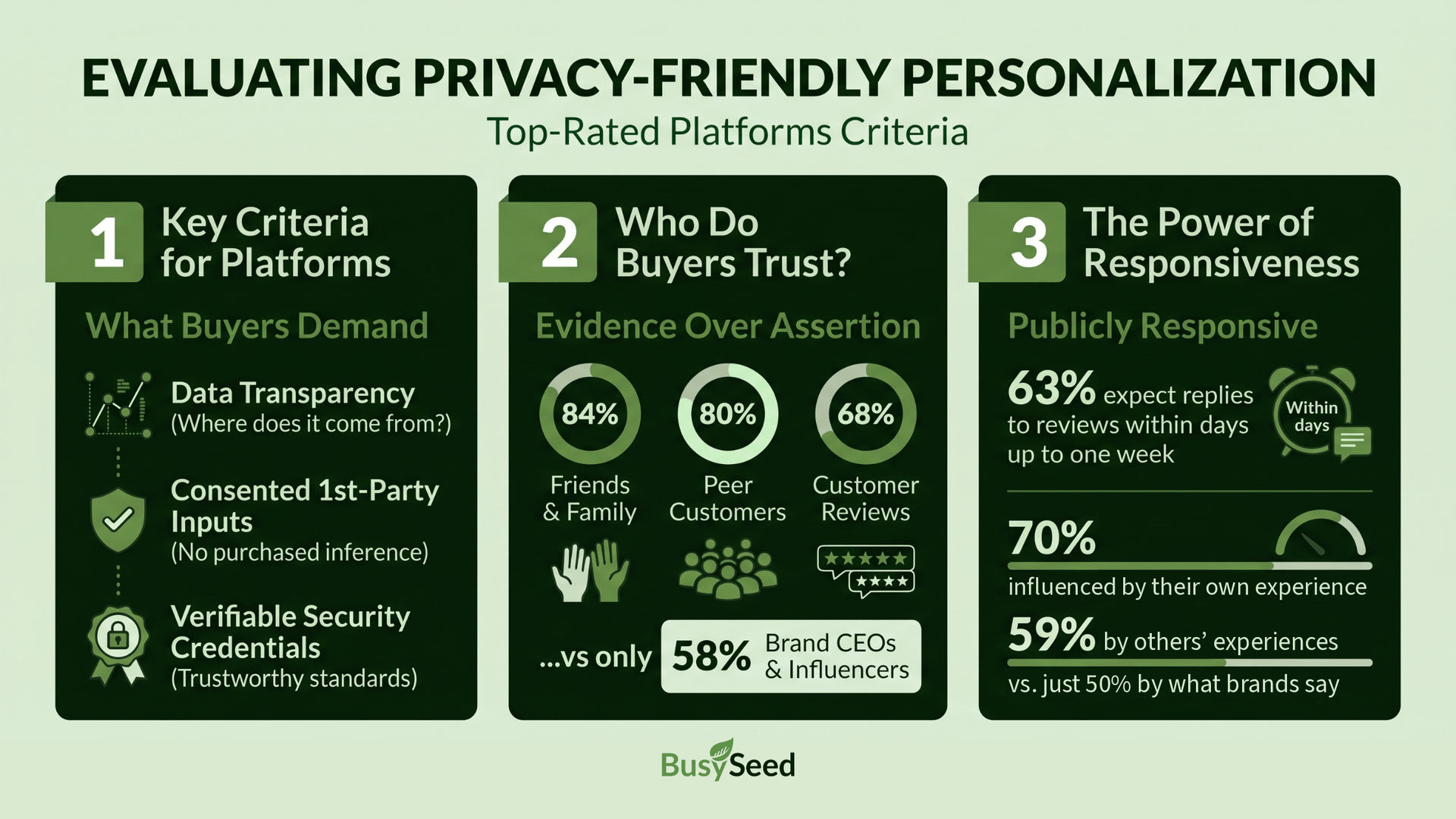
Top-rated platforms for privacy-friendly personalization should be judged on three criteria that buyer research already validates:
- Transparent data provenance: Clear visibility into exactly where each data point came from.
- Consented first-party inputs: Utilizing information the customer willingly provided, rather than relying on purchased inference.
- Verifiable security credentials: Documented proof of data protection.
Those are not soft preferences. Buyers in G2's 2024 Buyer Behavior Report rank product security certifications, review source, and transparent validation among the five most helpful features of a review platform, and the same standard reasonably applies to any system that stores customer data.
Evidence beats assertion here, because other people's voices outrank your own. Edelman's 2025 Trust Barometer Special Report establishes a clear hierarchy of trust, revealing that buyers heavily favor third-party validation over brand messaging:
- 84% trust friends and family
- 80% trust customers like themselves
- 68% trust customer reviews
- 63% trust brand employees
- 59% trust journalists
- 58% trust the brand's CEO and influencers
The same study found 70% said their own experience had at least moderate influence on their pre-purchase opinion, 59% said the experiences of others did, and 50% said what the brand says did.
Public responsiveness is the most privacy-friendly personalization there is, since the customer chose the venue. BrightLocal's 2025 Local Consumer Review Survey found only 7% of consumers do not expect a business to respond to reviews, while 63% expect a reply within two to three days up to one week.
We hold our own work to a similar standard, publishing original studies on how AI assistants recommend companies with downloadable datasets, stated methods, named limitations, and an independent verification stage before anything is released. Ask any vendor for the same before trusting their numbers.
How Do Digital Marketing Services Get A Brand Onto The Shortlist?
Digital marketing services get a brand shortlisted by making it findable and complete on every surface buyers use during research, which now means conventional search, review platforms, social feeds, and AI assistants at the same time. Discovery is distributed, so a single-channel presence quietly removes you from consideration you never see.
BrightLocal's 2025 Consumer Search Behavior Study highlights exactly how fragmented discovery has become. According to the research:
- 70% of general online searches were run on Google.
- 40% of consumers were actively using generative AI within search.
- 26% of Gen Z consumers used social media as their primary local-search method.
- 85% of consumers consider the presence of contact information and opening hours important when researching a business.
Missing hours or a stale phone number is not a branding problem; it is a shortlist problem.
AI-mediated research is now part of customer behavior rather than an edge case. Edelman's 2025 Trust Barometer Special Report found 55% of respondents across 15 markets used generative AI platforms, and 91% of those users applied them to shopping in some way. Being quotable, specific, and corroborated by third parties is what makes a brand usable by those systems.
Agencies that cover search, reviews, social, and AI visibility together tend to close more of these discoverability gaps than single-channel efforts, since a brand missing from even one surface can be removed from a shortlist nobody tells it about.
Bringing It Together: Trust Wins The Shortlist
Brand trust is no longer built in the pitch meeting; it is established in the silent research phase. When 81% of buyers choose a vendor before talking to sales, your digital footprint, independent reviews, transparent information, social proof, and privacy-friendly personalization become your most important sales rep. In a crowded market, the brand that makes it easiest for buyers to find credible, verifiable answers on their own is the one that wins the deal.
If you want a partner who can operationalize this trust across search, social, and AI platforms, let’s talk. BusySeed helps businesses build complete, discoverable digital presences that turn silent researchers into confident buyers. Ready to win the research phase? Connect with us to build a strategy that stands up to buyer scrutiny.
FAQs
Q1) How can small businesses compete with established brands in building customer trust?
By winning the research phase. 6sense found 81% of surveyed B2B buyers had chosen a preferred vendor before contacting sales, so trust is built through independent reviews, complete information, and specific proof rather than late-stage persuasion. Edelman's data also shows 85% treat a good reputation and high-quality customer service as important or a deal breaker, both of which a small team can demonstrate directly.
Q2) What are the best tools for evaluating content trust signals?
Public product-review sites, local review platforms, and your own review-response log. G2 reports 31% of buyers name public review websites as their most consulted source, and its top five helpful features (pricing information, review source, security certifications, transparent validation, and trusted-reviewer badges) make a practical audit list. BrightLocal found 74% of consumers check two or more review sites, so test for consistency across them.
Q3) What are the best marketing tools avoiding creepy personalization?
Tools that personalize from consented first-party signals: support history, purchase history, stated preferences, and current session behavior. Zendesk found 61% of consumers expect AI-driven interactions to feel tailored, while 63% would leave after one bad experience, so precision matters more than reach. Qualtrics identifies emotion as the strongest loyalty driver, which argues for tailoring that reduces effort and acknowledges history as the core of your customer experience strategy.
Q4) What makes a platform genuinely privacy-friendly for personalization?
Transparent data provenance, consented inputs, and verifiable security certifications are the same signals G2's buyers rank among the most helpful on review platforms. Favor systems that can show where each attribute came from and let customers see or correct it. Public, invited interactions also qualify: BrightLocal found 63% of consumers expect a review response within two to three days up to one week.
Q5) What should digital marketing services cover in a saturated market?
Coverage across every research surface, plus the proof that survives scrutiny on each one. BrightLocal found 70% of searches run on Google, 40% of consumers using generative AI in search, and 85% expecting contact details and hours to be present. Edelman found 91% of generative-AI users apply those tools to shopping, so search, reviews, social, and AI visibility belong in one plan.
Works Cited
- 6sense. 2024 Buyer Experience Report. 6sense, 2024.
- BrightLocal. Consumer Search Behavior Study. BrightLocal, 2025a.
- BrightLocal. Local Consumer Review Survey 2025. BrightLocal, 2025b.
- Edelman. 2025 Edelman Trust Barometer Special Report: Brand Trust, From We to Me. Edelman, 2025.
- G2. 2024 Buyer Behavior Report. G2, 2024.
- Qualtrics XM Institute. Success, Effort, and Emotion: Five Years of Loyalty Research. Qualtrics, 2024.
- Zendesk. 2025 CX Trends Report. Zendesk Newsroom, 2024.