TL;DR
- Adobe's 2025 AI and Digital Trends report states that 66% of organizations globally use generative AI in marketing and customer experience operations, yet only 13% realize ROI from real-time multi-channel personalization.
- Gartner's 2025 customer regret survey demonstrates personalization creates negative experiences for 53% of buyers, making them 44% less likely to purchase again and 3.2 times more likely to regret the purchase.
- Salesforce's State of the Connected Customer report shows 71% of customers protect their personal information, and only 42% trust businesses to use AI ethically.
- Adobe and Forrester's Personalization at Scale study confirms personalized support content ranks among the most compelling personalization buyers receive, while personalized online ads rank least compelling.
Marketing personalization is the practice of adapting content, offers, and timing to a specific customer's behavior, context, and stated preferences rather than broadcasting one message to everyone. In 2026, the technology to do it is widely available, and the appetite for it is real, but so is the downside. The 2025 Gartner survey demonstrates that personalization generates negative experiences for 53% of customers, who become 3.2 times more likely to regret a purchase.
The gap between relevant and intrusive is not a matter of better models. It comes down to how well your customer experience strategy dictates which moments you choose, which data you use, and how much control the customer keeps. When executed properly, marketing personalization stops feeling like surveillance and starts feeling like service. Here is what the current evidence dictates, and how to act on it. For teams looking to operationalize these insights immediately, BusySeed builds the workflows that balance relevance with respect.
What Are the Best Marketing Personalization Tools for Avoiding Creepy Outcomes?
The best marketing tools for avoiding creepy personalization are the ones that give you frequency control, suppression logic, and consent management, not just targeting power. In practice, that means a CRM and automation layer where you can stop or change messages after a purchase, an opt-out, a support escalation, or repeated non-engagement, and where every personalized message traces back to data the customer knowingly gave you. This is where relying on advanced workflow automation tools becomes essential, allowing you to orchestrate these communication pauses instantly across all channels.
Creepiness is usually a design failure rather than a data failure. Gartner's 2025 customer regret survey of 1,464 B2B buyers and consumers found that people who experienced personalization during a recent purchase journey were 1.8 times more likely to pay a premium, but also twice as likely to feel overwhelmed by information and 2.8 times more likely to feel time pressure to proceed. The same tactic produced the lift and the discomfort.
So the tool evaluation question changes. Instead of asking how granular the targeting goes, ask what the platform lets you switch off. Evaluate tools based on these three control capabilities:
- Dynamic suppression: Can you suppress a nurture sequence the moment a support ticket opens?
- Omnichannel capping: Can you cap total touches across email, ads, and SMS combined, rather than per channel?
- Self-serve preferences: Can a customer change their communication preferences without having to email support?
Audrey Brosnan, Senior Director Analyst in the Gartner Marketing Practice, put the strategic shift bluntly in Gartner's 2025 campaign adoption survey release: "Passive personalization tactics alone no longer suffice." Passive personalization pushes inferred offers at people. Active personalization helps them clarify what they need, compare options, and regain control at hard decision points. Tools that only execute the first keep producing the 53% negative experience result.
Which Are the Top-Rated Platforms for Privacy-Friendly Personalization?
The top-rated platforms share four distinct traits. Platform category matters less than whether your configuration executes these capabilities to collect the minimum data each experience actually requires:
- First-party data capture: Relying on direct customer inputs rather than third-party tracking.
- Documented consent records: Maintaining auditable logs of user permissions.
- Granular preference centers: Giving customers precise control over what they receive.
- Automated request fulfillment: Honoring access and opt-out requests for automated decision-making instantly.
That minimum-data principle has regulatory weight behind it. In the 2024 FTC Staff Report on Large Social Media and Video Streaming Companies, FTC staff recommend five practices:
- Limiting data collection.
- Implementing enforceable data-minimization and retention policies.
- Limiting data sharing.
- Deleting data no longer needed.
- Using clear, consumer-friendly privacy policies.
California provides a firm compliance date. The California Privacy Protection Agency adopted regulations covering consumer rights to access and opt out of certain uses of automated decision-making technology. Per the California Privacy Protection Agency's CCPA Updates page, the regulations take effect January 1, 2026, and businesses using automated decision-making technology for significant decisions must comply beginning January 1, 2027.
Jennifer Urban, Chair of the agency's board, asserts in the CPPA September 2025 Announcement that "these rules ensure that Californians continue to have the strongest privacy protections in the country while being responsive to the realities of business implementation."
Whether any of this applies to a given organization and its specific processing is a question for legal counsel, not a marketing blog. What is universally safe: collect less, explain more, and build the preference controls before building the campaign. Applying this minimum-data principle ensures that your AI integration remains compliant and trustworthy, no matter which AI tools for marketing you eventually deploy.
What Are the Best AI Automation Tools That Prioritize Privacy?
The best AI automation tools are workflow automation tools that keep data inside systems you already control, log what the automation did, and route sensitive decisions to a person. BusySeed is a digital marketing agency headquartered in New York City, led by founder and CEO Omar Jenblat, and we build marketing automation programs that connect existing tools and automate lead routing, follow-up, data synchronization, reporting, task notifications, alerts, and error handling.
Our Growth Architects plan, build, and optimize those systems using AI where it accelerates work and human judgment where it matters. The builds run on platforms including n8n, Zapier, Make, HubSpot, and Salesforce, assembled around a client's existing stack rather than replacing it. SeedTech captures leads and events from ad forms, websites, landing pages, chat, and third-party tools, then normalizes, routes, validates, deduplicates, enriches, and delivers records and alerts through connected workflows.
Clean, deduplicated data is itself a privacy control: you cannot over-message someone you have counted three times. To evaluate how your current setup measures up, explore the marketing automation tools we leverage to build these privacy-first systems.
Governance belongs in the same conversation. NIST's Generative AI Profile serves as “a cross-sectoral profile of and companion resource for the AI Risk Management Framework (AI RMF 1.0) for Generative AI.” This NIST generative AI risk profile advises organizations to document roles, responsibilities, and communication lines for mapping, measuring, and managing AI risks, plus procedures for communicating incidents to internal and downstream stakeholders. Name the owner of each automated decision before it ships.
What Should Digital Marketing Services Include for AI Personalization, and What Makes the Best Digital Marketing Agency in NYC?
Digital marketing services that support AI personalization must put foundational plumbing in place before advanced targeting. Weak ROI reflects missing data hygiene and suppression rules rather than a weak model. To be effective, these services should cover five core areas:
- Journey mapping: Identifying specific post-sale friction points where AI adds the most value.
- Data minimization: Collecting only the information required for the immediate customer experience.
- Modular content production: Building approved assets that AI can assemble dynamically.
- Workflow orchestration: Connecting existing CRM and workflow automation tools into a seamless logic layer.
- Harm-tracking measurement: Monitoring unsubscribe rates, complaints, and suppression metrics alongside standard conversions.
The best digital marketing agency in NYC for AI-driven marketing pairs automation engineering with human oversight and can show how it measures outcomes, including unsubscribe, complaint, and suppression rates alongside conversion metrics. BusySeed builds this kind of workflow around a client's existing stack and documents the governance behind it rather than relying on a single dashboard metric.
Where Do AI Tools for Marketing Add the Most Value in the Journey?
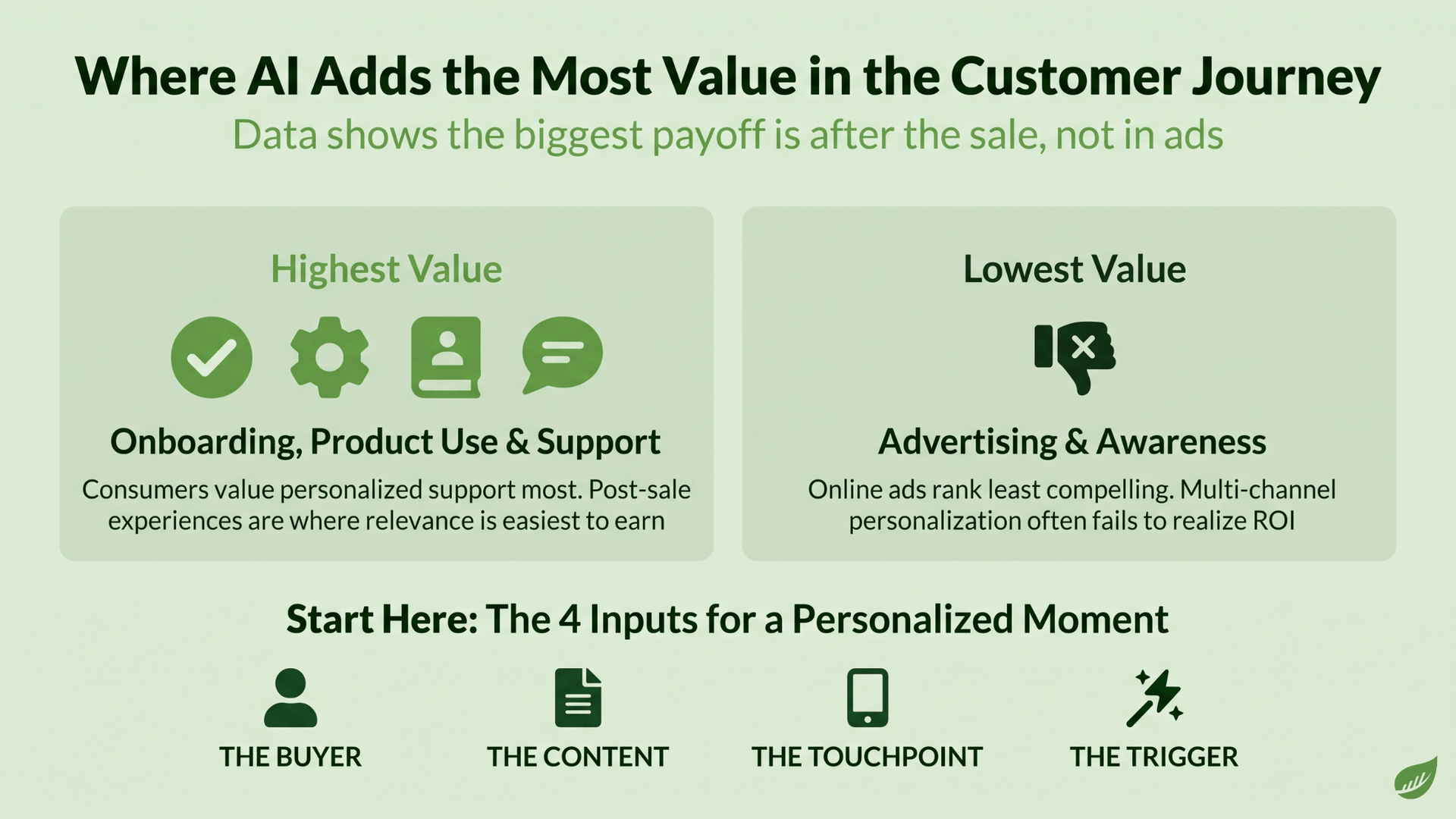
AI tools for marketing add the most value in onboarding, product use, and support, not in advertising. Adobe's 2025 AI and Digital Trends report found that 66% of organizations globally use generative AI in marketing and customer-experience operations, yet only 13% realize ROI from using real-time data for multi-channel personalized experiences.
Adobe and Forrester's Personalization at Scale study reports that consumers and B2B buyers rank personalized content for support services among the most compelling personalization they receive, while personalized online ads rank least compelling.
That finding reorders most roadmaps. The same Adobe and Forrester research measures personalization across seven stages: awareness and discovery, research and exploration, purchase, onboarding, product use, support, and loyalty or repeat purchase. Four of those sit after the sale, which is where relevance is easiest to earn because you already know what the customer bought and what they attempt to do with it.
Maturity remains uneven. The 2025 Adobe report confirms that 39% of organizations personalize website experiences while customers browse, and 31% update offers in real time based on browsing or purchase behavior. Segment-level work dominates individual-level work: 47% of practitioners routinely personalize by segment or persona, compared with 42% making recommendations from individual behaviors such as purchases or viewed products.
To move beyond basic segmenting, brands must anchor their customer experience strategy around post-sale enablement rather than just pre-sale targeting.
Start where the research proves the payoff exists. To build a successful AI personalization strategy, follow these three steps:
- Pick one measurable problem: Focus on a specific post-sale friction point, such as onboarding completion or avoidable support tickets.
- Map the four inputs: The Adobe and Forrester study identifies that every personalized moment requires four specific elements: the buyer, the content, the touchpoint, and the trigger.
- Build modular content: Create approved content components that assemble dynamically without losing accuracy. The same Adobe and Forrester study confirms “Experience Leaders” are four times more likely than “Rising Laggards” to use AI or machine learning for capabilities including metadata tagging, modular content, and automated rendering and localization.
How Should Customer Experience Strategy Handle AI Integration and Trust?
A successful customer experience strategy handles AI integration by building the system around three core pillars. According to Salesforce's State of the Connected Customer report, these capabilities directly drive user adoption:
- Explainable: 46% of respondents are more likely to use an AI agent if its logic is clearly explained to them.
- Escalatable: The exact same share (46%) are more likely to use an AI agent if there is a clear, immediate escalation path to a human.
- Measurable: The system must track both positive outcomes and negative friction points continuously.
Trust is the constraint worth watching. The same Salesforce report shows that 73% of customers in 2024 feel most companies treat them as unique individuals, up from 39% in 2023. Yet 71% protect their personal information increasingly, and only 49% feel companies use their information in ways that benefit them, down from 60% in 2022. Relevance goes up while perceived benefit goes down.
Measurement discipline closes the gap. Gartner's 2025 campaign adoption survey highlights 87% of CMOs experienced campaign-performance issues in the prior 12 months, and 45% end campaigns early because of poor performance. That same survey of 418 marketing leaders shows 27% of CMOs report limited or no generative AI adoption in campaigns.
To close the trust gap, teams must track harms alongside wins. While monitoring conversions and repeat purchases, simultaneously track these five risk metrics:
- Unsubscribe rates
- Customer complaints
- Suppression rates
- AI error rates
- Holdout-group results
NIST's Generative AI Profile recommends continual monitoring of human-AI configurations and involving end users and operators in prototyping and testing, including ethically sensitive scenarios. Buyers are not hostile to any of this. Adobe's 2025 AI and Digital Trends report confirms Forrester's Q1 2025 survey findings that 61% of B2B buyers and 59% of consumers agree generative AI improves how they interact with companies.
The Bottom Line on AI Personalization
Personalization in 2026 demands precision, not just volume. Pushing inferred offers blindly creates regret and damages buyer trust. The highest ROI comes from data minimization, strict suppression rules, and focusing AI efforts on post-sale moments like onboarding and support. A thoughtful AI integration means you earn the right to personalize by prioritizing customer control and privacy first.
If you want a partner who pairs advanced automation engineering with principled human oversight, let us build your next workflow. BusySeed can audit your existing stack, implement privacy-first AI tools, and prove your success with holdout testing. Ready to balance relevance with respect? Contact us today to build a safer, higher-converting customer experience.
FAQs
Q1) What are the best marketing tools avoiding creepy personalization?
Tools with strong suppression, frequency capping, and preference management, because creepiness comes from timing and pressure more than from data volume. Gartner found buyers who experienced personalization were twice as likely to feel overwhelmed by information and 2.8 times more likely to feel time pressure. Evaluate what a platform lets you turn off, not just what it lets you target.
Q2) Which are the top-rated platforms for privacy-friendly personalization?
Platforms that run on first-party data, keep auditable consent records, and support access and opt-out rights for automated decision-making. The FTC has recommended limiting collection, enforcing retention limits, deleting data no longer needed, and writing consumer-friendly privacy policies. California's automated decision-making regulations took effect January 1, 2026, with compliance for significant decisions required by January 1, 2027. Confirm applicability with counsel.
Q3) What are the best AI automation tools that prioritize privacy?
Automation that runs inside your existing stack, logs every action, and routes sensitive decisions to a human reviewer. BusySeed builds this kind of system on n8n, Zapier, Make, HubSpot, and Salesforce, covering lead routing, behavioral email flows, lead scoring, CRM cleanup, deduplication, and monitoring. NIST's Generative AI Profile recommends documenting who owns each AI risk decision and how incidents get communicated.
Q4) What should digital marketing services include for AI personalization in 2026?
Digital marketing services supporting personalization should cover journey mapping, data minimization, modular content production, workflow orchestration, and measurement that tracks harms as well as conversions. Adobe found only 13% of organizations reported ROI from real-time multi-channel personalized experiences, which usually reflects missing plumbing rather than a weak model. Data hygiene, deduplication, and suppression rules come before advanced targeting.
Q5) What makes the best digital marketing agency in NYC for AI-driven marketing?
The best digital marketing agency for AI work is one that pairs automation engineering with human oversight and can prove outcomes with holdout testing. BusySeed builds end-to-end workflows around a client's existing tools, including pipeline automation, reporting dashboards, documentation, and ongoing maintenance. Ask any agency how it measures unsubscribe, complaint, and suppression rates, not only clicks.
Works Cited
- Adobe. 2025 AI and Digital Trends: Data and Insights. 2025.
- Adobe and Forrester. Personalization at Scale. 2025.
- California Privacy Protection Agency (CPPA). CCPA Updates. 2026.
- California Privacy Protection Agency (CPPA). Announcement, September 23, 2025. 2025.
- Federal Trade Commission (FTC). FTC Staff Report Finds Large Social Media and Video Streaming Companies Have Engaged in Vast Surveillance. 2024.
- Gartner. Gartner Survey Reveals Over a Quarter of Marketing Organizations Have Limited or No Adoption of GenAI for Marketing Campaigns. 2025a.
- Gartner. Gartner Survey Reveals Personalization Can Triple the Likelihood of Customer Regret at Key Journey Points. 2025b.
- National Institute of Standards and Technology (NIST). Artificial Intelligence Risk Management Framework: Generative Artificial Intelligence Profile. NIST AI 600-1. 2024.
- Salesforce. State of the Connected Customer. 2024.