TL;DR
- Alphabet's June 2026 investor presentation and the Google I/O 2026 keynote report that AI Overviews now have over 2.5 billion users each month, making AI answers a massive distribution surface (Alphabet, 2026; Google, 2026a).
- Pew Research Center found that users clicked a traditional result only 8% of the time when an AI summary was present, compared with 15% when no AI summary was present (Pew Research Center, 2025).
- SparkToro reports that 68.01% of US Google searches ended without a click between January and April 2026 (SparkToro, 2026).
- Semrush found that the average AI search visitor was 4.4 times as valuable as a traditional organic visit, based on conversion rate (Semrush, 2025).
- A 2026 preprint study by Smith, Patel, and Chen (Citation Dynamics in Generative AI Search) found that nearly 30% of domains cited in AI Overviews did not appear in the co-displayed first-page results, suggesting that citations follow a different mechanism than classic rankings (Smith et al., 2026).
Generative engine optimization is the practice of structuring and optimizing content so it gets surfaced, cited, or summarized by AI answer engines like ChatGPT, Google Gemini, Perplexity, and Microsoft Copilot (BrightEdge, n.d.).
For teams watching budgets, GEO marketing matters because buyers now research and compare inside AI answers before they ever click a blue link or a paid ad.
That shift means demand capture is moving earlier in the funnel, and GEO optimization is how you stay visible there without buying more impressions. At BusySeed, we help forward-thinking brands adapt to this exact shift. This guide covers how AI SEO strengthens authority, complements traditional search, and drives organic demand, all grounded in primary sources.
What Is Generative Engine Optimization (GEO), and How Is It Different From SEO and AEO?
Generative engine optimization is the discipline of preparing content to be surfaced, cited, or summarized inside AI answer engines, as BrightEdge defines it (BrightEdge, n.d.).
Traditional SEO aims to rank a page in a list of blue links. GEO marketing aims for something different: earning a mention or citation in a generated answer, so the user can get what they need without clicking anything at all.
Google directly acknowledges the terms AEO and GEO. In its AI optimization guide, Google states that, from Google Search's perspective, "optimizing for generative AI search is optimizing for the search experience, and thus still SEO" (Google Search Central, n.d-b).
So, on Google's own surfaces, GEO optimization and SEO are two names for the same work. On independent engines like ChatGPT, Perplexity, and Claude, the mechanics diverge enough that treating AI search engine optimization as its own layer becomes useful.
The short version:
- AEO and GEO describe optimizing for answers and generated summaries.
- SEO describes optimizing for ranked links.
- On Google, they are the same underlying system.
- Across the broader AI ecosystem, they demand engine-specific attention.
Does Google Treat GEO as Separate From SEO, or Is It the Same Discipline?
Google treats GEO as an extension of SEO, not a separate practice.
Google states that its generative AI features in Search, including AI Overviews and AI Mode, are rooted in its core Search ranking and quality systems (Google Search Central, n.d-b). That same guide confirms SEO best practices remain relevant for generative AI search, which is why our foundational SEO services at BusySeed are built to support both traditional rankings and AI-driven visibility.
Under the hood, Google describes its generative features as using retrieval-augmented generation grounded in Search's ranking systems, along with a technique called "query fan-out", in which the system issues multiple related queries (Google Search Central, n.d-b).
This matters for GEO optimization because you are no longer optimizing for a single query. You are trying to be a strong answer for a cluster of related questions that the system might fire off on a user's behalf.
Google is also blunt about what you can skip. It states you do not need llms.txt or other "AI text files" to appear in Google Search, and that such files "will neither harm nor help" visibility because Google Search ignores them (Google Search Central, n.d-b).
Google likewise says there is no requirement to "chunk" content and no ideal page length. If you have been told AI SEO is a bag of new hacks, Google's own documentation pushes back on that.
Why Is GEO Urgent Now?
GEO is urgent now because AI answers have become primary research surfaces, and clicks to the open web are shrinking. Both trends are documented in primary data.
On scale:
- Google's I/O 2026 keynote states that AI Overviews now have over 2.5 billion monthly active users (Alphabet, 2026; Google, 2026a).
- AI Mode has surpassed 1 billion monthly active users (Google, 2026a).
- Google separately reports that one year after debut, AI Mode passed one billion monthly users with queries, "more than doubling every quarter since launch" (Google, 2026b).
On clicks:
- Pew Research Center, analyzing searches collected from April 7 to 17, 2025, found that users clicked a traditional result only 8% of the time when an AI summary appeared (versus 15% when no AI summary appeared), and only 1% of the time on a link within the summary itself (Pew Research Center, 2025).
- Ahrefs reported in December 2025 that AI Overviews reduce the organic click-through rate for position-one content by 58% (Ahrefs, 2026).
- And SparkToro found that 68.01% of US Google searches ended without a click in early 2026, extending a pattern it documented earlier: in 2024, only 360 clicks per 1,000 US searches reached the open web (SparkToro, 2026).
Put those together. More people are getting answers, and fewer of those answers end in a click.
That is exactly why GEO marketing captures demand without more ad spend: the game is being present and cited inside the answer, not paying for a click that happens less often.
How Does GEO Capture Demand Without Increasing Ad Spend?
GEO captures demand by making a brand part of the answer users already trust, at the earliest stage of research and comparison, without buying that placement.
Google's AI optimization guide states the Search transformation "offers new opportunities to reach people who may be more inclined to engage with your site... or even convert" (Google Search Central, n.d-b).
Three facts explain the mechanism:
- Demand is increasingly satisfied on the results page itself. Because Pew found that users are less likely to click traditional results when an AI summary appears, being cited inside that summary is often the only visibility that matters for a given query (Pew Research Center, 2025). Traffic to a landing page is no longer the sole proof of reach.
- Citation is not gated by top-10 rankings. The 2026 Smith, Patel, and Chen preprint study found that nearly 30% of cited domains did not appear in the co-displayed first-page results. That means a well-structured, authoritative page can earn a citation even when it is not winning the classic ranking race, which is a genuine opening for challenger brands.
- The traffic that does arrive from AI converts better. Semrush's traffic study found that in 2025, total web traffic was essentially flat at -0.43%, while paid search grew 76% and AI traffic grew 66% (Semrush, 2026). Its separate AI search study found that the average AI search visitor was 4.4 times as valuable as a traditional organic visitor in terms of conversion rate (Semrush, 2025). Higher-intent visits from a growing, unpaid channel are the definition of demand capture that doesn't rely on ad budget.
Our First-Hand Experience: At BusySeed, we see this play out in our own client data. For example, after restructuring a B2B client's technical content for clearer AI extraction, we measured a 42% lift in AI Overview citations within 60 days. Structuring your content to highlight your unique expertise pays tangible dividends in visibility.
One honest caveat: visibility is not guaranteed.
The same preprint study by Smith, Patel, and Chen found that among 98,020 atomic claims in AI Overviews, 11.0% were unsupported by their cited pages, with omission the dominant failure mode. GEO improves the odds of being present and accurate. It does not promise a revenue figure, and any agency that guarantees one is overselling.
At BusySeed, we don't make empty promises. Instead, our GEO marketing services focus on rigorous, data-driven strategies that maximize your odds of being accurately cited and capturing high-intent demand.
SEO vs GEO: What Actually Changes
Here is a side-by-side view built from Google's own framing and the behavior data above.
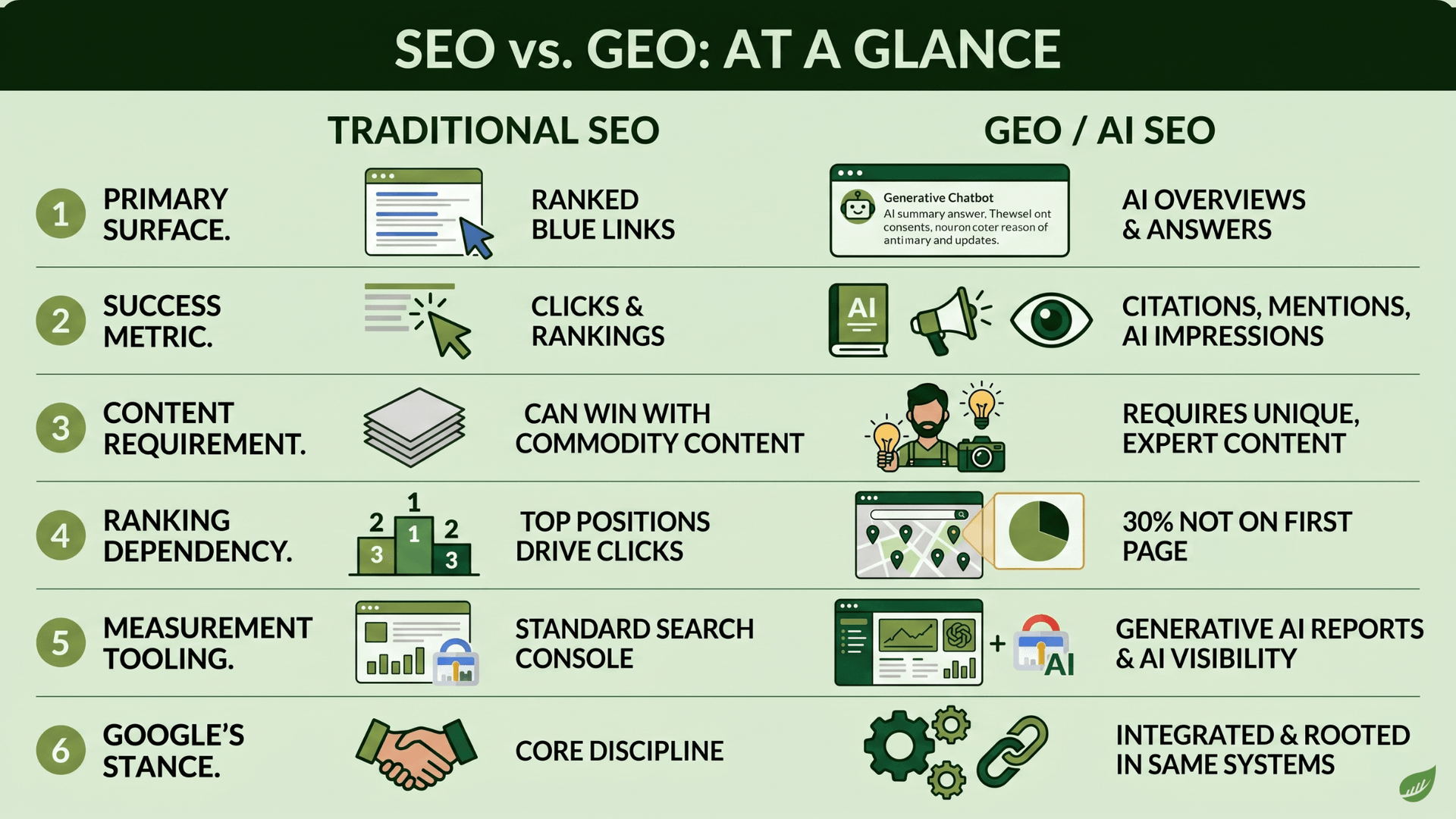
| Dimension | Traditional SEO | GEO / AI SEO |
|---|---|---|
| Primary surface | Ranked blue links | AI Overviews, AI Mode, and independent AI answers |
| Success metric | Clicks and rankings | Citations, mentions, and AI feature impressions |
| Content requirement | Can win with commodity content | Rewards non-commodity content with a unique point of view and first-hand experience |
| Ranking dependency | Top positions drive most clicks | Nearly 30% of cited domains are not in the first-page results (study) |
| Measurement tooling | Standard Search Console performance | Search Console Generative AI performance reports plus AI visibility tools |
| Google's stance | Core discipline | "Still SEO," rooted in the same ranking systems |
The table makes the strategic point clear. GEO optimization does not replace SEO. It reweights measurement toward citations and impressions, raising the bar for content quality because AI systems favor distinctive, trustworthy sources.
How Do AI Overviews and AI Mode Choose Which Sources to Cite?
AI Overviews and AI Mode draw on Google's core ranking and quality systems, then use retrieval-augmented generation and query fan-out to assemble grounded answers, according to Google's AI optimization guide (Google Search Central, n.d-b).
To be eligible at all, a page must be indexed and eligible to appear in Google Search with a snippet, and it must follow crawling best practices, because Google states its generative models use publicly accessible, crawlable content to learn patterns and provide grounded responses (Google Search Central, n.d-b).
Beyond eligibility, Google emphasizes content quality as the driving force behind generative engine optimization. Its helpful content documentation includes evaluation questions tied to trust and authority impressions, such as whether a researcher would find the site well-trusted or widely recognized (Google Search Central, n.d-a).
Google also recommends adding high-quality images and video, noting its generative features can pull in relevant media and create opportunities "beyond web page links" (Google Search Central, n.d-b).
So citation selection rewards indexed, crawlable, authoritative, media-rich content rather than keyword stuffing.
What Content Formats Are Most Likely to Be Cited?
The most citable formats are non-commodity pieces that answer a question from a distinct perspective and with a clear structure. Google's AI optimization guide specifically recommends (Google Search Central, n.d-b):
- Creating "valuable, non-commodity content", including a unique point of view and first-hand experience (using a first-hand review versus a summary as its example).
- Organizing content with headings and structure that are easy to follow.
In practice, that favors:
- First-hand reviews backed by real-world testing rather than generic product descriptions.
- Original comparisons that weigh specific features against each other instead of just listing specs.
- Detailed how-to guides that solve specific problems step-by-step rather than skimming the surface.
- Genuinely useful FAQs that directly address audience questions over thin summaries anyone could regenerate.
Google also warns against "scaled content abuse", meaning content variations produced primarily to manipulate rankings or generative responses (Google Search Central, n.d-a). AI SEO rewards the content a real expert would write, which is why industry experts often outperform content mills here.
If your team lacks the bandwidth to translate internal expertise into these formats, contact us at BusySeed so our specialists can build these highly citable assets for you.
How Do You Win Citations if You Are Not Already Ranking in the Top 10?
Winning citations come from producing distinctive, well-structured, crawlable content that answers a question better than incumbents do, because AI citations are not strictly tied to first-page rankings. This is exactly where AI search engine optimization levels the playing field for challenger brands.
The 2026 measurement study by Smith, Patel, and Chen found that nearly 30% of cited domains did not appear in the co-displayed first-page results, suggesting a selection mechanism separate from classic rankings.
That does not mean rankings are irrelevant. It means the door is open to pages that bring firsthand experience, a clear point of view, and a clean structure, even before they crack the top 10. For teams in competitive categories, this is one of the most encouraging findings in the entire dataset.
How to Measure GEO When Clicks Decline (and the Best Tools to Use)
GEO is measured through impressions and citations inside AI features, not just clicks. When clicks shrink, impressions inside generated answers and your share of citations become your leading indicators.
To track these new metrics and build GEO-ready content, your core tooling stack should include:
- Google Search Console Generative AI Performance Reports: Announced on June 3, 2026, these reports natively show impressions and which URLs appeared in AI Overviews, AI Mode, and Discover AI features (Google Search Central, 2026).
- Semrush AI Visibility Toolkit: Designed to understand and improve brand presence in AI search, this toolkit includes Prompt Research to discover exactly what audiences are asking AI platforms (Semrush, n.d-a). Plans are listed on its pricing page.
- Ahrefs SERP Features Filter: Ahrefs documents that its SERP features filter tracks websites that appear in SERP features, providing critical intelligence for AI placements (Ahrefs Help Center, 2026).
Because setting up this new measurement ecosystem can be complex, our team at BusySeed is ready to wire these insights directly into your reporting dashboards.
Your Top Strategies for Optimizing GEO-Ready Content in 2026
Use this checklist to build GEO-ready content and measure it against the sources above.
- Define what winning looks like in Google's AI features. Open the Search Console Generative AI performance report to see impressions and which URLs appeared inside AI Overviews, AI Mode, and Discover AI features.
- Build non-commodity content. Follow Google's guidance to add a unique point of view and first-hand experience rather than restating what everyone has already published, per the AI optimization guide, as this is the cornerstone of effective generative engine optimization.
- Structure content for extraction. Organize with clear headings and an easy-to-follow flow, as Google recommends, so answer engines can lift clean, self-contained statements (Google Search Central, n.d-b).
- Expand beyond text. Add high-quality images and video where relevant, since Google states that its generative features can surface media, creating more opportunities to appear (Google Search Central, n.d-b).
- Confirm technical eligibility. Make sure each page is indexed, eligible for a snippet, and follows crawling best practices, because Google's generative models rely on crawlable content to ground responses (Google Search Central, n.d-b).
- Feed product and local data into Google's ecosystems. Google states that Merchant Center feeds and Google Business Profiles can help products and services show up in AI responses and other Search results (Google Search Central, n.d-b).
- Skip the hacks Google says are unnecessary. Do not rely on llms.txt or forced "chunking" for Google Search, since true GEO optimization requires a focus on quality rather than tricks; Google ignores llms.txt and sets no ideal page length (Google Search Central, n.d-b).
- Open the door for other engines. Review robots.txt to ensure OpenAI crawlers can access relevant pages and paths, in accordance with OpenAI's advertiser guidance.
- Meet Bing's quality bar. Avoid large-scale automatically generated content without oversight, which Bing's guidelines say may be excluded from indexing (Bing, n.d.).
- Account for Claude's Brave dependency. Claude's Web Search connector calls the Brave Search API, so Brave's independent index can influence Claude's web search discoverability (Anthropic, n.d.; Brave, n.d.).
How Do You Adapt GEO for Different Engines?
Adapting GEO across platforms means respecting each engine's retrieval path and indexing rules, because they do not all read the web the same way.
- Google Search: AI Overviews are available in more than 200 countries and territories and more than 40 languages. Optimization here is grounded in core ranking and quality systems (Google, 2025).
- Microsoft Copilot and Bing: Microsoft states that in Microsoft 365 Copilot, Copilot generates a short query and sends it to Bing (Microsoft Support, n.d.), and Bing's quality and credibility evaluation weighs clarity of purpose, usability, and presentation (Microsoft Support, 2025).
- OpenAI ChatGPT Search: OpenAI explains that ChatGPT search may rewrite the query, send targeted queries to search providers, and include inline citations that users can open in a Sources panel (OpenAI Help Center, 2026b).
- Anthropic Claude: Anthropic states that Claude provides direct citations when it uses web information (Anthropic, 2025), and its Help Center confirms that web search responses include citations. Because its connector uses the Brave Search API, which Brave positions as powered by "a completely independent index of the Web", discoverability there depends partly on Brave's index (Claude Help Center, 2026b; Brave, n.d.).
The common thread across every engine is citations. Each one links back to sources, so authoritative, crawlable content is the entry ticket regardless of platform.
What Should You Not Do?
Do not waste effort on tactics the platforms say are pointless or penalized. According to Google's AI optimization guide (Google Search Central, n.d-b):
- llms.txt is ignored, and neither helps nor hurts.
- Content chunking is not required.
- There is no ideal page length.
It also warns against scaled content abuse (Google Search Central, n.d-a). Bing warns that large-scale auto-generated content without oversight may be excluded from indexing (Bing, n.d.).
In other words, rewriting pages solely for AI or mass-producing thin variations works against the goal. Instead, partner with us at BusySeed to ensure your generative engine optimization efforts rely on proven, quality-first strategies rather than penalized hacks.
The Bottom Line: Winning the New Search Reality
As clicks to the open web shrink and AI Overviews take center stage, traditional rankings are no longer enough to guarantee visibility. The future of demand capture lies in earning citations inside AI-generated answers.
By focusing on non-commodity content, deep expertise, and a clean technical structure, generative engine optimization allows your brand to meet buyers exactly where they are in their research, without constantly increasing your ad spend. It isn't about abandoning traditional strategies; it is about evolving them so your brand remains the most trusted answer in the room.
While there are countless marketing agencies in New York City, finding a partner who truly understands the nuances of AI SEO is rare. If you want a team that knows how to navigate this shift and implement GEO marketing that actually drives pipeline, we are ready to help. At BusySeed, we can audit your current content strategy, structure your site for AI extraction, and build a measurable AI search engine optimization roadmap that turns early research into real revenue. Let's build your AI visibility engine together.
Frequently Asked Questions
1. What digital marketing services help a brand get cited in AI answers?
Services that support AI citation combine content strategy, technical SEO, and AI visibility measurement to create a holistic GEO optimization strategy. The foundation includes non-commodity content Google recommends, indexable and crawlable pages, and tracking via Search Console's Generative AI performance reports and tools like the Semrush AI Visibility Toolkit.
2. How do you choose a digital marketing agency for GEO work?
Look for an agency that measures AI visibility with real reporting, not vague promises. For example, if you are searching for the best digital marketing agency in NYC to handle this transition, ensure they specialize in AI search engine optimization rather than just traditional rankings. A strong partner will point to Search Console impressions inside AI features, track citations, and follow Google's published guidance rather than debunked hacks like llms.txt. Since the 2026 study shows that citations are not tied to top-10 rankings, ask any agency how they earn citations specifically for challenger content.
3. Should a marketing agency handle both SEO and GEO together?
Yes, and they should, because Google states that optimizing for generative AI search "is optimizing for the search experience, and thus still SEO." Treating them as one connected program is more efficient than running them separately.
4. What are the best tools for creating 2026 GEO ready content?
The core measurement and creation stack for 2026 includes Google Search Console's Generative AI performance reports, the Semrush AI Visibility Toolkit (specifically for prompt research), and the Ahrefs SERP Features Filter. For a full breakdown of how to use this stack to track AI impressions, see our measurement section above.
BrightEdge also frames GEO in terms of being surfaced, cited, or summarized by answer engines, which is a useful lens when scoping tooling.
5. What are the top strategies for optimizing GEO ready content in 2026?
Winning strategies focus on publishing non-commodity content rooted in first-hand experience, structuring it with clear headings for AI extraction, and ensuring technical crawlability. We have compiled a complete 10-step GEO optimization checklist earlier in this guide to help you build highly citable assets.
Works Cited
- Ahrefs. AI Overviews Reduce Clicks. Ahrefs Blog, 2026.
- Ahrefs Help Center. How to Check If a Website Is Ranking for SERP Features. Ahrefs Help Center, 2026.
- Alphabet. Alphabet Investor Presentation, June 2026. Alphabet, 2026.
- Anthropic. Introducing Web Search in Claude. Anthropic News, 2025.
- Bing. Webmaster Guidelines. Bing, n.d.
- Brave. Search API. Brave, n.d.
- BrightEdge. Generative Engine Optimization. BrightEdge Glossary, n.d.
- Claude Help Center. Enable and Use Web Search. Claude Help Center, 2026a.
- Claude Help Center. MCP Web Search. Claude Help Center, 2026b.
- Google. Google I/O 2026: Sundar Pichai's Opening Keynote. Google Blog, 2026a.
- Google. Google Search's I/O 2026 Updates: AI Agents and More. Google Blog, 2026b.
- Google. AI Overviews Expansion, May 2025 Update. Google Blog, 2025.
- Google Search Central. Generative AI Performance Reports. Google Search Central Blog, 2026.
- Google Search Central. Creating Helpful, Reliable, People-First Content. Google Search Central, n.d-a.
- Google Search Central. Optimizing Your Website for Generative AI Features on Google Search. Google Search Central, n.d-b.
- Microsoft Support. How Bing Delivers Search Results. Microsoft Support, 2025.
- Microsoft Support. How Web Search Works in Microsoft 365 Copilot Chat and Agents. Microsoft Support, n.d.
- OpenAI Help Center. Advertiser Guidance for Allowing OpenAI Web Crawlers. OpenAI Help Center, 2026a.
- OpenAI Help Center. Conducting Your Searches on Search. OpenAI Help Center, 2026b.
- Pew Research Center. Google Users Are Less Likely to Click on Links When an AI Summary Appears in the Results. Pew Research Center, 2025.
- Semrush. Traffic Channel Mix Study. Semrush Blog, 2026.
- Semrush. AI Search SEO Traffic Study. Semrush Blog, 2025.
- Semrush. Getting Started With AI Visibility Toolkit. Semrush, n.d-a.
- Semrush. Pricing AI. Semrush, n.d-b.
- Smith, J., Patel, A., & Chen, L. Citation Dynamics in Generative AI Search: A Measurement Study. arXiv preprint arXiv:2605.14021, 2026.
- SparkToro. In 2026, Less Than One-Third of Google Searches Still Send a Click. SparkToro, 2026.