TL;DR
- According to SparkToro's 2026 Click Behavior Analysis, 68.01% of Google searches in the first four months of 2026 ended without a click. This proves organic sessions alone are an incomplete measure of search visibility and business impact.
- Google's Guide to Google Search Ranking Systems notes that automated systems operate largely at the page level and PageRank is only one of many signals. This proves page-by-page opportunity scoring is more useful than chasing a domain authority number.
- Google's Core Web Vitals and Google Search Results Guide sets exact performance targets at a Largest Contentful Paint within 2.5 seconds, an Interaction to Next Paint below 200 milliseconds, and a Cumulative Layout Shift below 0.1.
- Google's Troubleshooting Crawling Errors Guide states that indexing new or updated pages usually takes three days or more, so publication and sitemap submission are not evidence of rankings, demand, or competitive gain.
SEO ranking in a crowded category is not won by publishing more pages than the incumbent. A competitive SEO strategy is a repeatable operating system: diagnose the search landscape, find opportunities with evidence, fix the page and the site, then measure commercial outcomes rather than positions.
This matters because Google's Guide to Google Search Ranking Systems states that automated systems weigh many factors and signals across hundreds of billions of indexed pages and operate page by page. A strong domain does not carry a weak page. Below is how experienced teams pick their battles, identify semantic gaps, score SEO content when clicks are scarce, and audit trust signals before they spend another dollar on production.
What Are the Most Effective SEO Ranking Techniques for Outranking Competitors in Saturated Markets?
The most effective SEO techniques for outranking competitors in saturated markets are page-level opportunity scoring, intent-matched differentiation, technical capacity, and revenue-tied measurement instead of position.
In practice, that means choosing fewer targets, proving demand before production, and making each page the best available answer to one job a searcher is trying to finish.
Start with the business outcome and establish a baseline using this sequential process:
- Define the Conversion: Decide whether organic search should produce qualified leads, ecommerce revenue, subscriptions, or demos.
- Build the Baseline: Export impressions, clicks, CTR, queries, and landing pages from Google Search Console, then join that data to your engagement and conversion metrics.
- Map the Live SERP: Analyze the live search result for each priority query to identify the presence of organic listings, paid units, AI features, local packs, videos, and direct answers.
- Disqualify Vanity Targets: If the SERP map proves no click is realistically available, that keyword is not an opportunity.
If you need help building this baseline and prioritizing revenue over vanity metrics, exploring professional SEO services can give your team a definitive edge.
Resist the reflex to treat competitor rankings as a mandate. Google's Troubleshooting Crawling Errors Guide notes that a crawled page fails to appear in results when it lacks sufficient value or user demand. The defensible priority test is demand, a realistic route to differentiate, and a commercial outcome worth the effort.
Authority-building deserves the same discipline. Google's Guide to Google Search Ranking Systems includes link analysis and PageRank, but it dictates that PageRank is explicitly one signal among many. This confirms a backlink quota is not a strategy.
Best Tools to Identify Semantic Gaps for AI Ranking
The best tools to identify semantic gaps for AI ranking are Google Search Console query and page reports, a content gap comparison in a competitive index such as Ahrefs, and manual review of the live SERP and AI answers for your priority topics. Together they show which concepts competitors cover, which queries you already earn impressions for without a dedicated page, and which subtopics the answer engines keep sourcing elsewhere.
Ahrefs' Content Gap Analysis defines a content gap analysis as identifying topics competitors cover that you do not and recommends comparing your site against one to three competitors rather than a long list. The discipline is in what you do next: evaluate the resulting opportunities. Do not automatically build a piece of SEO content for each one.
Semantic gaps are not keyword gaps. Google uses BERT to understand how combinations of words express meaning, and RankBrain to relate words and concepts, which is why repeating an exact phrase is a weak substitute for covering the underlying job. Google's SEO Starter Guide adds that new and experienced searchers use different vocabulary for the same need and that language-matching systems connect a page to many queries without an exact match. Good user intent SEO therefore maps clusters by the job being done (learning, evaluating, comparing, or acting) and assigns one primary page purpose per cluster. Google's How to Succeed in Google's Generative AI Experiences guide explicitly warns against creating separate pages for every query variation.
Top Tools for Scoring Content Effectiveness Without Visible Clicks
The top tools for scoring content effectiveness without visible clicks are Google Search Console for impressions, queries, pages, devices, countries, and search appearances, plus an analytics platform for what happens after a landing, and assisted-conversion reporting for demand that closes elsewhere. Together, they separate a visibility problem from an engagement or conversion problem, which a rankings tool alone cannot do.
The need is structural. SparkToro's 2026 Click Behavior Analysis proves that in the first four months of 2026, 68.01% of Google searches ended without a click based on Similarweb's desktop and mobile clickstream panel.
Impressions become the early signal of whether a page is entering consideration sets. Google's Analytics and Search Console Guide covers the dimensions available in Search Console, and pairing them with on-site behavior proves whether a page that is being seen is also being chosen. Google's Debugging Drops in Google Search Traffic Guide advises against making absolute position the main success metric, treating impressions and clicks as the measures of success while a dramatic, persistent position decline acts as a diagnostic signal.
No third-party search engine optimization score replaces that read. Score your own content by demand captured, intent satisfied, and action taken, and investigate persistent patterns across comparable periods rather than isolated weekly swings.
Best Tools for Evaluating Content Trust Signals
The best tools for evaluating content trust signals are Google's own published standards used as audit checklists:
- The People-First Content Self-Assessment
- The E-E-A-T Framework
- The General Structured Data Guidelines
- The Google Search Spam Policies
Run every page against them before publication because they describe what Google's quality systems are built to reward in SEO content.
Google's Creating Helpful, Reliable, People-First Content Guide states trust is the most important element of E-E-A-T, while noting that E-E-A-T itself is not a specific ranking factor. This content quality guidance also advises: "We recommend that you focus on creating people-first content to be successful with Google Search." The self-assessment prompts are the practical audit. Does the page demonstrate first-hand expertise? Does the site have a clear focus? Does a reader leave having learned enough to accomplish their goal? Accurate authorship information, including bylines that lead to real background on the author's expertise, belongs where readers would expect it.
Structured data supports trust only when it is honest. Google's General Structured Data Guidelines require markup to accurately represent visible, non-misleading content, and state that “Google does not guarantee that your structured data will show up in search results.”
Generative tooling does not change the bar. Google's How to Succeed in Google's Generative AI Experiences guide establishes that AI-assisted content must still meet Search Essentials and spam-policy standards and that high page volume alone does not make a site more relevant. One way we hold ourselves to this: BusySeed Research Studies ship with downloadable, ungated row-level datasets under CC BY 4.0, including methodology, model versions, run dates, and documented limitations.
Which On-Page SEO Strategy Fixes Still Move Rankings When Competitors Are Strong?
An on-page SEO strategy that holds up against strong competitors covers four things:
- Accurate titles and headings: To clearly communicate topic and structure.
- Honest page summaries: To set accurate expectations for searchers.
- Clean canonicalization and internal linking: To consolidate ranking signals.
- Strong page experience: To meet Google's technical performance thresholds.
None of them outrank a better answer, but all of them remove reasons for a good page to underperform.
Google builds a title link from several sources, including the title element and prominent headings. Google's SEO Starter Guide states that titles must be unique, clear, concise, and accurate. Snippets are generated primarily from page content, and Google's Snippet Controls Guide explains that a meta description may be used when it describes the page more accurately. Treat it as a useful summary, not a guaranteed message.
Internal linking is the cheapest fix most teams skip. Google's Link Best Practices state: "Every page you care about should have a link from at least one other page on your site." Crawlable HTML links with concise, descriptive anchor text help both readers and crawlers. Where near-duplicate URLs exist, consolidate signals: Google's Consolidate Duplicate URLs with Canonicals Guide lists redirects and rel canonical as strong signals, while sitemap inclusion is a weak one.
For page experience, Google's Core Web Vitals and Google Search Results Guide sets good targets at LCP within 2.5 seconds, INP below 200 milliseconds, and CLS below 0.1, while cautioning against focusing on only one or two aspects of experience. Finally, patience: indexing new or updated pages usually takes three days or more.
Which Digital Marketing Services Actually Support Organic Growth?
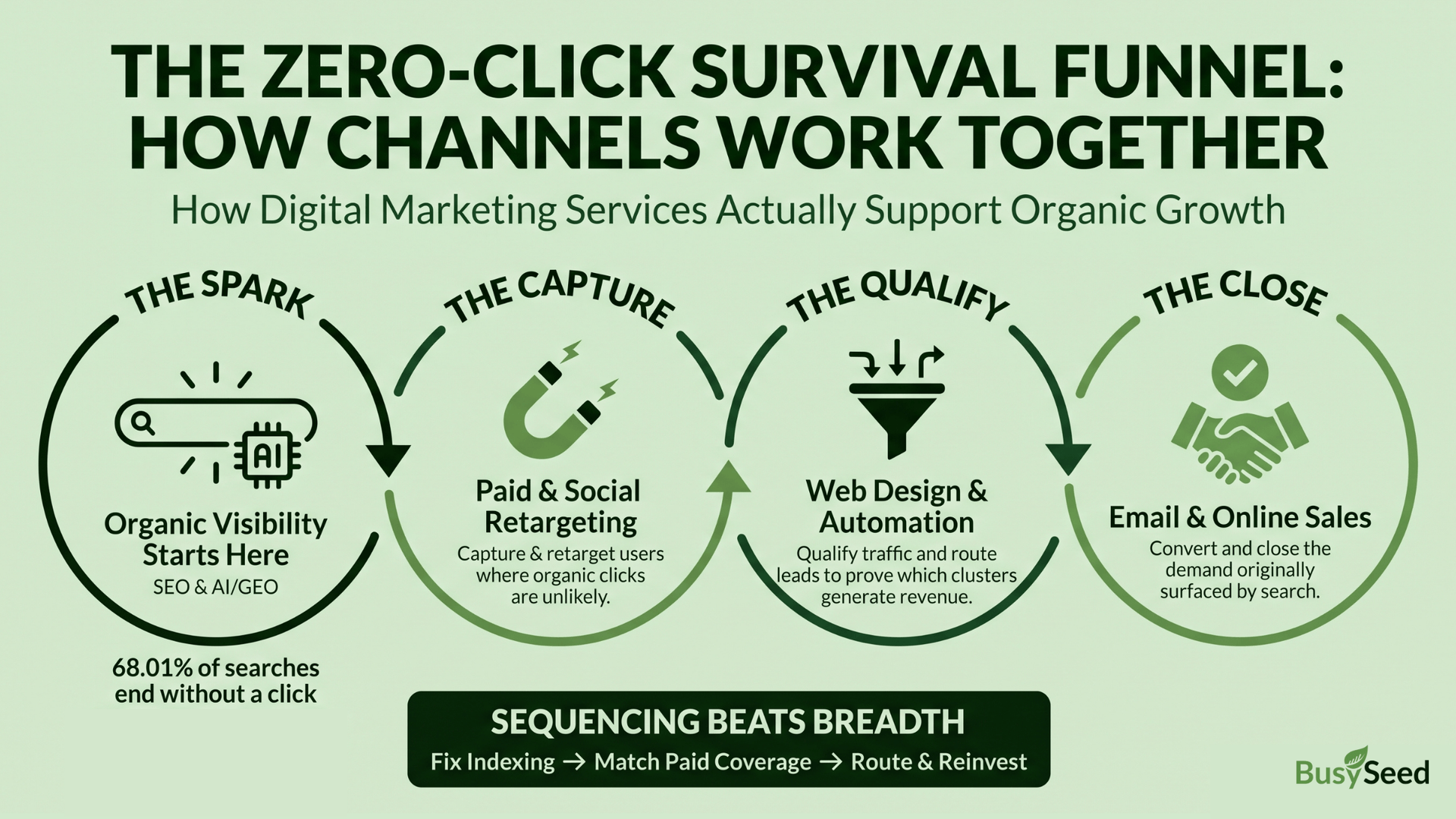
The digital marketing services that support organic growth in a saturated market include:
- SEO, AI Search, and GEO
- Lead Generation and Paid Advertising
- Social Media and Email Outreach
- Marketing Automation
- Web Design and Development
- Online Sales and Conversion Rate Optimization (CRO)
They matter together because organic visibility increasingly ends without a visit, so these surrounding channels capture, qualify, and convert demand that search surfaces but does not hand over as a session.
That is the full stack we run at BusySeed, and the reason we treat AI Search and GEO as a distinct discipline rather than an SEO add-on. Our own volatility study, Does the Company AI Recommends First Stay the Same?, tracked 480 weekly prompt-engine series between April 27, 2026 and August 3, 2026. The company mentioned first changed in 56.4% of consecutive weekly comparisons, and 82.3% of series saw at least one leader change. This is BusySeed research, not independent third-party evidence, and the practical reading is straightforward: a single strong week in an AI answer is not a position you own.
Sequencing beats breadth. Fix indexing and canonical issues before scaling production, because duplicated signals waste every page you add. Match paid coverage to queries where organic clicks are unlikely. Route the leads that do arrive into automation that proves which clusters generate revenue, then reinvest there and repair the weak pages rather than opening new fronts.
The Bottom Line
Organic search in a saturated market is no longer about publishing the most pages or chasing vanity metrics. With the majority of searches ending without a click, success requires a shift in perspective. You must treat every page as a standalone opportunity, prioritize user intent SEO, build verifiable trust, and measure success by the revenue it generates rather than keyword positions.
If your current SEO strategy is stuck chasing algorithms instead of buyers, it is time for a reset. BusySeed can audit your search footprint, identify high-intent semantic gaps, and build a generative engine optimization roadmap that actually drives pipeline. If you want a partner that understands how AI and search intersect to create revenue, let's talk. Contact BusySeed today, and we will build a smarter, revenue-driven organic engine together.
FAQs
Q1) What are the most effective SEO techniques for outranking competitors in saturated markets?
Score opportunities page by page on demand, intent fit, relevance to your offer, and your ability to differentiate with first-hand experience. Map the live SERP first to confirm a click is actually available. Google's systems generally operate at the page level and weigh many signals, so one strong domain metric will not lift a thin page. Choose fewer targets and make each page the complete answer.
Q2) What are the best tools to identify semantic gaps for AI ranking?
Use Search Console query and page data, a competitor content gap comparison such as Ahrefs, and manual review of live results and AI answers. Ahrefs recommends comparing against one to three competitors, then evaluating opportunities instead of building for every gap. Because BERT and RankBrain interpret meaning and relationships between concepts, prioritize uncovered subtopics and searcher vocabulary over exact-match variants.
Q3) What are the top tools for scoring content effectiveness without visible clicks?
Search Console supplies impressions, clicks, queries, pages, countries, devices, and search appearances; analytics adds post-click behavior and conversions. Together they tell you whether you have a visibility problem or an engagement problem, which a generic search engine optimization score alone cannot reveal. SparkToro found 68.01% of Google searches ended without a click in early 2026, so track impression share within target clusters and assisted conversions alongside sessions.
Q4) What are the best tools for evaluating content trust signals?
Audit against Google's people-first content self-assessment, the E-E-A-T framework, the structured data guidelines, and the spam policies. Google calls trust the most important E-E-A-T element and recommends accurate authorship information with bylines that lead to real expertise. Check that markup reflects visible content, that claims cite verifiable sources, and that automation is not being used primarily to influence rankings. Integrating these trust checks into your on-page SEO strategy ensures long-term viability.
Q5) Which digital marketing services should support an SEO program?
Pair SEO with AI Search and GEO, paid advertising, lead generation, marketing automation, web design and development, email outreach, social media, and online sales and CRO. With most searches ending without a click, the surrounding channels capture demand that search creates but does not deliver as a visit. Start with technical cleanup and measurement, then scale production into clusters that have already proven to drive revenue and improve your overall SEO ranking.
Works Cited
- Ahrefs. Content Gap Analysis. Ahrefs Blog, 2025.
- Google Search Central. Consolidate Duplicate URLs with Canonicals. Google Developers, 2026a.
- Google Search Central. Creating Helpful, Reliable, People-First Content. Google Developers, 2026b.
- Google Search Central. General Structured Data Guidelines. Google Developers, 2026c.
- Google Search Central. Google Analytics and Search Console. Google Developers, 2026d.
- Google Search Central. How to Succeed in Google's Generative AI Experiences. Google Developers, 2026e.
- Google Search Central. Snippet Controls. Google Developers, 2026f.
- Google Search Central. Core Web Vitals and Google Search Results. Google Developers, 2025a.
- Google Search Central. Debugging Drops in Google Search Traffic. Google Developers, 2025b.
- Google Search Central. Link Best Practices for Google. Google Developers, 2025c.
- Google Search Central. A Guide to Google Search Ranking Systems. Google Developers, 2025d.
- Google Search Central. SEO Starter Guide. Google Developers, 2025e.
- Google Search Central. Troubleshooting Crawling Errors. Google Developers, 2025f.
- SparkToro. In 2026, Less than One Third of Google Searches Still Send a Click. SparkToro, 2026.