
TL;DR
- The Google Ads auction insights report defines impression share as impressions received divided by estimated eligible impressions, proving that a low number isn’t automatic proof of a budget problem since eligibility reflects targeting, approval status, and Quality Scores.
- The Google Ads Customer Match best practices guide reports a 5.3% conversion uplift for campaigns using Customer Match list signals, making first-party data one of the most competitive inputs a smaller advertiser owns outright.
- The Google Ads Performance Planner guide models ad spend allocation across campaigns at a set total spend and recommends a budget of zero for campaigns failing to contribute to efficient distribution.
- The Google Ads Conversion Lift setup documentation requires strict minimums of 1,000 observed conversions and a $5,000 campaign budget to measure incremental conversions against a control group.
A paid media strategy is a documented plan for which auctions you enter, which audiences and outcomes you value, how you bid, what you exclude, and how you redistribute a fixed budget. For a challenger brand, that plan matters more than the size of the check.
You are not going to win every auction against a category leader, and you do not need to. You need to win the auctions where your intent matches, your landing page, and your customer economics are stronger than theirs, and stop paying for the rest. The tools to do that already sit inside Google Ads and Google Analytics.
What follows is how experienced teams use them to compete on efficiency rather than volume. If you need expert guidance to operationalize these tactics, BusySeed's paid media services can help you build a strategy that punches above its weight.
Why Does a Sharper Paid Media Strategy Beat a Bigger Budget?
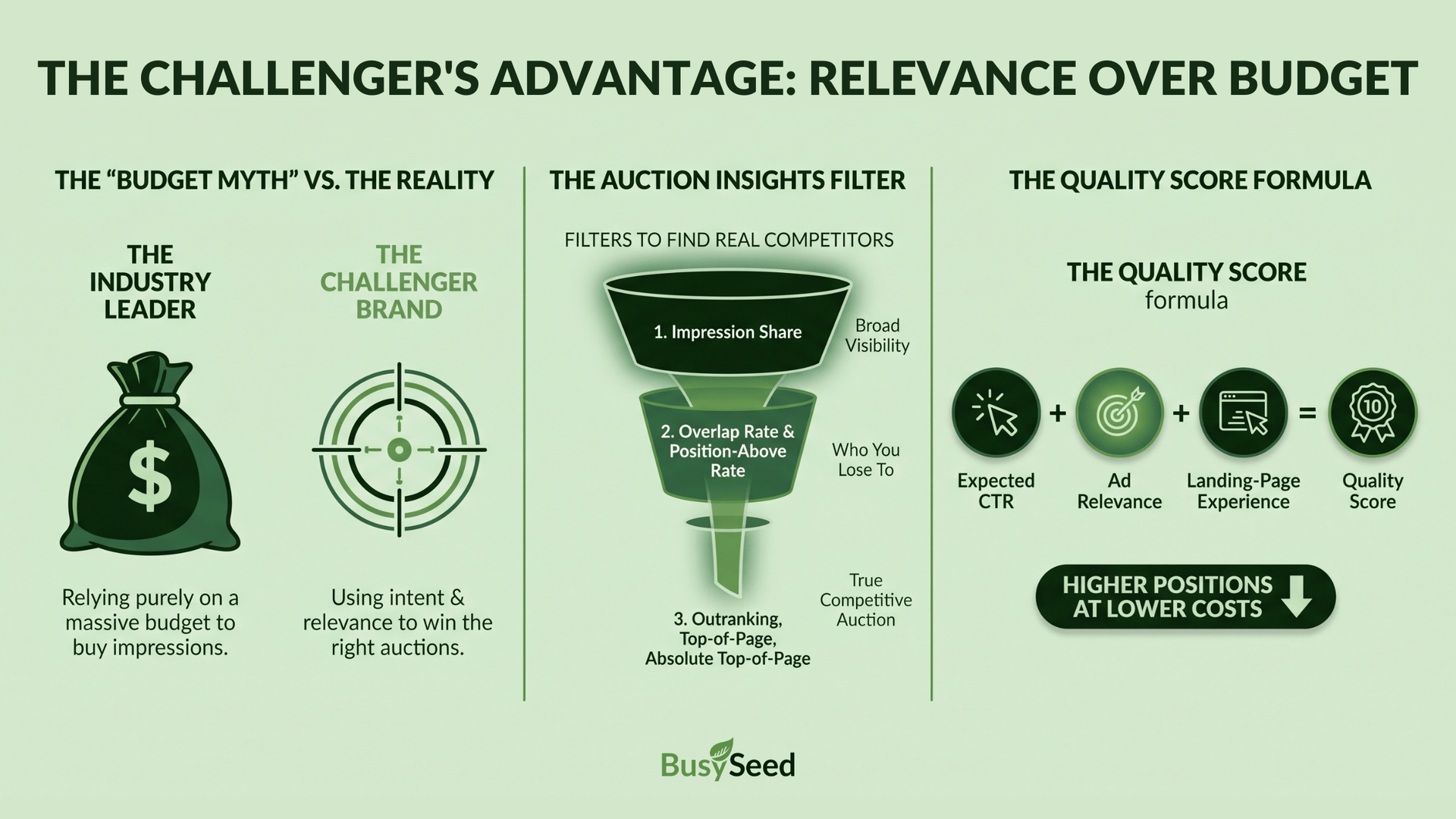
Diagnose the competitive gap before you react to it, because a flaw in your paid media strategy often masquerades as a budget shortfall. The Google Ads auction insights report provides data for Search, Shopping, and Performance Max. For Search campaigns, the report details six specific measures:
- Impression share: The percentage of eligible impressions your ads actually received.
- Overlap rate: How often a specific competitor's ad appeared in the exact same auction as yours.
- Outranking share: The frequency with which your ad ranked higher than a competitor's ad.
- Position-above rate: How often a competitor's ad showed higher on the page than yours when both appeared.
- Top-of-page rate: The percentage of time your ad appeared anywhere above the organic search results.
- Absolute-top-of-page rate: How often your ad appeared as the very first sponsored result on the page.
These six metrics separate a competitor who is simply visible everywhere from one who is genuinely in your auctions. Specifically, overlap rate and position-above rate reveal exactly who you are losing to.
Impression share is received impressions divided by estimated eligible impressions, and eligibility already accounts for your targeting settings, approval status, and Quality Scores. Raise bids against a low number caused by weak relevance, and you buy the same inefficiency at a higher price.
Quality Score is where that relevance shows up. Google scores it from 1 to 10 at the keyword level using expected click-through rate, ad relevance, and landing-page experience. The Google Ads Quality Score guide plainly states: "Quality Score is a diagnostic tool meant to give you a sense of how well your ad quality compares to other advertisers." It is not a KPI and not an auction input. Furthermore, the Google Ads search keyword guide notes that higher-quality, more relevant ads lead to lower costs and better positions. That is the challenger's opening: intent alignment bought with craft rather than cash.
What Are the Best AI Solutions for Targeted Advertising When You Cannot Outspend the Leader?
The best AI solutions for an outspent advertiser are the ones fed with data a bigger competitor lacks: Customer Match lists, value-based bidding, and conversion value rules layered onto Smart Bidding.
The Google Ads Smart Bidding documentation describes Smart Bidding as conversion-based strategies that set bids in each individual auction, drawing on contextual signals including:
- Device and operating system
- Location and language
- Time of day
- Remarketing lists
- Browser type
The guide confirms these are auction-level decisions, providing the exact granularity a smaller account needs.
Customer Match uses your first-party customer data to reach, re-engage, and find customers across Search, Shopping, Gmail, YouTube, and Display. Integrating this data directly into your media buying ensures you are targeting known prospects rather than renting cold audiences. The Google Ads Customer Match best practices page reports a 5.3% conversion uplift for campaigns using Customer Match list signals. Treat that as directional platform evidence, not a promise.
Two settings dictate whether audiences help or hurt:
- Observation: The Google Ads targeting and observation settings documentation recommends this for Search campaigns because it produces audience performance data without restricting reach. For Smart Bidding, first-party audiences added through Observation act directly as bidding signals.
- Targeting: The same documentation contrasts this by restricting delivery solely to the selected segment. Over-restricting a high-intent campaign before securing evidence eliminates scale you cannot buy back.
Remarketing lists support both bid and message differentiation, and the "Google Ads data segments for Search" guide limits list membership to a maximum of 540 days.
What Are the Best Ethical AI Tools for Paid Media?
The best ethical AI tools hash the customer data they ingest, keep exclusions under human review, and state plainly what they cannot measure. Enhanced Conversions for the web is a primary example. The Google Ads enhanced conversions guide explains that the tool uses hashed first-party information, such as an email address or phone number, to match conversions to signed-in Google users who interacted with an ad.
The same Google guide lists three specific benefits:
- Recovering conversions that would otherwise go unmeasured.
- Improving bidding through more accurate, comprehensive data.
- Maintaining user privacy through secure data hashing.
Those recovered conversions matter disproportionately to a small account, where every missed signal distorts the bidding model.
Privacy restraint applies to reporting as well. The Google Ads search terms report documentation confirms the platform omits some low-volume queries for privacy reasons, making your query review intentionally partial.
Ethical use also requires protecting your own reach. Account-level negative keyword lists apply across Search, Performance Max, App, Shopping, Smart, and Local campaigns. The Google Ads Performance Max negative keywords guide directs advertisers to use negatives in Performance Max strictly for essential brand-safety needs or completely irrelevant terms. The control is restrictive and stops the system from finding valuable traffic. Before any of this goes live with customer data, you must send consent and data-sharing practices through legal and platform-policy review. You can also leverage specialized agency tools to ensure your data activations remain both compliant and highly profitable.
Top AI Platforms for Ethical Advertising Solutions: How Do You Verify What They Claim?
Top AI platforms for ethical advertising solutions allow you to test their claims with a holdout. Judge any platform by whether it supports controlled testing. The Google Ads experiments guide details how experiments split budget or traffic between an original campaign and a variant to compare results. When results stay inconclusive, the guide instructs advertisers to let an experiment run at least four to six weeks. Ad variations test a single text or URL change at a specific traffic percentage, assigning users by cookies so they see only one version. This methodical approach to testing paid ads prevents you from making broad, costly assumptions about your messaging.
Attribution is the other half of verification. The Google Analytics attribution guide defines attribution as “the act of assigning credit for important user actions to different ads, clicks, and factors along the user's path.” It confirms data-driven attribution evaluates both converting and non-converting paths, weighing time to conversion, device type, and the sequence of ad interactions. By understanding exactly which paid ads trigger the highest-value actions, you can confidently cut the underperformers.
However, credit reassignment is not incremental gain. The Google Ads Conversion Lift setup documentation describes a controlled comparison between people who saw ads and a control group who did not, with listed minimums of 1,000 observed conversions and $5,000 in campaign budget, and not every account is eligible.
For ad spend allocation at a fixed total, the Google Ads Performance Planner guide confirms the tool models the best split across campaigns, refreshes forecasts daily on the previous seven to ten days of data, and recommends a budget of zero where a campaign drags efficiency down. The guide frames those forecasts as directional, which is the honest framing to hold any vendor to.
What Separates the Top Advertising Companies in New York From the Rest?
The top NYC advertising companies bring rigorous discipline to their media buying, proving exactly where your money is wasted before they ask for more of it. A competent agency reads Auction Insights against your actual overlap competitors, names the primary conversion goal optimizing your bidding, and runs a controlled experiment.
The Google Ads conversion goals guide notes that a conversion action must be set as Primary and included in the campaign's selected goal to influence bidding. An agency failing to explain this goal configuration cannot explain your results.
Value matters more than volume for challengers. The Google Ads value-based bidding guide states that this strategy optimizes toward the value you assign to outcomes and requires two or more unique conversion values. Additionally, the Google Ads conversion value rules documentation explains that rules adjust those values by audience, device, or location directly at auction time.
What Makes the Best Digital Marketing Agency in NYC for a Fixed Budget?
The best NYC digital marketing agency for a fixed budget reallocates existing spend before requesting budget increases. That discipline shows up when a team models spend across campaigns. The Google Ads Performance Planner guide confirms the tool recommends a budget of zero for campaigns failing to contribute to efficient distribution. Top-tier PPC management services pair that reallocation habit with weekly search-term review and a clearly stated primary conversion goal, making the agency's process verifiable.
BusySeed is a full-fledged digital marketing agency managing media buying across Google, Meta, LinkedIn, and other channels for clients throughout the United States. Its comprehensive paid advertising engagement covers:
- Channel and budget strategy: Allocating ad spend across the most efficient platforms to maximize your return on ad spend.
- Campaign architecture: Structuring accounts and ad groups to ensure strict alignment between search intent and bidding algorithms.
- Audience and keyword research: Identifying high-intent search terms and first-party data segments that drive qualified, bottom-of-funnel conversions.
- Conversion-tracking setup: Implementing precise, privacy-compliant tracking frameworks to feed accurate outcome data back to the platform models.
- Daily bid and budget management: Actively monitoring and reallocating daily spend to capitalize on auction inefficiencies.
- Ongoing creative testing: Running continuous ad variations and holdout experiments to confidently stop investment in paid ads that fail to convert.
Bringing It Home
Outspending the category leader is a losing battle. Outsmarting them is how challenger brands grow. Efficiency is the ultimate equalizer in paid media. When you harness first-party data, model your ad spend allocation with precision, and relentlessly measure incremental lift, your fixed budget goes further than a bloated competitor's ever could. The tools to build this advantage already exist inside your platforms, but deploying them requires a refined paid media strategy rather than just a bigger credit card.
If you are tired of competing on volume and want to start winning on value, let's talk. We can audit your current Google Ads setup, find where your budget is leaking, and build a targeted reallocation strategy to maximize your ROAS. Connect with BusySeed to rebuild your strategy and turn efficiency into your biggest competitive advantage.
FAQs
Q1) What are the best AI solutions for targeted advertising?
For advertisers competing against larger budgets, the strongest AI solutions for targeted advertising are Smart Bidding fed by first-party signals, Customer Match audiences, and conversion value rules. Smart Bidding sets bids in each auction using signals such as device, location, time of day, and remarketing list. Customer Match contributes customer knowledge the platform does not otherwise hold. Google reports a 5.3% conversion uplift for campaigns using Customer Match list signals.
Q2) Which are the top advertising companies in New York for a smaller brand?
The top advertising companies in New York for a smaller brand compete on efficiency rather than reach, using Auction Insights, search-term review, and controlled experiments to justify every dollar. Ask any shortlisted firm how it diagnoses low impression share, since Google's report proves eligibility reflects targeting, approvals, and Quality Scores as well as budget.
Q3) What are the best ethical AI tools for paid media?
The best ethical AI tools for paid media hash customer data, respect consent, and keep exclusion decisions reviewable. Enhanced Conversions for web uses hashed first-party information such as an email address or phone number and maintains privacy through that hashing. Google also advises restraint with negative keywords in Performance Max, recommending them only for essential brand safety or completely irrelevant terms.
Q4) What should I look for in top AI platforms for ethical advertising solutions?
Look for platforms that support holdout testing and state the limits of their own forecasts. Google Ads experiments compare a variant against an original campaign and should run at least four to six weeks when results are inconclusive. Conversion Lift compares exposed users with a control group, though Google lists minimums of 1,000 observed conversions and $5,000 in campaign budget, and not every account qualifies.
Q5) How do I choose the best digital marketing agency in NYC without raising my budget?
Choose on reallocation discipline, not promised reach. The Google Ads guide states that the tool recommends a budget of zero for campaigns failing to contribute to efficient distribution. Strong PPC management services pair that modeling with weekly search-term review and clear primary conversion goals.
Works Cited
- Google Ads Help. About auction insights. Google.
- Google Ads Help. About data segments for Search. Google.
- Google Ads Help. About conversion goals. Google.
- Google Ads Help. About conversion value rules. Google.
- Google Ads Help. About enhanced conversions for web. Google.
- Google Ads Help. About experiments. Google.
- Google Ads Help. About keywords in Search campaigns. Google.
- Google Ads Help. About negative keywords in Performance Max. Google.
- Google Ads Help. About Performance Planner. Google.
- Google Ads Help. About Quality Score for search campaigns. Google.
- Google Ads Help. About Smart Bidding. Google.
- Google Ads Help. About targeting and observation settings. Google.
- Google Ads Help. About the search terms report. Google.
- Google Ads Help. About value-based bidding. Google.
- Google Ads Help. Customer Match best practices. Google.
- Google Ads Help. Set up Conversion Lift based on users. Google.
- Google Analytics Help. Get started with attribution. Google.