TL;DR
- Google's New controls for website owners announcement reports AI Overviews above 2.5 billion monthly active users and AI Mode above 1 billion as of August 31, 2026, making generated answers a primary discovery surface rather than an experiment worth watching.
- OpenAI's Buy it in ChatGPT update states that more than 700 million people use ChatGPT weekly for everyday tasks, including finding products. Furthermore, OpenAI's Introducing ChatGPT search announcement confirms ChatGPT Search has been open to everyone since February 5, 2025.
- Google's “AI features and your website” guide states that optimizing for generative AI search is still SEO, and that a page must be indexed and snippet-eligible before it can appear in any generative Search feature at all.
- Measurement is platform-specific. The same Google guide recommends its Generative AI performance report and confirms no third-party tool sees Google's internal AI systems. For alternative platforms, OpenAI's Publishers and Developers FAQ states that the company adds a referral parameter for ChatGPT traffic to analytics platforms.
AI SEO is the work of making your pages discoverable, accurate, and citable inside AI-generated answers from systems like Google AI Overviews, Google AI Mode, and ChatGPT Search. It matters now because the audience is enormous.
According to Google's “New controls for website owners” announcement, AI Overviews passed 2.5 billion monthly active users, and AI Mode passed 1 billion monthly users as of August 31, 2026. Buyers are building shortlists inside generated responses before they ever scan a list of blue links. BusySeed is a United States digital marketing agency offering AI Search / GEO services alongside SEO, paid media, and other growth programs.
What Are The Best Tools For Prompt Tracking And Optimization?
The best tools for prompt tracking and optimization are the platform-owned ones first: the Generative AI performance report in Google Search Console for Google's generative features, and ChatGPT referral attribution inside your analytics platform for ChatGPT Search. Third-party prompt trackers are useful as an observation layer, but Google's “AI features and your website” guide states plainly that no third-party tool has access to its internal ranking or AI systems.
That single caveat should reset how you buy software. LLM rank tracking is directional sampling, not a reading from a meter. A tool can tell you that your brand appeared in four of ten sampled answers to a buying question last Tuesday; it cannot tell you the rank that produced it, because no such public rank exists.
On the ChatGPT side, OpenAI's Publishers and Developers FAQ notes that publishers who allow OAI-SearchBot can track ChatGPT referral traffic in analytics platforms, because ChatGPT appends a parameter identifying itself as the source. That turns a vague question about mentions into a reportable number of sessions.
We run this discipline on our own data too. BusySeed Research analyzed 1,548,342 AI-assistant answers across ChatGPT, Claude, and Gemini in The State of AI Search, July 2026, covering a cohort of 153,251 companies, with a published methodology, named model versions and run dates, stated limitations, and a row-level dataset released under CC BY 4.0. That is our own research rather than an independent validation, and we label it that way. The point for your stack is simple: a prompt tracker is only as credible as the methodology it will show you.
Best Prompt Tracking Tools For Marketers: What Should They Actually Record?
The best prompt tracking tools for marketers record how your brand appears for real buyer questions across Google Search, Google AI experiences, and ChatGPT Search, not whether a single keyword moved two positions.
For each priority prompt, log these five specific fields:
- Mentioned: Did the generative engine include your brand name?
- Cited: Was your brand explicitly referenced as a source?
- Linked: Did the response include a clickable URL to your domain?
- Accurately described: Was the factual context about your brand correct?
- Positioned against alternatives: How was your brand framed compared to competitors?
Treat each platform as its own baseline. One assistant recommending you does not mean another does, and a tool that blends platforms into a single composite score hides the gap you need to fix.
Head-term tracking is also a weaker proxy than it used to be. Google's AI Mode update describes query fan-out as a model generating concurrent, related searches to gather what it needs, and reports AI Mode issues a multitude of queries on a user's behalf to explore the web more deeply than traditional search. A buyer asking one layered question triggers several searches about constraints, comparisons, pricing, and alternatives, so your tracked prompt list must mirror those decision criteria instead of five tidy keywords.
There is also encouraging context for volume. This Google update reports that AI Overviews drove a more than 10% increase in Google usage for the query types where they appeared in the United States and India during an experiment running from September 2024 through April 2025. Google reports that generated answers expanded search behavior, rather than only absorbing it.
Finally, make the tool report outcomes. Mentions are an input; qualified sessions, engaged visits, leads, pipeline, and revenue are the output your executive team will fund next year.
Generative Engine Optimization Solutions: What AI SEO Really Requires
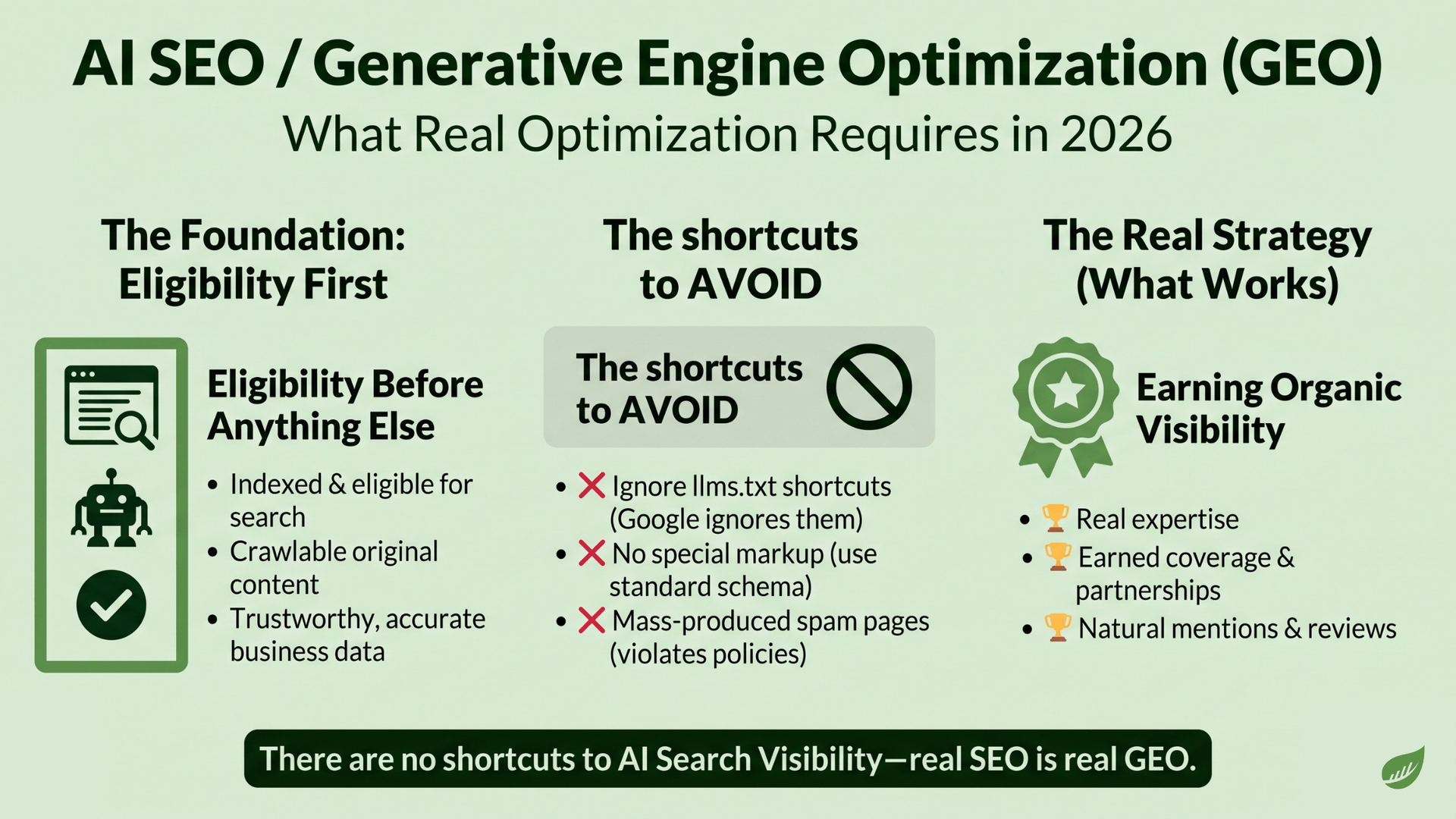
The generative engine optimization solutions that hold up are unglamorous: indexable pages, crawlable content, original expertise, accurate business data, and credible earned coverage.
Google does not treat this as a separate discipline. Google's “AI features and your website” guide confirms that optimizing for generative AI search is optimizing for the Search experience, and therefore is still SEO. Asked directly whether SEO remains relevant for generative AI search, Google Search Central answers, "In short, yes!"
Eligibility comes before everything else. The same Google guide dictates a page must be indexed and eligible to appear with a snippet in Google Search before it can appear in generative Search features, and that meeting those requirements still guarantees nothing about crawling, indexing, or display.
Three shortcuts deserve a flat no:
- llms.txt files: Google says it ignores llms.txt files for Google Search, including generative AI features, and that maintaining one neither helps nor harms visibility.
- Generative-specific markup: There is no special schema.org markup for generative Search, though Google still recommends structured data as part of overall SEO because it supports rich-result eligibility.
- Scaled variant pages: Mass-producing pages aimed at every possible fan-out variation violates Google's scaled content abuse spam policy.
Manufactured mentions fail the same way. Google acknowledges that its generative features can reflect what blogs, videos, and forum discussions say about products and services, then warns that seeking inauthentic mentions is unhelpful because its quality and spam systems still apply.
Real GEO optimization work is earning coverage, reviews, expert participation, and partnerships that a reasonable editor would have run anyway. Anything sold as a private shortcut into the answer box is being sold on a claim no vendor can verify.
Improving Generative Engine Performance: Where Do The Gains Come From?
Improving generative engine performance comes from two places: content no model can find anywhere else, and the removal of technical barriers that keep that content out of the answer. Google is unambiguous about which matters more. Google's “AI features and your website” guide asserts that "Creating content that people find unique, compelling, and useful will likely influence your website's presence in generative AI search in the long run more than any of the other suggestions in this guide".
Google's generative features use retrieval-augmented generation, or grounding, to pull relevant and up-to-date pages from the Search index, review what those pages say, generate an answer, and show clickable supporting links.
So the practical way to optimize content for Google AI overviews is to be the page worth retrieving. This means prioritizing:
- First-hand experience: Share direct, practitioner-level insights.
- Original research: Publish proprietary data and distinct metrics.
- Documented processes: Detail step-by-step methodologies rather than high-level theory.
- Case evidence: Provide verifiable outcomes and real-world examples.
- A distinct point of view: Deliver original analysis instead of restating what already exists.
Then clear the obstacles. The same Google guide notes that good mobile performance, reduced latency, clear main content, and JavaScript SEO all matter, because its models work from publicly accessible, crawlable content. The same guide recommends organizing pages with clear sections and headings for human readers, and reports that high-quality, relevant images and video create additional opportunities to appear beyond web page links.
ChatGPT has its own entry condition. OpenAI's Publishers and Developers FAQ states that any public website can appear in ChatGPT search, and adds that sites must not block OAI-SearchBot in robots.txt if they want content included in summaries and snippets. Furthermore, OpenAI's Introducing ChatGPT Search announcement confirms ChatGPT Search has been available to everyone without sign-up since February 5, 2025.
How Should Digital Marketing Services Change For AI Search?
When shifting strategies toward AI SEO, data quality is often the most underfunded piece. Google establishes that generative responses include product listings, product information, and local-business information, and recommends Merchant Center feeds and Google Business Profiles where appropriate.
For ecommerce, Google's Product structured data documentation reports that combining on-page product markup with a Merchant Center feed maximizes eligibility and helps Google verify product data. Stale pricing, hours, or availability is now a visibility problem, not just a customer service one.
Commerce reinforces the point. OpenAI's Buy it in ChatGPT update reported in September 2025 that more than 700 million people use ChatGPT weekly for everyday tasks, including finding products, and confirms product results are organic and unsponsored, ranked purely on relevance to the user. No media budget buys that placement.
Participation is also a decision to make deliberately. Google's “New controls for website owners” announcement confirms Search Console controls for generative Search rolled out globally as of August 31, 2026, and sites that opt out receive no impressions or traffic from those features.
The Bottom Line On AI Search
Generative AI isn’t just changing how people search; it’s changing where they decide to buy. If your brand relies on outdated SEO playbooks instead of modern AI SEO, you risk being left out of the AI answers that millions of buyers already trust. Mastering generative engine optimization requires a unified approach: indexable pages, pristine data feeds, original content, and earned media that models actually want to cite. You have to earn your place inside the answer.
If you want an expert team to pressure-test your current visibility and prioritize the highest-ROI optimization moves, let’s talk. BusySeed can audit your technical foundation, build a practical GEO roadmap, and unify your SEO, content, and data into a single revenue engine. Connect with us here to secure your brand's spot in the generative search era.
FAQs
Q1) What are the best tools for prompt tracking and optimization?
Start with platform-native reporting: Google's Generative AI performance report in Search Console covers discovery through generative features in Search and Discover, and analytics-based ChatGPT referral tracking covers ChatGPT Search. Add a third-party prompt tracker for cross-assistant sampling if needed. Treat its output as directional, since Google states that no third-party tool can see its internal ranking or AI systems. This is why treating LLM rank tracking as a precise science is a mistake.
Q2) What are the best prompt tracking tools for marketers running lean teams?
The best prompt tracking tools with limited capacity track fewer prompts more carefully. Pick ten to twenty questions that genuinely decide deals, check them across Google AI experiences and ChatGPT Search on a fixed schedule, and record whether you were mentioned, cited, linked, and described accurately. A spreadsheet with a documented method beats an expensive dashboard with an undocumented one.
Q3) What does solid GEO work actually include?
Solid GEO optimization includes indexability and snippet eligibility, crawler access, original expertise-led content, clear page structure, accurate product and local-business data, earned third-party coverage, and platform-specific measurement. It should not include llms.txt as a strategy, AI-only schema, or thin pages built for every prompt variation. Google says it ignores llms.txt for Search and that scaled variant pages can trigger its spam policies.
Q4) How can you start improving generative engine performance this quarter?
Confirm priority pages are indexed and snippet-eligible, unblock crawlers including OAI-SearchBot if ChatGPT inclusion matters, and fix mobile performance, latency, and JavaScript rendering issues. Then replace one commodity page per month with something only your team could write, such as original data, a documented process, or a real case, to better optimize content for Google AI overviews. Baseline your priority prompts before the work starts so improvement is measurable.
Q5) Which digital marketing services matter most for AI search visibility?
Technical SEO, original content production, structured product and local data management, digital PR that earns genuine mentions, and analytics that connect AI discovery to revenue matter most. Ecommerce brands should prioritize Merchant Center feeds plus on-page product markup; local businesses should prioritize Google Business Profile accuracy. BusySeed delivers these through a combined AI Search / GEO, SEO, and research practice rather than as disconnected engagements.
Works Cited
- Google. AI features and your website. Google Search Central, 2026a.
- Google. New controls for website owners. Google Blog, 2026b.
- Google. AI in Search: Going beyond information to intelligence. Google Blog, 2025a.
- Google. Product structured data. Google Search Central, 2025b.
- OpenAI. Publishers and developers FAQ. OpenAI Help Center, 2026.
- OpenAI. Buy it in ChatGPT. OpenAI, 2025.
- OpenAI. Introducing ChatGPT search. OpenAI, 2024.