TL;DR
- Traditional search engine volume is projected to drop 25% by 2026 as search marketing loses share to AI chatbots and virtual agents, making early discovery critical (Gartner, 2024).
- The click is becoming optional: 58.5% of U.S. Google searches resulted in zero clicks in 2024, and when an AI summary appears, users click a traditional link only 8% of the time (SparkToro, 2024; Pew Research Center, 2025).
- Generative AI is already moving money, with referred traffic to U.S. retail sites jumping 1,200% year over year and roughly doubling every two months (Adobe, 2025).
- In the B2B space, 68% of buyers have a frontrunner in mind at the start of their journey and select that preferred vendor 80% of the time, meaning bottom-funnel marketing is often too late (Forrester, 2025).
- AI search engines prioritize institutional credibility, citing .gov sites three times more often than standard results, which means brands must shift from writing keyword-heavy blog posts to publishing highly credible, citable claims (Pew Research Center, 2025).
What is Generative Engine Optimization (GEO) and Why is Early Brand Discovery Critical in 2026?
Here's the uncomfortable truth most marketing teams still haven't internalized: by the time a buyer types your category into a search bar, the decision is often already half made.
Generative engine optimization is the practice of making your brand visible and citable inside AI-generated answers, so you influence buyers during that early, invisible stretch of discovery before search ever happens. If you're still building your entire funnel around capturing high-intent search clicks, you're showing up to a party that started an hour ago.
We've watched this shift accelerate over the last two years, and the data backs up what we're seeing in client accounts. Gartner predicted that by 2026, traditional search engine volume will drop 25% (Gartner, 2024) as search marketing loses share to AI chatbots and virtual agents.
Buyers aren't searching less because they care less. They're finding brands somewhere else first: AI answers, social feeds, communities, and review platforms. The search, when it finally comes, is often just a confirmation of a choice already forming.
This piece is about where that discovery actually happens now and how to build visibility upstream of the query. If you want an expert team to build this architecture for you, explore our digital marketing services at BusySeed. Let us get into it.
Why Does the Buyer Journey No Longer Start with a Google Search?
The buyer journey no longer starts with a Google search because AI answers, social feeds, and peer communities now shape brand awareness before a prospect ever feels the need to search.
Even when buyers do use Google, the click has become optional. SparkToro and Datos found that 58.5% of U.S. Google searches in 2024 resulted in zero clicks (SparkToro, 2024), with only 360 clicks per 1,000 searches reaching the open web.
Then AI summaries poured gasoline on that fire.
A Pew Research Center browsing-data study from March 2025 found that when an AI summary appeared in the results, users clicked a traditional link only 8% of the time, compared with 15% without a summary (Pew Research Center, 2025). They clicked a link inside the AI summary itself just 1% of the time. Read that again. The answer is being consumed, and the source is barely getting a glance.
So the game changed. Your content isn't competing for a click anymore. It's competing to be the thing the AI says, or the thing a Reddit thread recommends, or the review a buyer skims on their phone. AI search engine optimization is now less about ranking a page and more about being the trusted reference that gets pulled into someone else's answer.
Mastering AI SEO means adapting to this shift. The foundation of modern AI search engine optimization requires brands to become the definitive source that language models consistently cite.
But here's our mildly contrarian take, and plenty of SEO folks will push back on it: chasing keyword rankings in 2026 is often a lagging investment. Not useless. Lagging.
The ranking still matters for the small slice of buyers who click through, but the larger influence is happening on surfaces you can't rank in the classic sense. If your reporting only tracks organic sessions, you're measuring the shadow, not the object.
What Is Generative Engine Optimization and How Is It Different from SEO?
Generative engine optimization is the discipline of optimizing your content and brand entity so AI systems cite you inside their generated responses, rather than optimizing for blue-link rankings.
Princeton and KDD researchers formalized this as a distinct paradigm (Kwiatkowski et al., 2024), separate from traditional search optimization, precisely because the mechanics of being chosen by a model differ from those of ranking on a results page.
The difference matters operationally:
- Classic SEO rewards pages.
- AI SEO rewards sentences and entities.
When an AI assembles an answer, it lifts standalone claims that make sense on their own, then attributes them to a source it trusts. That means your job is to write extractable, self-contained, well-sourced statements and to keep your brand entity consistent everywhere it appears.
Here's something that surprised even us. Pew found that in AI summaries, .gov sites accounted for 6% of cited sources, compared with just 2% in standard results (Pew Research Center, 2025).
AI summaries appear to place immense weight on institutional credibility. So the lesson isn't "write more blog posts". It's "publish content that can sit comfortably next to a government or university source". Cite rigorously. Publish your methods. Cut the unverifiable fluff. If your content reads like a press release, the model quietly skips you.
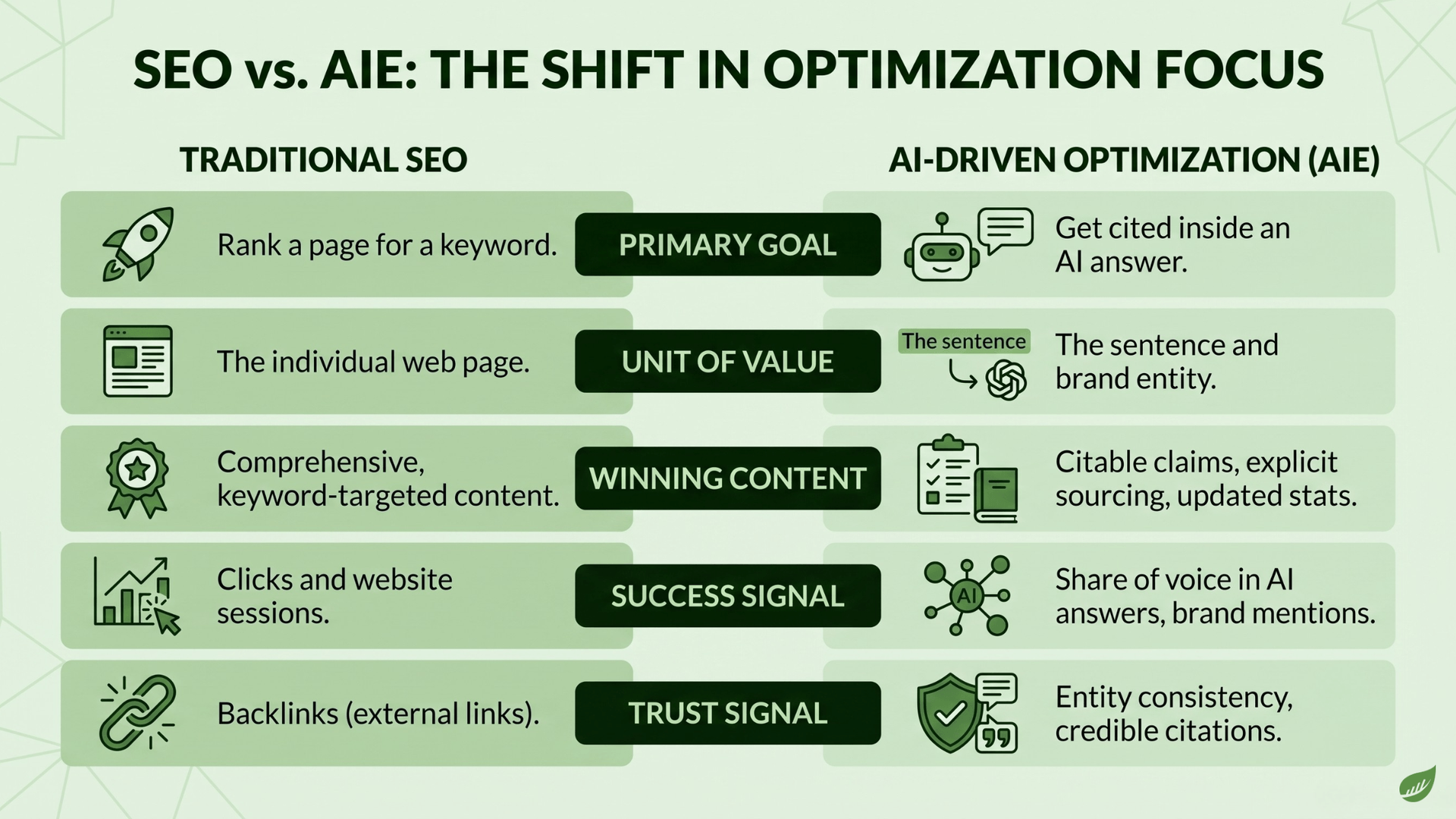
| Optimization Focus | Traditional SEO | Key Metric |
|---|---|---|
| Primary goal | Rank a page for a keyword | Get cited inside an AI answer |
| Unit of value | The page | The sentence and the brand entity |
| Winning content | Comprehensive, keyword-targeted | Citable claims, explicit sourcing, updated stats |
| Success signal | Clicks and sessions | Share of voice in AI answers, brand mentions |
| Trust signal | Backlinks | Entity consistency, credible citations |
Neither replaces the other. But if we had to reallocate a fixed budget for a mid-market brand in 2026, we'd move real dollars toward the right-hand column. That said, this isn't a fix for a weak product or a confused positioning. GEO amplifies clarity. It also amplifies incoherence, so get your entity story straight first.
Where Do Buyers Actually Discover Brands Before They Search?
Buyers discover brands before searching across five main surfaces in 2026:
- AI answer engines
- Social feeds
- Online communities
- Review platforms
- Multimodal search
Each one shapes a first impression that a later Google query merely confirms. Let us walk through what's working in each, because the tactics differ more than people assume.
1. AI Answer Engines Are a Discovery Layer Now, Not Just a Research Shortcut
AI answers have become common enough to change behavior at a population scale. Pew Research Center counted 68,879 unique Google searches by panelists in March 2025 and found that roughly 18% of those searches produced an AI summary (Pew Research Center, 2025).
And these tools are already moving money. Adobe Analytics observed that generative AI-referred traffic to U.S. retail sites jumped 1,200% when comparing February 2025 to July 2024 (Adobe, 2025), roughly doubling every two months since September 2024.
To operationalize this, design content to be citable, not just rankable. That means clean definitions, concise claims, explicit sourcing, and formatting a machine can quote: headings that mirror real questions, short paragraphs, tables, and bullet summaries.
Build an evidence library, especially for B2B, with your own benchmark data and methodologies that an AI can lift with confidence. And obsess over entity consistency: your brand name, product names, category, and integrations should read identically across every source. When your "who and what" wobbles from site to site, AI answers get shaky, or they leave you out entirely.
Specialized platforms that analyze which sentences from your content are most likely to be cited in AI-generated responses are now standard AI tools for marketing teams. These tools help marketers refine their messaging to align with patterns observed in multimodal search results, ensuring brand entities remain consistent across text, images, and video.
By integrating these tools into your workflow, you can systematically improve your AI search engine optimization and stay ahead of competitors who are still relying solely on traditional SEO tactics. If your team needs help vetting and deploying the right AI tools for marketing, reach out to the specialists at BusySeed.
2. Social Feeds Work Like Search Results, with Intent Showing Up Later
People find products while passively scrolling, long before they'd ever describe themselves as "in market". Sprout Social's Q4 2025 Pulse Survey shows 45% of social users turn to social media for gift ideas and product discovery (Sprout Social, 2025), edging out the 35% who ask friends and family.
Coveo's 2024 Commerce Industry Report, a survey of 4,000 shoppers, highlighted the same browse-then-discover dynamic (Coveo, 2024), with a real gap between where discovery happens and where purchase lands.
Our advice here runs against the usual "drive traffic to the site" instinct. Treat short-form video less as a click machine and more as a category-positioning tool. The goal isn't the link in bio. It's becoming the default example a viewer pictures when they think about the problem you solve.
Create comment-aware content, too. The FAQ isn't on your website anymore. It lives in comments, stitches, and Reddit threads. Mine those weekly and ship content that answers buyers in their own phrasing, not your brand's style guide.
And measure social as an upstream assist. Track view-through and CRM touches; watch for branded search lift and direct traffic spikes after a social moment. Social platforms are increasingly indexing these conversations, making them a crucial component of AI SEO.
When optimizing your video content and social posts, think of it as an extension of your AI search engine optimization strategy. Last-click attribution will tell you social does nothing. Last-click attribution is lying to you.
3. Communities and Peer Validation Filter the Shortlist Early
We'll open this one with a field observation. Last year, we sat with a B2B client convinced their content was "everywhere". Well, we checked.
Their category conversation on Reddit had thousands of engaged posts, and their brand appeared in exactly none of them, while a scrappier competitor kept turning up because two of their engineers answered questions like humans.
That competitor was on more shortlists. Not because of ad spend. Because of their presence where the sorting happens. Communities are enormous and increasingly indexable by both Google and AI. Reddit's 2025 10-K reported 121.4 million daily active uniques (Reddit, 2026) for the three months ending December 31, 2025.
Pew separately found that the most frequently cited sources in both AI summaries and standard results included Wikipedia, YouTube, and Reddit (Pew Research Center, 2025). When your buyers and the AI both trust the same communities, showing up there creates compounding leverage.
Community seeding beats community posting. Here is how to execute it:
- Empower real employees and subject-matter experts to participate as people, not logos.
- Publish genuinely useful teardowns, templates, and honest "how we decided X" narratives.
- Turn customer success into discovery media by capturing implementation notes, ROI benchmarks, and integration gotchas.
- Repurpose those insights into community-native posts and knowledge base pages that an AI can cite.
Building this kind of compounding, community-led authority is a core part of how we scale brands at BusySeed. It essentially creates an AI SEO moat that competitors cannot easily replicate.
4. Reviews Became a Discovery Layer, Not a Closing Layer
Reviews used to be the last thing a buyer checked before purchase.
Now they're one of the first.
BrightLocal's 2026 survey reports 97% of consumers read online reviews, and 41% "always" read them when browsing for businesses (BrightLocal, 2026), up sharply from 29% the prior year. Where they read matters, too:
- Google: 45%
- Facebook: 34%
- Yelp: 24%
- Apple Maps: 17%
- Tripadvisor and BBB: 16%
So operationalize review velocity, not just star average:
- Automate post-purchase review requests via email and SMS.
- Time those requests by category.
- Treat your responses as marketing content because they are.
Reviewers describe use cases in natural language, exactly the kind of phrasing an AI may reuse when someone asks it for a recommendation. A thoughtful response can also correct a misunderstanding before it hardens into consensus.
5. Multimodal Search Collapsed Inspiration and Research into One Motion
Multimodal search is discovery through images, video, and camera input rather than typed text, and it's now a mainstream buying behavior. Google states its Lens tool handles nearly 20 billion visual searches every month (Google, 2024).
A buyer sees something, points a camera, and moves from "what is this?" to "where do I buy it?" in seconds. The old gap between inspiration and evaluation is disappearing.
Because of that, modernize your image and product data pipeline the way you once obsessed over keyword pages. Ensure consistent product naming, clean SKU and title structure, rich alt text, and strong structured data for Product, Organization, and FAQ where appropriate.
Publish visual proof buyers can screenshot: comparison charts, teardown images, short demo clips, implementation diagrams. If a screenshot of your asset ends up in a buyer's group chat, that's discovery you never paid for.
The best multimodal search tools in 2026 include platforms that analyze visual search patterns and optimize image metadata for AI-driven discovery. These tools help brands ensure their visual content appears in relevant multimodal search results, whether through Google Lens, Pinterest visual search, or other emerging platforms.
By leveraging these AI tools for marketing, you can capture buyers at the exact moment they're inspired by a product image or video, turning passive browsing into active discovery.
The B2B Reality Check Most Funnels Ignore
If you only invest in bottom-funnel intent capture, you're competing after the shortlist has already formed. Forrester's 2025 Buyers' Journey Survey found that 68% of B2B buyers have a front-runner in mind at the start of the journey and select that preferred vendor 80% of the time (Forrester, 2025).
Sit with that number. The frontrunner is chosen early, and it usually wins. All that budget aimed at the moment of high intent is fighting over the 20% of deals where the frontrunner slips.
The strategic implication is blunt. If you're invisible during discovery, your beautifully optimized bottom-funnel machine is polishing scraps. You want to become the frontrunner in communities, review platforms, and AI answers, where early sorting happens through generative engine optimization. A mature AI SEO approach guarantees you are part of that initial sorting. By deploying the right AI tools for marketing, you can monitor these emerging surfaces and intercept buyers long before they finalize their shortlists.
Key Takeaways for Building Discovery-First Visibility
- Build an evidence library: Publish clean definitions, original benchmark data, and explicit sourcing so AI models have a credible reason to cite your brand.
- Seed communities, don't just post. Empower your experts to answer questions on Reddit and forums with genuinely useful teardowns and templates.
- Operationalize review velocity: Automate category-specific review requests and treat your responses as marketing content, as AI often scrapes natural language from reviews.
- Modernize your visual assets: Optimize image metadata, alt text, and comparison charts so your brand appears when buyers use multimodal search tools like Google Lens.
- Fix your pipeline plumbing: Ensure your CRM centralizes all discovery channels, deduplicates records, and immediately alerts sales to high-intent behaviors.
Case Study: Recovering 813 Hidden Sales Opportunities through Marketing Automation
Here's the part nobody wants to hear. Discovery before search isn't only a visibility or AI search engine optimization problem. It's a plumbing problem. A B2B SaaS client came to us, certain that their lead generation was underperforming. Their marketing looked fine on paper. Their pipeline didn't match.
When our team at BusySeed ran a discovery audit, we found the real issue wasn't demand. It was intake. Buyers were discovering the brand across scattered surfaces, and those touches were creating leads that never mapped cleanly into the CRM. We uncovered 813 qualified leads that had never reached the sales team, stranded in disconnected systems.
Here's what we changed:
- Centralized all lead sources in the CRM, including web forms, paid lead forms, chat, booking tools, webinar and event registrations, and partner referrals.
- Standardized lifecycle stages and lead statuses so "discovered us" didn't get mislabeled as "unqualified".
- Automated routing so leads went to the right rep without a human having to copy and paste anything.
- Added deduplication so sales saw one clean record instead of five partial ones.
- Built source-of-truth attribution fields capturing first touch, last touch, and the discovery surface itself.
- Mapped each discovery channel to a lifecycle stage so early-stage interest wasn't treated like a dead end.
- Set alerts on high-intent behaviors so hot leads didn't sit overnight.
- Reported on sales-accepted lead rate by discovery surface, not just raw volume.
The framing line we keep coming back to: in 2026, if your stack and AI tools for marketing can't recognize and route early discovery signals, you'll manufacture low performance no matter how good your marketing is.
As BusySeed, we've worked with 500+ businesses across marketing, sales, and technology, and this pattern repeats constantly. The demand is usually there. The wiring isn't. Let our team audit your tech stack to ensure you never lose a lead to bad plumbing again.
Why Your KPIs Need a Rewrite
If discovery moved upstream and clicks became optional, then "sessions" as your north star would be a problem. Pew found AI summaries push more users to end their browsing session entirely, 26% versus 16% (Pew Research Center, 2025), without one. People are getting what they need and leaving satisfied.
That's not a failure of your content. It's the new UX.
So expand the scorecard to measure your overall AI SEO performance. Track the following:
- Share of voice in AI answers.
- Branded search lift indicates discovery is working even when direct clicks don't.
- Review velocity and community mention volume.
- Sales-accepted lead rate by discovery surface (including multimodal search).
Not every brand sees the same lift from these shifts, and honestly, some categories still convert heavily on classic search. Measure before you overhaul. But if your dashboard can't see discovery, you'll keep defunding the exact activity that's building your pipeline. Book a consultation with BusySeed to help you rebuild a modern, discovery-first reporting dashboard.
Bringing It All Together
The brands winning in 2026 aren't the ones shouting loudest at the moment of high intent. They're the ones already living in the answers, feeds, and threads where buyers make up their minds long before they search. Build for discovery first. The search will take care of itself.
If your brand is struggling to adapt to generative engine optimization, or you want to ensure you're capturing early-stage intent across multimodal search and AI-driven platforms, you don't have to navigate it alone. BusySeed can help you integrate the right AI tools for marketing, rewire your CRM for discovery-first tracking, and build a resilient AI search engine optimization strategy.
Ready to stop fighting over the last 20% of bottom-funnel scraps and become the early frontrunner? Let's build your discovery engine together. Connect with us at BusySeed to get started.
Frequently Asked Questions
1. What are the best generative engine optimization solutions for a mid-market B2B brand?
The strongest generative engine optimization (GEO) solutions combine three things: citable content built around self-contained, well-sourced claims; a consistent brand entity across every platform where you appear; and presence in the communities and review sites that AI models trust, like Reddit and Google Reviews. Start by auditing which AI answers already mention your category and who gets cited. Then build an evidence library of original benchmarks and methodologies, since Pew's research (Pew Research Center, 2025) shows AI summaries favor credible, well-sourced domains.
2. How do I choose the best digital marketing agency in NYC, and which ones specialize in GEO?
When looking for the best digital marketing agency that understands AI search engine optimization, look for one that demonstrates expertise in both content strategy and technical implementation. Several marketing agencies in New York City have developed specialized generative engine optimization (GEO) solutions, but the strongest ones combine technical expertise with practical execution. Look for agencies that offer discovery audits to identify where your brand is already being cited in AI answers. Ask about their approach to entity consistency, citable content creation, and how they measure success beyond traditional SEO metrics. The top partners will showcase case studies proving their versatility in AI SEO and multimodal search optimization, and they will understand how to integrate AI tools for marketing into your existing workflows without disrupting current performance.
3. What are the best multimodal search tools for marketers to prioritize in 2026?
The best multimodal search tools in 2026 include Google Lens, Pinterest Visual Search, and emerging AI-powered platforms that analyze both images and text. Google Lens is particularly important, handling nearly 20 billion visual searches every month (Google, 2024). To optimize these tools, focus on clean product data: consistent naming, structured data markup, rich alt text, and screenshot-worthy visual assets such as comparison charts and demo clips. The most effective multimodal search tools integrate with your existing content management system to ensure your visual assets are properly tagged and discoverable.
4. Is traditional SEO dead in 2026?
No, traditional SEO isn't dead, but its role has narrowed. Gartner projects search engine volume to drop by 25% by 2026 (Gartner, 2024), and zero-click behavior means fewer of those searches result in a visit. SEO still captures the buyers who click and confirm choices made earlier in discovery, so keep it running, but stop treating it as the front door when most first impressions now happen elsewhere through generative engine optimization and multimodal search.
5. How is AI SEO different from paying for AI ad placements?
AI SEO earns your way into AI-generated answers through citable, trusted content and consistent brand entity signals, while ad placements pay for visibility that disappears the moment the budget stops. Earned AI citations compound over time as models repeatedly pull from sources they trust, similar to how organic authority built up in classic search. The two can work together, but earned AI visibility through generative engine optimization tends to be more durable and more credible to buyers who are actively filtering their shortlist.
Works Cited
- Adobe. Adobe Analytics: Traffic to US Retail Websites from Generative AI Sources Jumps 1200 Percent. Adobe Blog, 17 Mar. 2025.
- BrightLocal. Local Consumer Review Survey 2026. BrightLocal, 2026.
- Coveo. Coveo's 2024 Commerce Industry Report Finds More Than 70% of Shoppers Discover Products While Browsing. Coveo Investor Relations, 2024.
- Forrester. B2B Buyer Vendor Preferences Are Durable Across All Purchase Types. Forrester Research, 2026.
- Gartner. Gartner Predicts Search Engine Volume Will Drop 25 Percent by 2026 Due to AI Chatbots and Other Virtual Agents. Gartner Newsroom, 19 Feb. 2024.
- Google. Google Search Lens October 2024 Updates. Google Blog, Oct. 2024.
- Kwiatkowski, Tomasz, et al. GEO: Generative Engine Optimization. Princeton University, 2024.
- Pew Research Center. Google Users Are Less Likely to Click on Links When an AI Summary Appears in the Results. Pew Research Center, 22 July 2025.
- Reddit. Form 10-K for the Fiscal Year Ended December 31, 2025. SEC EDGAR, 2026.
- Sprout Social. Sprout Social Q4 2025 Pulse Survey. Sprout Social Media Library, Nov. 2025.
- SparkToro. 2024 Zero-Click Search Study: For Every 1,000 US Google Searches, Only 374 Clicks Go to the Open Web (in the EU, It's 360). SparkToro Blog, 2024.