TL;DR
- The 2024 6sense B2B Buyer Experience Report found that 69% of the B2B purchase process happens before buyers engage sellers, 81% had a preferred vendor before talking to sales, and 85% had already set requirements.
- Gartner's 2025 Sales Survey found 73% of 632 surveyed B2B buyers actively avoid suppliers that send irrelevant outreach, and 61% prefer an overall rep-free buying experience.
- LinkedIn's 2025 Pipeline Acceleration and Funnel Optimization report proves early adopters of Qualified Leads Optimization saw a 39% decrease in the cost to acquire each qualified prospect in its November to December 2024 testing.
- The 2025 Edelman and LinkedIn B2B Thought Leadership Impact Report found 85% of hidden decision-makers rated vendor expertise important in a final RFP choice, while only 41% cited being the safest choice.
Lead qualification is the process of deciding which inquiries deserve sales capacity, judged by how well a prospect fits your ideal customer profile and what their behavior says about buying intent. When every competitor in your category lists the same services, the same guarantees, and roughly the same promotion, more traffic will not fix the problem. The pipeline gets busier, and close rates stay flat, because volume was never the constraint. Relevance was.
This guide covers the mechanics that actually move lead quality: refining your lead qualification framework, separating fit from engagement in your lead scoring, reading behavior signals properly, using AI tools without burning trust, and sending downstream outcomes back into the platforms that buy your traffic. The numbers come from buyer research, not opinion.
What Separates A Qualified Lead From An Interested One In A Crowded Market?
A qualified lead is a prospect who matches your ideal customer profile and has shown behavior consistent with an active buying process, not simply someone who downloaded something. The distinction matters most in commoditized categories, because interest is cheap there and purchase intent is rare.
The timing problem is structural. The 2023 LinkedIn B2B Institute CMO Scorecard describes the "95-5 Rule", stating that 95% of potential B2B buyers are out of market at any given moment, so lead generation only ever reaches the small in-market slice. Among those who are in market, most of the work is already done. The 2024 6sense B2B Buyer Experience Report, based on 2,509 recent B2B buyers, found that 81% had chosen a preferred vendor before speaking to sales and 85% had established purchase requirements first.
Familiarity decides a lot of shortlists. The 2024 TrustRadius B2B Buying Disconnect Report proves that 78% of buyers who built a shortlist picked products they had heard of before research began, rising to 86% among enterprise buyers.
BusySeed is a digital marketing agency serving businesses across the United States, and we build separate lead-generation paths for B2B and B2C organizations rather than running one funnel for both. When executing lead generation for service businesses, the approach must account for longer consideration phases. That is why our B2B lead generation strategies are designed for SaaS, agencies, professional-services firms, and other considered sales with multiple stakeholders and longer cycles.
What Are The Best Tools For Evaluating Lead Quality Using Behavior Signals?
The best tools for evaluating lead quality based on behavior signals don't operate in a silo. They require a connected three-part technology stack:
- Marketing automation platforms: Tools with behavioral scoring capabilities (such as Adobe Marketo Engage) that allow you to build complex lead scoring models to track and score user actions.
- Customer Relationship Management (CRM): A system that accurately records downstream outcomes, tracking a lead's progression to closed-won revenue.
- Ad platforms: Systems that can distinguish qualified leads from raw, top-of-funnel form fills.
Together, this tech stack allows you to separate who a lead is from what that lead actually did.
The 2026 Adobe Marketo Engage Glossary defines lead scoring as assigning points based on demographic attributes and behavioral actions to determine quality and sales readiness, with separate demographic and behavioral scores that combine into a composite. That separation is the whole trick. A perfect-fit company with zero engagement is a marketing problem; a highly engaged student researching a paper is not a prospect at all.
Weighting matters as much as the signal list. Adobe's 2024 Building a Person Scoring Model guidance uses industry as a characteristic that should be scored once, while webinar attendance is an activity that can be scored each time it happens, and it requires testing the scoring campaign with a test form submission before launch. The same guidance advises examining closed-lost opportunities for patterns, which is how you build disqualifiers rather than only loss reports.
On the measurement side, the Google Ads Conversion Categories guide documents distinct lead conversion categories for qualified leads, converted leads, lead-form submissions, booked appointments, quote requests, and contacts. Our SeedLeads platform sits upstream of all of this, capturing submissions from websites, social platforms, and third-party forms, filtering leads, blocking bots, and pushing status updates into the CRM.
What Are The Best AI Tools For Ethical Lead Qualification?
The best AI tools for ethical lead qualification are the ones that score and route leads using consented first-party data, keep the scoring logic visible to the humans reviewing it, and hand the buyer to a person when the buyer wants one. This ensures every qualified lead meets strict privacy standards. Ethical here is also commercial: intrusive or irrelevant automation costs you the deal before a rep ever speaks.
Gartner's 2025 Sales Survey found that 73% of B2B buyers actively avoid suppliers that send irrelevant outreach. As Gartner's Robert Blaisdell put it, "Many B2B buyers feel overwhelmed and frustrated by the outreach they receive from sellers and the seller's organization." Scale without relevance is not efficiency; it is attrition.
Three practical tests separate responsible tooling from the rest:
- Data handling: The Google Ads Enhanced Conversions for Leads documentation dictates using hashed first-party data (such as an email address from a lead form) matched to imported offline conversions. This is the privacy-safe pattern to copy.
- Transparency: A model that cannot explain why a lead scored an 80 cannot be audited or trusted by your sales team.
- Escalation: The same Gartner research found that while 61% of buyers prefer an overall rep-free experience, they still want seller input on whether a solution actually fits their company. Automation must escalate to a human on demand.
Our LeadChaser tool, also called SeedChase, triggers immediate phone and SMS follow-up after a form submission and uses conversational AI for text interactions, then transfers hot leads to a team member in real time rather than keeping the buyer in a bot loop.
Which AI Models Score Leads Based On Intent Signals?
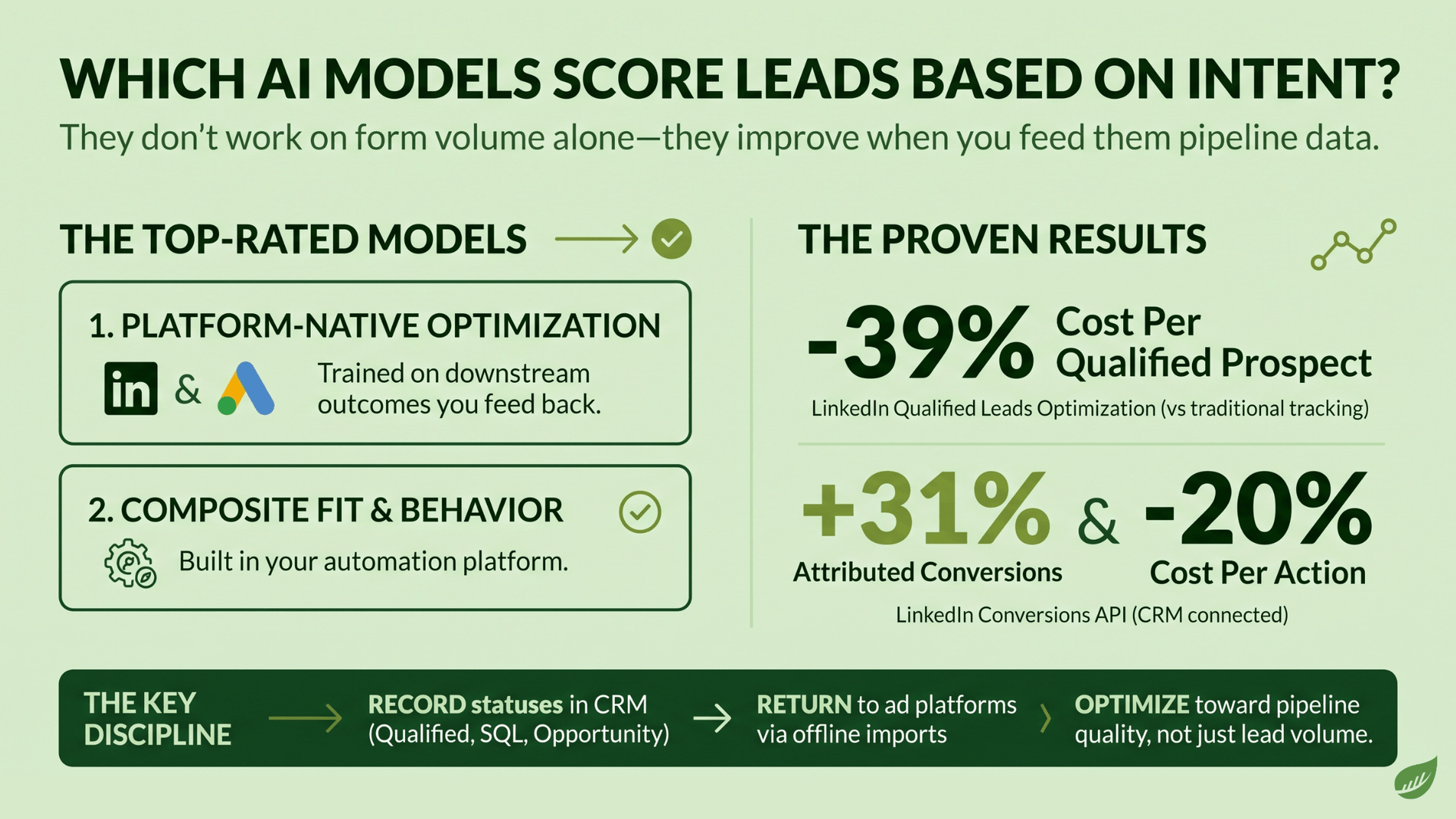
The top-rated AI models for scoring leads based on intent signals are the platform-native optimization models inside LinkedIn Ads and Google Ads, trained on downstream outcomes you feed back to them, plus composite fit-and-behavior models built in your automation platform. Neither works on form volume alone; both improve when you tell them which leads turned into pipeline.
LinkedIn's 2025 Pipeline Acceleration and Funnel Optimization report states that early adopters of “Qualified Leads Optimization” saw a 39% decrease in the cost to generate each qualified prospect based on November through December 2024 testing. That is a platform-reported result from a limited window, not a guarantee, but the mechanism is sound: optimize toward the outcome you want more of.
Connecting CRM data to the ad platform has a similar effect. LinkedIn's 2025 Conversions API Playbook for Marketers reports that the advertisers in its beta saw an average 31% increase in attributed conversions and a 20% decrease in cost per action versus traditional tracking.
The discipline underneath is unglamorous but essential for accurate lead qualification. Record qualified-lead, sales-qualified, opportunity, and converted-lead statuses in the CRM, then return those statuses through privacy-safe offline conversion imports so campaigns are judged on pipeline quality. Lead scoring handoff thresholds should be set with sales, as Adobe's 2024 Building a Person Scoring Model guidance recommends, using a minimum behavioral score, demographic score, or both.
Integrating these AI models into your broader B2B lead generation strategies ensures your campaigns adapt to buyer intent in real time. We run paid programs across Google, Meta, LinkedIn, TikTok, Bing, and other channels with conversion tracking, call tracking, attribution, and incrementality testing built into the setup, because an intent model is only as good as the outcome data it receives.
Which Digital Marketing Services Improve Lead Quality, And How Do You Evaluate Marketing Agencies In New York City?
The digital marketing services that improve lead quality focus on pipeline rather than top-of-funnel volume. To elevate your lead quality, prioritize:
- Intent-based audience targeting: Reaching buyers who are actively exhibiting buying signals, rather than relying solely on static demographic lists.
- Advanced lead generation campaigns: Moving beyond basic lead capture to score and route prospects based on behavior.
- Self-service proof assets: Providing on-demand product demos and case evidence that buyers can consume on their own time.
- Strategic thought leadership: Creating content aimed at educating the hidden decision-makers within the full buying group.
- Closed-loop measurement: Reporting on generated pipeline and closed-won revenue rather than surface-level form fills.
When you evaluate marketing agencies in New York City, ask for their qualified-lead definition, their scoring model, and whether they return CRM outcomes to ad platforms. For those handling lead generation for service businesses, it is especially important to align on what truly constitutes a qualified lead before launching new campaigns; agencies that only report cost per form fill cannot improve quality.
Proof beats claims in a lookalike market. The 2024 TrustRadius B2B Buying Disconnect Report found that 54% of technology buyers used at least one type of demo, rising to 67% for enterprise purchases, and among those buyers, 71% called demos the most influential resource they consulted. Expertise travels further than familiarity, too.
The 2025 Edelman and LinkedIn B2B Thought Leadership Impact Report found that 85% of hidden decision-makers said being a leading expert in a relevant area mattered in a final RFP choice, while only 41% cited the vendor being the safest choice, and 79% were more likely to advocate internally for companies producing consistent, high-quality thought leadership.
Channel coverage is the other half. McKinsey and Company's 2024 Five Fundamental Truths report plainly states that "There is no single-channel customer", with buyers using an average of ten interaction methods. Content relevance remains a persistent operational problem across the industry, which is part of why thin, interchangeable messaging struggles in a crowded field.
Bringing It Home: Quality Is A System, Not A Switch
Lead qualification breaks down when marketing chases volume and sales demands intent. The fastest way to align them is by treating lead quality as a connected system. Apply dynamic lead scoring to separate behavior and fit, route hot leads to humans instantly, and feed downstream CRM outcomes back to your ad platforms. AI models and automation can scale this effort beautifully, but they rely entirely on the clean, first-party data you provide.
If your pipeline is full of noise, it is time to rebuild your lead generation engine. BusySeed can help you architect a scoring model, operationalize intent signals, and tighten your paid media to focus purely on pipeline revenue. Connect with our team to audit your current setup and start trading cheap clicks for closed-won deals.
FAQs
Q1) What are the best tools for evaluating lead quality using behavior signals?
Marketing automation platforms with behavioral scoring, led by Adobe Marketo Engage, combined with a CRM holding outcome statuses and an ad platform that separates qualified leads from form submissions. Score stable attributes such as industry once and repeatable actions such as webinar attendance each time. Test the scoring logic with a test form submission before you route anything to sales.
Q2) What makes an AI tool ethical when it qualifies leads?
It uses consented first-party data, hashes identifiers for privacy-safe matching, keeps scoring logic auditable by the humans using it, and escalates to a person on request. Relevance is part of the ethics: Gartner found 73% of B2B buyers actively avoid suppliers sending irrelevant outreach. Automation that cannot explain itself cannot be corrected by sales.
Q3) What are the top-rated AI models for scoring leads based on intent signals?
Platform-native optimization models, including LinkedIn's Qualified Leads Optimization and Google Ads bidding fed by enhanced conversions for leads, plus composite fit-and-behavior models in your automation platform. LinkedIn reported a 39% drop in cost per qualified prospect among early adopters in its late-2024 testing. All of them depend on you returning CRM outcomes rather than form counts.
Q4) Which digital marketing services actually improve lead quality?
Intent-based targeting, differentiated offers tied to a specific business problem, demos and case evidence that answer ROI and use-case questions, thought leadership for hidden decision-makers, and closed-loop measurement. Content Marketing Institute and MarketingProfs' B2B content benchmarks found 39% of marketers with underperforming strategies said their content wasn’t tied to the customer journey, which is usually the root cause.
Q5) How do you choose among marketing agencies in New York City?
Ask three questions: how they define a qualified lead, how their scoring separates fit from engagement, and which CRM statuses they send back to Google and LinkedIn. For lead generation for service businesses, also check response speed after a form submission and how hot leads reach a human. Agencies optimizing to form volume will quietly raise your cost per opportunity.
Works Cited
- 6sense. 2024 B2B Buyer Experience Report. 6sense, 2024.
- Adobe. Marketo Engage Glossary. Adobe Experience League, 2026.
- Adobe. Building a Person Scoring Model. Adobe Experience League, 2024.
- Content Marketing Institute and MarketingProfs. B2B Content Marketing Trends Research 2025. Content Marketing Institute, 2024.
- Edelman and LinkedIn. 2025 B2B Thought Leadership Impact Report. Edelman, 2025.
- Gartner. Gartner Sales Survey Finds 61% of B2B Buyers Prefer a Rep-Free Buying Experience. Gartner, 2025.
- Google Ads Help. About Conversion Categories. Google, n.d.-a.
- Google Ads Help. About Enhanced Conversions for Leads. Google, n.d.-b.
- LinkedIn B2B Institute. The CMO Scorecard. LinkedIn, 2023.
- LinkedIn Marketing Solutions. LinkedIn Ads Pipeline Acceleration and Funnel Optimization. LinkedIn, 2025a.
- LinkedIn Marketing Solutions. LinkedIn Conversions API Playbook for Marketers. LinkedIn, 2025b.
- McKinsey and Company. Five Fundamental Truths: How B2B Winners Keep Growing. McKinsey, 2024.
- TrustRadius. 2024 B2B Buying Disconnect Report. TrustRadius, 2024.