TL;DR
- 6sense's The B2B Buyer Experience Report for 2025 found buyers chose a vendor from their day-one shortlist 95% of the time in 2025, up from 85% the year before, which makes pre-contact preference the real battleground.
- LinkedIn's Better, Bolder B2B Branding report proves a 2.3% bottom-funnel response rate among audiences with prior brand exposure versus 1.0% for cold audiences in its 2022 North American technology campaigns.
- Content Marketing Institute's B2B Content Marketing Trends Research 2025 found 87% of B2B marketers said content built awareness, but only 49% said it generated sales or revenue, and 56% struggled to attribute ROI.
- The same Content Marketing Institute research demonstrates search engine marketing was the best-performing paid content channel for 61% of B2B marketers, ahead of social advertising at 49% and display at 35%.
Plenty of brands are known. Far fewer are chosen. Lead qualification is the process of deciding which of your inbound contacts actually match a buying situation worth pursuing, and it is the hinge where recognition either turns into revenue or quietly evaporates. 6sense's 2025 report proves most of the decision happens before anyone fills out a form, and most measurement systems never see it.
This post walks through what the evidence says about buyer behavior, search visibility, paid media strategy, behavioral lead scoring, and funnel instrumentation, so you can find the specific place where recognition stops converting into pipeline.
Why Does Recognition Outpace Lead Qualification?
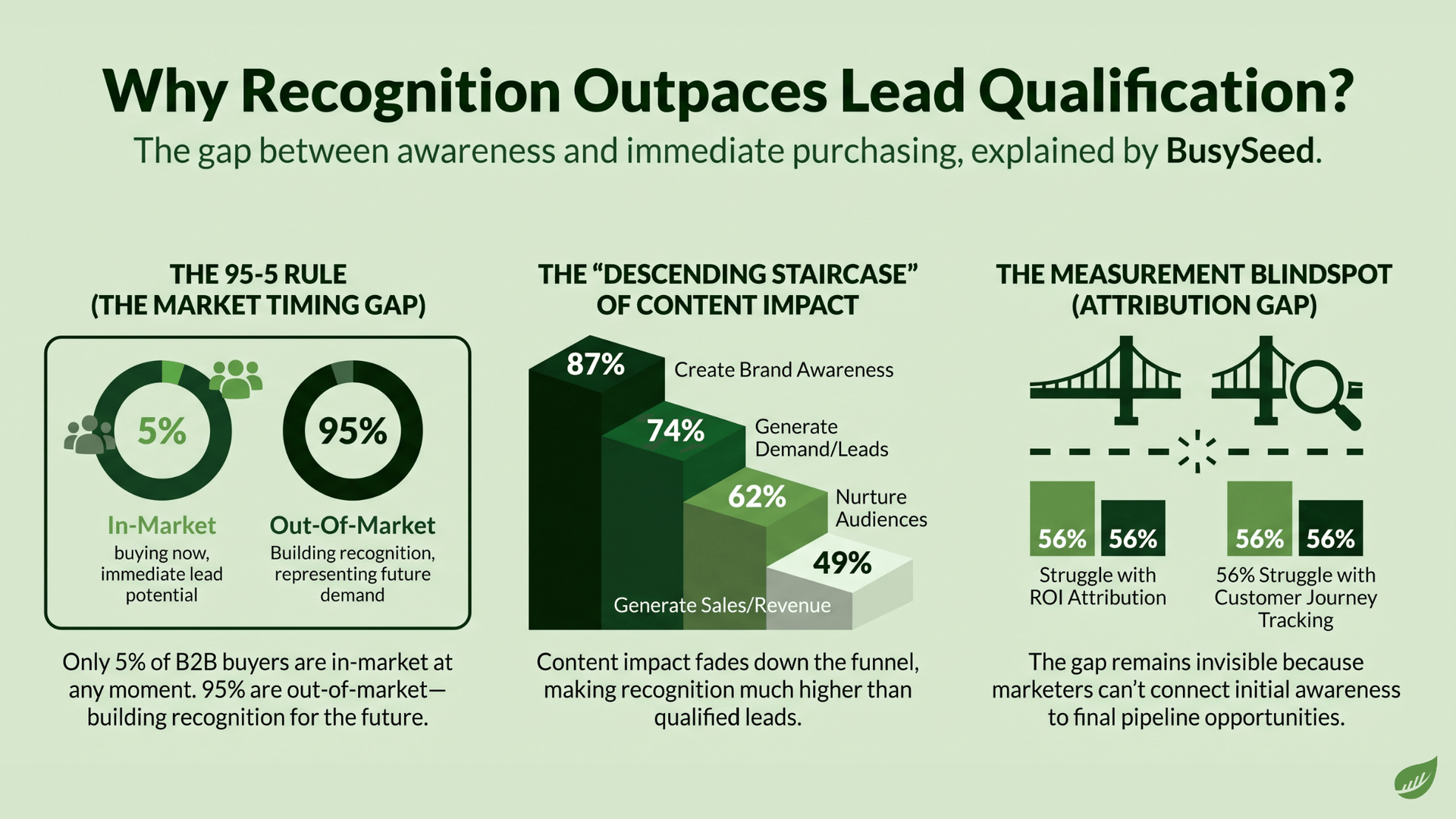
Recognition grows without producing more qualified leads because brand awareness and purchase intent operate on different clocks, and most measurement systems only count the second one. LinkedIn's B2B Institute describes the 95-5 Rule in LinkedIn's The CMO Scorecard: roughly 5% of potential B2B buyers are in market at any moment, while 95% are out of market and represent future demand. Reaching the 95% is not wasted spend, but it will not show up as a lead this quarter.
The survey data shows the same split from the practitioner side. In Content Marketing Institute's B2B Content Marketing Trends Research 2025, 980 respondents revealed a descending staircase of content performance over the prior 12 months. This gap in numeric form looks like this:
- 87% said content marketing helped create brand awareness.
- 74% said it generated demand or leads.
- 62% said it nurtured audiences.
- Only 49% said it generated sales or revenue.
What makes it hard to diagnose is measurement, not effort. The same research found 56% of B2B marketers cited difficulty attributing ROI to content and 56% cited difficulty tracking customer journeys. If you cannot connect content exposure to lead progression to opportunity creation, the awareness-to-acquisition gap stays invisible until a board meeting.
We see this pattern repeatedly across client engagements at BusySeed: strong reach, thin pipeline, and no instrumentation in between. Prior exposure does pay off, though. LinkedIn's Better, Bolder B2B Branding Whitepaper puts it bluntly: "Strong brands have fatter pipelines."
What Are The Most Effective Strategies For Converting Brand Awareness Campaigns Into Measurable Lead Generation?
Earning day-one shortlist placement, matching conversion offers to buyer readiness, nurturing the majority until they become a qualified lead, and instrumenting progression from visit all the way to closed revenue are the levers that make these campaigns measurable. The single biggest shift is measuring the right outcome. As 6sense's The B2B Buyer Experience Report for 2025 states: "Measure success by shortlist placement and win rate; not raw lead counts."
That advice follows directly from the data. 6sense surveyed nearly 4,000 buyers and found they evaluated an average of 5.1 vendors, had prior experience with 3.8 of them, and placed 3.6 on a shortlist on day one. The winner came from that day-one shortlist 95% of the time in 2025, up from 85%. Awareness campaigns, in other words, are shortlist campaigns.
Four practical moves follow:
- Define the commercial conversion chain: Ensure terms like inquiry, qualified lead, sales-accepted lead, opportunity, customer, revenue, and acquisition cost mean the exact same thing across all teams.
- Design conversion paths around value exchange: Match offers (e.g., newsletter, research download, assessment, consultation, demo, or RFP) to buyer readiness rather than forcing a single demo button on everyone.
- Build intent-driven nurture paths: Address the buyer's next logical decision instead of just repeating promotional messages.
- Feed qualified outcomes back to ad platforms: Close the loop by sending revenue and pipeline data back to your advertising channels to train the algorithms.
Speed matters too. 6sense reported nearly 80% of seller conversations were buyer-initiated in 2025, and the vendor contacted first won eight out of ten deals. Being easy to contact early is a conversion strategy, not a courtesy. If you need help designing these readiness-matched conversion paths, explore our services at BusySeed to see how we align content with buyer intent.
What Are The Best Tools For Evaluating Lead Quality Using Behavior Signals?
The best tools for evaluating lead quality based on behavior signals are funnel analytics that track step-by-step progression, CRM stage data that records what happens after the form fill, and conversion import systems that return real outcomes to your ad platforms.
Google Analytics 4 is the practical starting point. Google Analytics Help's Create a Custom Funnel Report guide explains that the custom funnel report lets teams visualize the steps users take to complete a task and see how many drop off between each one to reduce inefficient or abandoned journeys.
The configuration limits are worth knowing before you design anything. Google Analytics Help's Funnel Exploration guide states that GA4 funnel explorations support up to 10 steps and up to four segments, which means you can compare the same journey by acquisition campaign, audience, device, or landing page side by side. Google Analytics Help's Measure a Lead Generation Funnel guide supplies a worked example using stages like website visits, form views, and form submissions.
Treat that as the floor, not the ceiling. A revenue-focused business should continue measurement into lead qualification, opportunity, and closed revenue inside the CRM, because behavior signals only become lead quality when they correlate with deals that close. The signals worth scoring are the ones tied to selection behavior. Focus on capturing:
- Repeat visits from the same domain.
- High-intent page views on pricing and comparison pages.
- Research downloads indicating active solution evaluation.
- Engagement depth among your intended account list.
Then close the loop. Google Ads Help's Offline Conversion Imports FAQ recommends starting with enhanced conversions for leads if you have not adopted offline conversion import, and notes the setup supports more durable reporting, including engaged-view and cross-device conversions.
What Are The Best AI Solutions For Targeted Advertising And Paid Media Strategy?
The best AI solutions for targeted advertising in 2026 are the automated bidding and audience systems inside major ad platforms, and their accuracy depends entirely on the quality of the conversion data you feed them. A paid media strategy built on form fills teaches the algorithm to find more form fills. One built on imported qualified leads and revenue teaches it to find buyers.
Google is specific about the mechanics. Google Ads Help's Offline Conversion Imports FAQ advises uploading conversions at least daily when possible, using a consistent schedule if daily is not feasible, and uploading all conversions with values when using value-based bidding. That cadence is the difference between an AI system optimizing toward pipeline and one optimizing toward noise.
Channel mix still matters alongside automation. Content Marketing Institute's B2B Content Marketing Trends Research 2025 found 84% of B2B marketers used paid channels. When looking at adoption versus performance, the data reveals a clear hierarchy:
- Top Channels Used:
- 73% used social advertising or promoted posts.
- 64% used search engine marketing (SEM/PPC).
- 62% used digital display.
- 62% used sponsorships.
- Best-Performing Channels:
- 61% named SEM or PPC their best-performing paid channel.
- 49% named social advertising.
- 48% named sponsorships.
- 35% named digital display.
Give each channel a defined job: broad, relevant reach to build future demand among the out-of-market 95%, intent capture for buyers actively researching, and remarketing or account-based programs to reconnect prior visitors with the next useful resource. Buyer scrutiny of AI itself is now part of the picture. 6sense's The B2B Buyer Experience Report for 2025 found that 58% of buyers engaged vendors earlier specifically to evaluate how AI is implemented within the solutions they were considering.
What Digital Marketing Services Close The Gap Between Search Visibility And Customer Acquisition Strategy?
The digital marketing services that close this gap are intent-staged SEO, conversion-path design, nurture programs, and funnel instrumentation working as one customer acquisition strategy rather than four disconnected retainers. Google Search Central's Search Documentation defines search engine optimization as increasing the visibility of website pages in search engines "in order to attract more relevant traffic". Relevant is the operative word.
Audit your search visibility across the five core intent stages:
- Early education: Target top-of-funnel queries (e.g., "what is", "how to") with guides and industry reports that help buyers name and define their core problem.
- Solution exploration: Map content to category-level searches where buyers are actively researching different methodologies or tool types to solve that problem.
- Vendor comparison: Capture mid-funnel "vs." queries, competitor alternatives, and feature comparisons to ensure you make the day-one shortlist.
- Implementation concerns: Address specific buying friction points with technical documentation, integration guides, and security FAQs.
- Conversion intent: Optimize bottom-of-funnel landing pages to capture high-intent transactional terms like "pricing", "consultation", or "demo".
Most sites are strong at the first and the last stages, but nearly empty in the middle. This is a critical gap, since buyers build their shortlist during this research.
6sense's The B2B Buyer Experience Report for 2025 reported buying cycles shortened from 11.3 months in 2024 to 10.1 months in 2025, and first seller contact moved from 69% to 61% of the journey, roughly six to seven weeks earlier. Less time means fewer chances to be discovered.
Audit your content against Google Search Central’s core guidelines to ensure your visibility survives algorithmic updates:
- Keyword Alignment: Google Search Essentials advises using the exact words people use to find your content within titles, headings, alt text, and link text.
- Content Quality: The "Creating Helpful, Reliable, People-First Content" guide recommends prioritizing the human experience over search engine manipulation.
- Generative AI Rules: The “AI Features and Your Website” guide warns against spinning up mass variations of pages for every slight query difference.
- Technical Health: Your site must be secure, fast, accessible, and fully responsive across all devices.
When deciding who should execute these services, businesses searching for the best digital marketing agency in NYC should ask how a partner measures success, not just how many channels it manages. The best digital marketing agency will talk about shortlist placement, opportunity creation, and win rate rather than lead volume, and will show how it instruments the CRM from first click through closed revenue.
An agency that only reports impressions and clicks has not connected its work to the commercial conversion chain described above. At BusySeed, we bridge that gap by tying every digital marketing effort directly to your pipeline and revenue goals.
Bringing It Together
Awareness without measurement is just noise, and leads without intent are a waste of your sales team's time. The businesses winning in 2026 are the ones that connect the dots: earning day-one shortlist placement, utilizing behavioral signals over vanity metrics, and feeding real pipeline outcomes back into their ad platforms as part of a unified customer acquisition strategy. When you instrument the full journey from first click to closed revenue, the gap between brand awareness and acquisition finally disappears.
If you need a partner to align your search visibility, paid media strategy, and funnel instrumentation, BusySeed can help. We design customer acquisition strategies that focus on shortlist placement, opportunity creation, and closed-won revenue, not just raw lead volume. Ready to turn recognition into pipeline? Connect with us to audit your funnel and build a measurable path to growth.
FAQs
Q1) What are the best tools for evaluating lead quality using behavior signals?
GA4 funnel explorations, CRM stage tracking, and ad-platform conversion imports together form the practical toolkit. GA4 supports up to 10 funnel steps and four comparison segments, so you can see where specific audiences drop off. Extend measurement past the form submission into qualification, opportunity, and closed revenue, because a behavior signal only identifies a truly qualified lead when it predicts a deal. Proper lead qualification requires this closed-loop reporting.
Q2) What are the best AI solutions for targeted advertising?
The automated bidding and audience targeting systems inside Google Ads and the major social platforms perform best when fed qualified outcomes rather than raw form fills. Google advises uploading offline conversions at least daily, on a consistent schedule, and with values attached when using value-based bidding. Buyers are scrutinizing AI too: 58% told 6sense they engaged vendors earlier to evaluate AI implementation.
Q3) What digital marketing services actually move pipeline?
Intent-staged search content, a defined paid media strategy, readiness-matched conversion paths, nurture sequences, and full-funnel instrumentation. Content Marketing Institute found that only 29% of B2B marketers rated their content strategy extremely or very effective, with 58% calling it moderately effective and unclear goals a leading cause. Services bought as separate line items rarely fix that; the chain has to be designed end to end.
Q4) How do I choose the best digital marketing agency in NYC?
Ask how the agency measures success. An agency aligned with current buyer behavior will talk about shortlist placement, opportunity creation, and win rate rather than lead volume, and will show you how it instruments the CRM.
Q5) How can brand awareness campaigns convert into measurable lead generation?
Earn day-one shortlist placement, make early contact easy, match conversion offers to buyer readiness, nurture buyers who are not ready, and instrument progression from visit to revenue. 6sense found that 95% of 2025 winners came from the day-one shortlist and that the first vendor contacted won eight of ten deals. Judge campaigns on pipeline contribution, not impressions.
Works Cited
- 6sense. The B2B Buyer Experience Report for 2025. 2025.
- Content Marketing Institute. B2B Content Marketing Trends Research 2025. 2025.
- Google Ads Help. Offline Conversion Imports FAQ. n.d.
- Google Analytics Help. Create a Custom Funnel Report. n.d.-a.
- Google Analytics Help. Funnel Exploration. n.d.-b.
- Google Analytics Help. Measure a Lead Generation Funnel. n.d.-c.
- Google Search Central. AI Features and Your Website. 2026a.
- Google Search Central. Creating Helpful, Reliable, People-First Content. 2026b.
- Google Search Central. Google Search Essentials. 2025a.
- Google Search Central. Search Documentation. 2025b.
- LinkedIn B2B Institute. Better, Bolder B2B Branding. 2024.
- LinkedIn B2B Institute. The CMO Scorecard. 2023.