
TL;DR
- Email automation generates 16x more revenue per send ($2.87 vs. $0.18) and 19x higher conversion rates than scheduled blasts (Omnisend, 2026).
- Roughly 70% of email opens now come from Apple's privacy proxy, so measure click-to-conversion and revenue per send instead (Validity, 2024).
- Only about 83.5% of emails reach the inbox globally, with spam placement nearly doubling to 8.6% by Q4 2024 (Validity, 2025).
- Gmail aims to keep spam complaints below 0.1% and requires one-click unsubscribe for promotional mail (Google, n.d.).
- Email ROI still ranges from 10:1 to 36:1, but you have to prove it, and measurement maturity is lagging (Mailgun, n.d.; Litmus, 2025).
U.S. Email Marketing Strategies That Convert in 2026: From Casual Interest to Action
Email marketing is a direct-response channel that moves prospects from casual interest to measurable action by delivering timely, personalized messages at each stage of the buying decision.
That definition matters more in 2026 than it did five years ago because the mechanics under the hood have shifted hard:
- The inbox got stricter.
- Open rates got noisier.
- And email automation quietly became the place where actual revenue happens.
If your email marketing strategy still centers on sending a nice monthly newsletter and hoping for clicks, you're playing a game that no longer exists.
Here's the uncomfortable part. Most teams are still optimizing for the wrong scoreboard. They celebrate a high open rate while their nurture sequence leaks buyers at every stage, and no one's watching.
We want to walk you through what's actually changed, what to measure instead, and how to build email marketing campaigns that earn the next step from a real human. We help run these programs at BusySeed, ranked the #1 Growth Group in the U.S. by TrustAnalytica, across 500+ businesses; so much of this comes from observing what breaks and what compounds.
Why Are Open Rates a Bad Way to Measure Email Marketing Now?
Open rates are unreliable in 2026 because roughly 70% of opens are now generated by Apple's Mail Privacy Protection proxy rather than by a human actually reading your message (Validity, 2024).
That means a beautiful 40% open rate is mostly due to machines pre-fetching your images. The number looks like performance. It behaves like fog.
We will say the thing the industry hates hearing: the open rate should be treated as a directional signal, not a KPI you report to leadership. When Apple started preloading email content to mask user behavior, it inflated "average" opens across the board, so year-over-year open comparisons quietly stopped meaning what they once did.
So what do you track instead?
- Click-to-conversion rate
- Revenue per send
- Reply rate
- Booked-appointment rate
Those are behaviors a proxy server can't fake. And the shift toward measuring them isn't just cleaner data hygiene; it's where the money actually shows up.
Even as shoppers clicked less often, click-to-conversion rose 53% year over year, moving from 5.9% to 9% (Omnisend, 2026). Fewer clicks, but each click carries far more intent. A click is now a raised hand, not a shrug.
This trend underscores why an effective email marketing strategy must prioritize quality over quantity; each interaction should guide the buyer closer to action, not just inflate vanity metrics.
That said, don't throw open rate in the trash entirely. It still tells you something about deliverability trends and subject-line resonance over time. Just stop pretending it predicts revenue. Email ROI still ranges from 10:1 to 36:1, but you have to prove it, and right now, measurement maturity is lagging across the industry (Mailgun, n.d.; Litmus, 2025).
If you are ready to pivot away from vanity metrics and build a system that tracks actual pipeline growth, explore how our comprehensive digital marketing services at BusySeed turn clicks into qualified customers.
What Actually Moves Buyers From Interest to Action?
Email automation moves buyers from interest to action more effectively than any other email format, and the gap is not small.
Automated emails averaged $2.87 per send, compared with $0.18 for scheduled campaign blasts. This works out to 16 times higher revenue per send, and those automations drove 19 times higher conversion rates (Omnisend, 2026). One-time newsletters get attention. Automated flows get outcomes.
Think about why. A scheduled campaign fires when your calendar says so. An automated flow fires when the buyer takes an action, so it arrives exactly when interest is hottest.
Behavior-triggered timing beats calendar timing almost every time, and the 16x number represents that difference in dollars.
For example, a well-structured email automation sequence can dynamically adjust content based on user behavior, such as browsing history or past purchases, ensuring each message feels relevant and timely. This level of personalization is nearly impossible to achieve with static campaign blasts, which is why email automation has become the backbone of high-performing email marketing campaigns.
Here's a field observation from a program we rebuilt last year. The client had a solid list and a decent newsletter, but almost no flows.
We added a welcome sequence, a browse-abandon follow-up, and a re-activation path. Within a couple of months, the automated messages, a small fraction of total sends, were driving the majority of email-attributed conversions. The newsletter didn't get worse. It just stopped being the whole strategy.
Because of that, we tell people to flip their mental model. Build your automations first as the conversion engine, then use campaign sends as air cover for awareness, launches, and seasonal pushes.
The flows below are where we would start, and they adapt cleanly from ecommerce to B2B and service businesses:
- Welcome / onboarding: set expectations and capture preference data early
- Intent-based follow-up: triggered when someone views a product, starts a quote, or hits a key page
- Drop-off rescue: cart, form-start, scheduler-start, or quote-start abandonment
- Post-purchase: usage tips, reorder reminders, reviews, and referral asks
- Reactivation: a sunset policy plus a genuine win-back offer before you suppress
Building these behavior-triggered flows takes strategic heavy lifting, but it is the fastest way to scale your revenue. See how our team at BusySeed architects custom email automation frameworks to do the selling for you while you sleep.
The Micro-Commitment Ladder: Stop Asking for the Whole Sale
The most effective 2026 email marketing campaigns ask for one small step at a time rather than pushing a single, giant call to action.
Each email earns a reply, a preference selection, a quiz answer, or a scheduler click, and automation compounds those micro-yeses into a decision. This works because clicks now signal high intent, so you want to design for more meaningful clicks, not more noise.
The ladder we use looks like this:
- Email one asks the reader to choose their number-one priority, which segments them by what they click.
- Email two shows the two options that match that priority using a dynamic content block.
- Email three delivers a single, unmistakable CTA: pick a time, claim the incentive, or confirm fit.
Each message does one job. Nobody's asked to leap the whole canyon in a single email.
But this isn't a fix for a weak offer. If your product doesn't solve a real problem, a clever ladder just gets people to the truth faster. Micro-commitments accelerate good decisions. They don't manufacture demand that isn't there.
Deliverability Is a Growth Strategy, Not a Technical Chore
Deliverability is now a competitive growth lever because a large share of sent emails never reaches the inbox.
Global inbox placement was roughly 83.5% in 2024, with about 6.7% landing in spam and 9.8% going missing entirely due to blocks or rejections (Validity, 2025). That's your funnel leaking before "interest to action" even begins. You can have the best sequence in the world, but it doesn't matter if a chunk of it is talking to an empty room.
It got worse during high-volume periods, too. Spam placement nearly doubled from 4.5% in Q1 2024 to 8.6% in Q4, which means even "accepted" mail increasingly slid into junk during peak season (Validity, 2025). So the moment you most want to reach people (holidays, launches, promotions) is exactly when the inbox squeezes hardest.
The mailbox providers also stopped being polite about it (Google, n.d.; Validity, 2025):
- Gmail now advises senders to keep their user-reported spam rate below 0.1% and explicitly warns against letting it hit 0.3% or higher, while requiring one-click unsubscribe for promotional mail.
- This matters even more because Gmail now makes up more than half of the average US sender's list. For a lot of brands, Gmail's rules effectively are the rules.
Yahoo aligned with the same timeline, with enforcement beginning in February 2024 and List-Unsubscribe policy enforcement in June 2024 (Yahoo, 2024).
Microsoft joined as well, and its guidance on the 550 5.7.515 non-delivery error states that high-volume senders need DMARC validation with SPF and/or DKIM alignment (Microsoft, n.d.). Authentication alignment isn't a nice-to-have anymore. It's the ticket in the door.
And the legal floor still has teeth. The FTC cites CAN-SPAM penalties up to $53,088 per violating email, and yes, that law applies to B2B mail too (U.S. Federal Trade Commission, 2023). One sloppy list purchase can get very expensive very fast.
A Deliverability Checklist Worth Running Before Your Next Send
Run through these before you scale volume. This is the exact hygiene sequence we hand to teams inheriting a messy sending domain:
- Set up SPF, DKIM, and DMARC, and confirm they're aligned to your From domain.
- Confirm DMARC is at a policy stronger than none if you send at high volume.
- Add RFC 8058-style one-click unsubscribe headers, not just a footer link.
- Build a preference center with opt-down options so people dial back instead of reporting spam.
- Suppress chronic non-engagers before mailbox providers do it for you.
- Warmly send new domains and IPs gradually, instead of blasting on day one.
- Monitor your spam complaint rate weekly and treat 0.1% as your red line.
- Segment high-volume seasonal sends by engagement to protect inbox placement.
- Watch your missing/blocked rate, not just spam, since nearly 10% of mail vanishes silently.
- Re-verify list hygiene quarterly, removing hard bounces and stale addresses.
Navigating strict inbox rules requires more than just a quick DNS update. Discover how our technical specialists at BusySeed can audit and protect your sender reputation to ensure your next major launch actually reaches your audience.
Personalization and Trust: Timely and Relevant Beats More Emails
Personalization now drives buyer trust more than send frequency, and buyers can feel the difference. The share of customers who feel they are treated as unique individuals jumped from 39% in 2023 to 73% in 2024 (Salesforce, 2026). People notice when a brand actually gets them. They also notice when it doesn't, and they punish the miss.
Here's the tension you have to hold. That same research found 71% of customers are increasingly protective of their personal information (Salesforce, 2026). So the appetite for relevance is rising at the exact moment the appetite for surveillance is falling.
The winning move is a visible value exchange:
- Tell people why they're receiving a message.
- Let them manage preferences rather than only unsubscribe.
- Use their data in ways that clearly benefit them.
AI transparency belongs in that trust conversation now, and this is where we will get a little contrarian. A lot of marketers are quietly automating replies and recommendations with AI email tools and saying nothing about it. We think that is a mistake.
73% of customers say it's important to know whether they're talking to an AI agent (Salesforce, 2026). Disclosing an AI assist and keeping a human accountable for it isn't a weakness. In 2026, it's a trust signal, and we would bet it becomes a differentiator before it becomes a regulation.
Optimize for the Post-Open Reality
Your email's first two or three lines now matter more than your full creative, because inbox tools summarize and sort mail before a human decides to engage.
Apple's move toward tabbed inbox categorization and Apple Intelligence email summaries means an AI may describe your email to the recipient before they ever open it (Validity, 2025). Your subject line and preview text are no longer the whole first impression. The summary is.
So write the "so what" up top. Lead with the value and the proof, put one primary CTA above the first scroll, and make the next step frictionless with a deep link straight to the scheduler, product, or booking page.
Scannable proof blocks help too:
- A specific outcome
- A short review
- A quick FAQ
If a summary engine has to guess what your email offers, you've already lost some readers.
Case Study: A 33% Open Rate That Signaled Real List Health
A medical optical boutique came to BusySeed with no structured email marketing strategy and no professional newsletter program. We introduced monthly email marketing campaigns built to promote our client's new location and strengthen existing customer relationships.
The most recent newsletter hit a 33% open rate, generating 1,454 opens, and contributed to a measurable lift in both in-store traffic and brand awareness.
Now, let us be honest about that number the way we would want an expert to read it. A 33% open rate is strong, but given Apple's proxy inflation, we will not oversell opens as proof of revenue.
What that consistent engagement suggests is healthy deliverability and genuine list relevance, because inbox placement is volatile and spam placement increases during peak seasons (Validity, 2025). Landing steady engagement in that environment points to list quality, not just a catchy subject line.
Working backward, 1,454 opens at a 33% rate implies roughly 4,400 delivered recipients, so this was a real audience, reached reliably.
Where does it go next? The honest answer is action metrics. For the next iteration, we would:
- Instrument clicks to the directions and appointment-booking pages.
- Add an in-store lift signal, such as a "show this email" offer or a "how did you hear about us" field at the counter.
- Track list health using the spam complaint rate and the 90-day engaged audience trend.
That's how you turn a strong directional metric into a defensible revenue story. If you want help building that measurement layer, our marketing services exist for exactly this kind of buildout.
This optical boutique is just one example of how we translate engagement into measurable growth. Check out BusySeed's full portfolio of case studies to see exactly how we drive in-store and online revenue across dozens of industries.
Newsletter Blasts vs. Automated Flows: A Side-by-Side
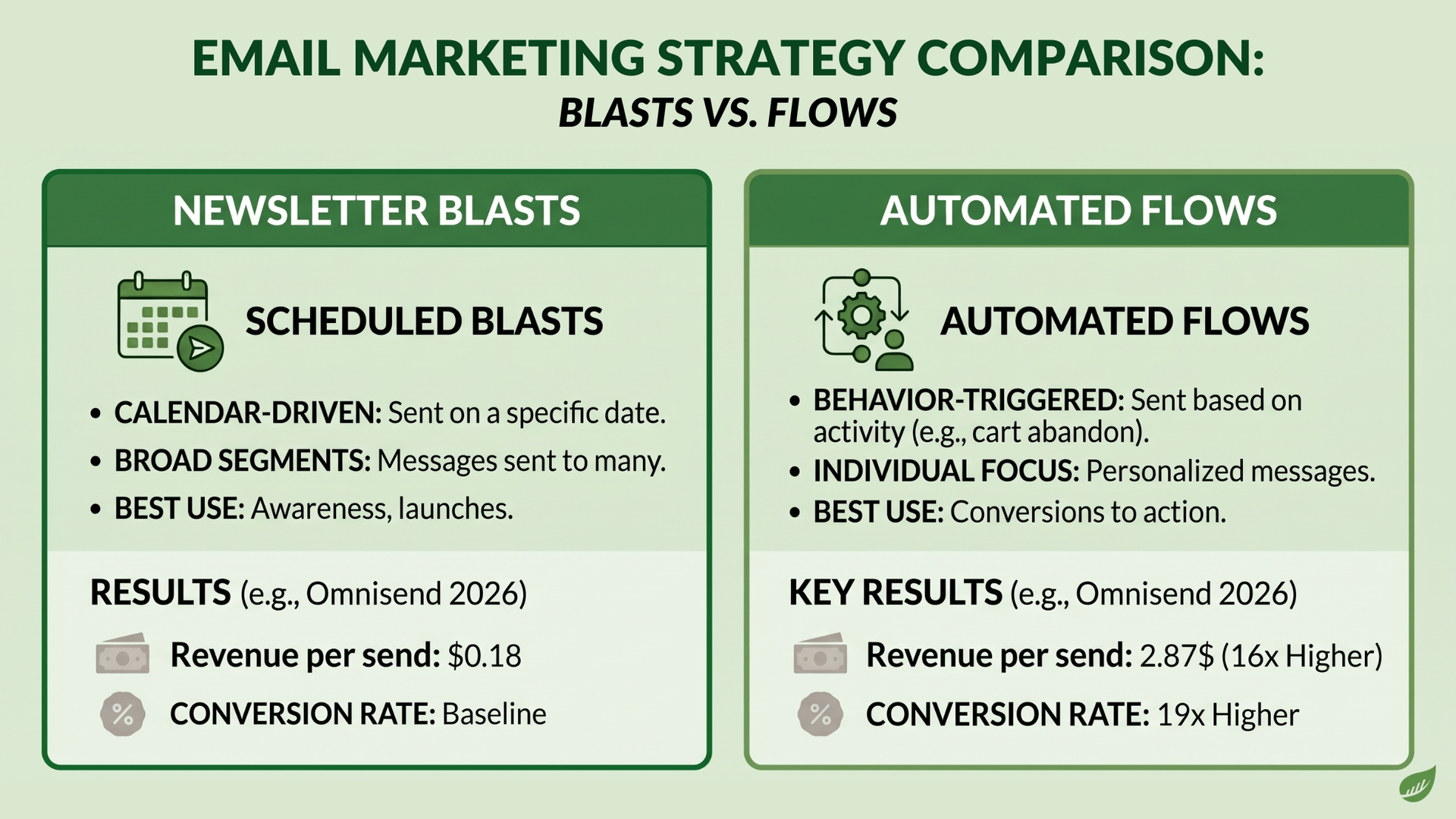
| Factor | Scheduled Campaign Blasts | Automated Flows |
|---|---|---|
| Revenue per send | $0.18 (Omnisend, 2026) | $2.87 (Omnisend, 2026), 16x higher |
| Conversion rate | Baseline | 19x higher (Omnisend, 2026) |
| Timing | Calendar-driven | Behavior-triggered, arrives at peak intent |
| Best use | Awareness, launches, seasonal pushes | Interest-to-action conversion |
| Personalization | Broad segments | Individual behavior and preference |
| Setup effort | Low, ongoing | Higher upfront, compounds over time |
The takeaway isn't "stop sending campaigns". It's that campaigns are the air cover and flows are the engine. Fund them accordingly.
Bringing It Together: Flows Over Blasts
The era of batch-and-blast marketing is over. The brands winning the inbox today rely on behavior-triggered email automation, rigorous deliverability hygiene, and transparent personalization. Open rates no longer tell the true story. You win by guiding users down a micro-commitment ladder, where each click brings them closer to action.
If you want an expert to pressure-test your current email marketing strategy and prioritize the highest-ROI moves, let's talk. We will audit your setup, build a practical automation roadmap, and pilot the changes that matter most. Connect with us at BusySeed to rebuild your conversion engine from the top down. We are ready to help.
Frequently Asked Questions
1. What are the top AI tools for email marketing automation with strong privacy protections in 2026?
The best AI tools combine behavior-triggered email automation with strict consent controls. With 71% of customers protecting their personal data, tools like ActiveCampaign and HubSpot excel by offering granular preference centers and transparent AI email disclosure. Prioritize systems that keep humans in the loop to ensure your email marketing strategy respects privacy while scaling personalized campaigns.
2. What are the recommended tools for humanizing automated emails?
Start by writing from a real person's name and triggering messages based on genuine behavior. Tools like Lemlist or Lavender help craft natural-sounding copy, while platforms like Drift support real-time interactions to complement your email marketing campaigns. The goal is to make your AI email components sound like a helpful individual rather than a scheduled robot.
3. How much do agencies charge compared to email marketing software enterprise rates?
Enterprise platforms like Salesforce Marketing Cloud or Adobe Campaign often range from $1,250 to over $10,000 per month for the software alone. In contrast, agencies offering comprehensive digital marketing services usually charge a project fee or retainer ranging from $3,000 to $20,000+ per month. Partnering with an agency gives you the software expertise, deliverability optimization, and creative execution without the overhead of managing it in-house.
4. Why is my email deliverability dropping even though my content is good?
Deliverability usually drops due to authentication issues or high spam complaints, not creative quality. Ensure your SPF, DKIM, and DMARC align with your From domain, as Gmail and Yahoo now enforce strict rules for high-volume senders. Check your spam rate weekly; keeping it below 0.1% is crucial to any effective email marketing strategy.
5. Should we still send a monthly newsletter in 2026?
Yes, but use it for brand awareness while letting email automation drive the actual conversions. A consistent newsletter builds relationships, which makes your automated flows perform better. For instance, when looking for the best digital marketing agency in NYC, you will find that top firms use newsletters for thought leadership while relying on targeted behavior triggers to seamlessly close deals.
Works Cited
- Google. Email sender guidelines. Google Support. No date (n.d.).
- Litmus. The ROI of Email Marketing. Litmus Blog. 2025.
- Mailgun. 2026 Email Impact Report. Sinch Mailgun. No date (n.d.).
- Microsoft. Fix NDR error 550 5.7.515 in Outlook.com. Microsoft Support. No date (n.d.).
- Omnisend. 2026 Ecommerce Marketing Report. Omnisend Resources. 2026.
- Salesforce. State of the Connected Customer. Salesforce Research. 2026.
- U.S. Federal Trade Commission. CAN-SPAM Act: A Compliance Guide for Business. FTC Business Guidance. 2023.
- Validity. 2025 Benchmark Report. Validity Resources. 2025.
- Validity. The State of Email in 2024: Keeping Ahead of the Curve. Validity Resources. 2024.
- Yahoo. Sender Hub FAQs. Yahoo Sender Hub. 2024.