
TL;DR
- Buyers are multi-touch by default. B2B buyers use an average of ten interaction modes (McKinsey, 2024), and 73% of purchases involve three or more departments (Forrester, 2026).
- Integrated media lifts brand outcomes. A Journal of Marketing analysis of 1,083 global campaigns found that media planning adjustments across traditional and digital channels can produce lifts in awareness or consideration of over 50% (American Marketing Association, 2025).
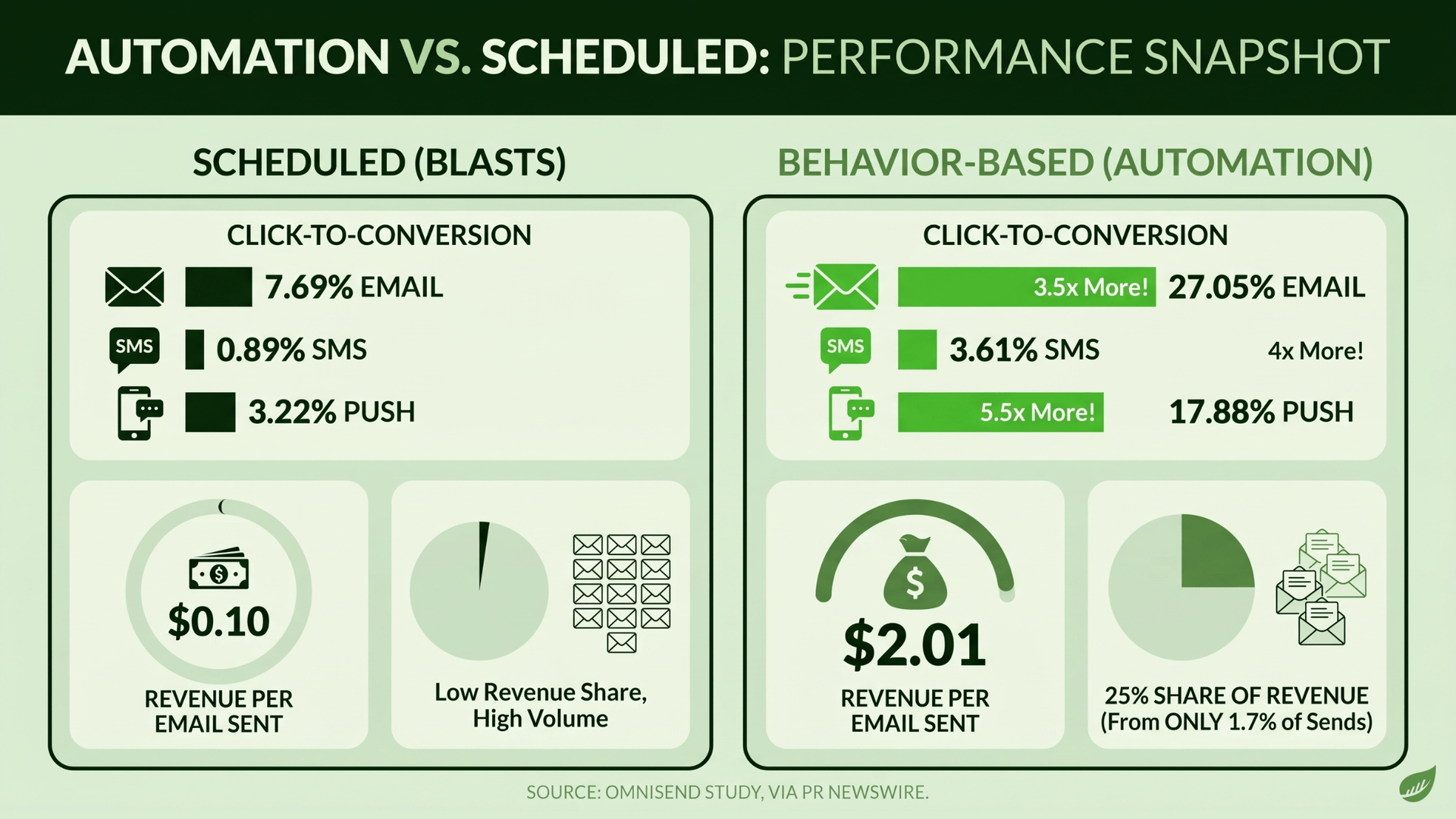
- Orchestration outperforms blasting. Automated emails generated 25% of total email revenue from just 1.7% of sends, at $2.01 revenue per send versus $0.10 for scheduled sends (Omnisend, 2026).
- Data fragmentation is the bottleneck. Only 26% of marketers are completely satisfied with their data unification (Salesforce, 2026), and only 24% report a 360-degree view of their customers (Google, 2025a).
- AI is now a step in the journey. Nearly 40% of U.S. shoppers use AI when shopping (IAB, 2025), and Gartner predicts 60% of brands will use agentic AI by 2028 (Gartner, 2026).
Integrated marketing is a coordinated marketing strategy that connects SEO and digital marketing, paid media, social media marketing, and email into one continuous customer experience rather than isolated channel campaigns.
In 2026, this matters more than ever because buyers no longer move in straight lines. They bounce between search engines, AI assistants, social feeds, inboxes, ads, and websites before they ever decide. According to McKinsey, B2B buyers now use an average of 10 different ways to interact throughout their journey (McKinsey, 2024). A single-channel plan simply cannot meet a buyer who is everywhere at once.
This guide explains why coordinated execution beats channel isolation, backed by recent research, and offers a practical checklist for building an integrated approach that holds up in the real world. If you are tired of disjointed campaigns and want an expert team to build this engine for you, reach out to BusySeed to see how we orchestrate unified customer journeys.
Why Do Buyers Refuse to Behave Single-Channel in 2026?
Buyers refuse to stay on a single channel because their decisions now involve more people, more sources, and more self-directed research than ever before. McKinsey's B2B Pulse research shows that buyers use an average of 10 touchpoints throughout their journey, with the top three being the company website, in-person sales, and video conferencing (McKinsey, 2024). That spread alone tells us that a website-only plan, even one backed by strong SEO and digital marketing, or a sales-only plan leaves gaps a competitor will fill.
The buying group has grown incredibly crowded and complex. Forrester's recent research highlights exactly how B2B purchasing has shifted:
- Committees are expanding: 73% of purchases now involve three or more departments (Forrester, 2026).
- Decisions require a crowd: An average of 13 internal stakeholders and 9 external individuals shape the final decision (Forrester, 2026).
- Younger buyers rely on outsiders: Half of younger buyers consult 10 or more external influencers, and over 50% lean on external sources such as social media (Forrester, 2024).
- High-ticket self-serve is the norm: More than half of B2B transactions over $1M now occur through digital self-serve channels such as websites and marketplaces (Forrester, 2024).
Ultimately, buyers want to research quietly, validate through multiple sources, and speak to a company only on their own terms. Companies are no longer marketing to a single person; they are marketing to a massive, self-directed committee.
That preference is measurable. A Gartner survey of 632 B2B buyers found that 61% prefer an overall rep-free buying experience (Gartner, 2025). A rep-free experience only works if channels are aligned, which is exactly where single-channel thinking falls apart.
What Is the Difference Between Multichannel, Cross-Channel, Omnichannel, and Integrated Marketing?
These terms describe increasing levels of marketing coordination:
- Multichannel marketing: A brand is present across multiple platforms, but each channel operates in its own silo, lacking a unified marketing strategy.
- Cross-channel marketing: Channels actively reference and hand off to one another, such as a paid media ad that retargets a user based on an email open.
- Omnichannel marketing: The customer experiences one continuous, seamless journey regardless of which platform or device they use to engage.
- Integrated marketing: The operating model behind omnichannel execution. It requires unified data, shared measurement, and a coordinated marketing strategy so that paid media, owned channels, and earned exposure all reinforce a single story.
The distinction matters because presence is not coordination. A truly integrated marketing strategy ensures that being on multiple platforms doesn't result in contradictory messaging. Being on five channels that contradict each other is worse than being on two that align.
Gartner found that 69% of B2B buyers report inconsistencies between information on a sales organization's website and what sellers tell them (Gartner, 2025). That gap is a trust problem born from channels operating in silos.
How Much Better Does Integrated Marketing Actually Perform?
Integrated marketing performs better because coordinated channels compound one another's effects rather than competing for the same attention. The evidence spans brand metrics, revenue per customer, and message orchestration.
On the brand side, coordinated media planning significantly enhances overall performance. A Journal of Marketing study analyzing 1,083 global campaigns revealed two major takeaways (American Marketing Association, 2025):
- The Synergy Effect: Combining traditional media (such as TV and outdoor) with digital channels (such as Facebook and YouTube) yields measurably better results than isolated campaigns.
- The Performance Lift: Simple adjustments to integrate these channels can produce lifts of over 50% in brand awareness or consideration.
That is not a new budget. That is the exact same spend, planned to work together.
On the commerce side, transitioning customers from single-channel to omnichannel behavior yields measurable revenue gains. According to a 2025 SymphonyAI report, this shift delivers (SymphonyAI, 2025):
- 16% growth in spend per customer, driven by an 8% higher shopping frequency and an 8% larger basket size.
- 20% incremental spend compared to a mere 4% cannibalization rate.
The orchestration numbers are the most striking. Across 150,000 brands in the Omnisend dataset, automated behavior-based messaging vastly outperformed standard blasts (Omnisend, 2026):
- Disproportionate Revenue: Automated emails generated 25% of total email revenue despite making up just 1.7% of all email sends.
- Massive Per-Send Value: Revenue per automated send reached $2.01, compared to a mere $0.10 for scheduled sends.
This means that if a prospect engages with your social media marketing, the subsequent automated email they receive should reflect that exact interest. And this is the heart of the email marketing customer journey argument: behavior-triggered messages beat calendar blasts, and they only fire correctly when data flows across channels.
Scheduled Messaging Versus Behavior-Based Automation
The click-to-conversion gap between scheduled and automated messaging shows why an integrated email marketing customer journey outperforms batch sends. The table below uses the Omnisend-reported figures.
| Channel | Automated (behavior-based) | Scheduled (blast) |
|---|---|---|
| Email click-to-conversion | 27.05% | 7.69% |
| SMS click-to-conversion | 3.61% | 0.89% |
| Push click-to-conversion | 17.88% | 3.22% |
| Revenue per email sent | $2.01 | $0.10 |
| Share of email revenue | 25% (from 1.7% of sends) | The majority of sends, a minority of revenue |
Source: PR Newswire coverage of the Omnisend study.
Automation wins on every line because it responds to a real signal a buyer just sent. That signal usually comes from another channel, which is why automation and integration are inseparable. Building triggered flows across email, SMS, and push requires data that spans all three channels rather than residing in a single system. Without that unified data, your email marketing customer journey will inevitably feel disjointed to the buyer.
Why Do Single-Channel Strategies Break Down in 2026?
Single-channel strategies break down because they cannot see or respond to the full buyer journey. Furthermore, most organizations still lack the unified data required to coordinate effectively. A recent Google and BCG research study highlighted this readiness gap (Google, 2025a):
- 42% of surveyed companies lacked a CRM platform, and 57% lacked a CDP.
- 29% of marketers reported limited data availability.
- Only 24% achieved a 360-degree view of their customers.
The readiness gap reappears in Salesforce's findings, with only 26% of marketers completely satisfied with their data unification (Salesforce, 2026).
When data sits in silos, channels cannot communicate with each other, so each optimizes for itself. That produces the contradictions buyers already distrust. Fixing this infrastructure is exactly where our team at BusySeed excels; we help brands unify their CRM and CDP data so every channel operates from a single source of truth.
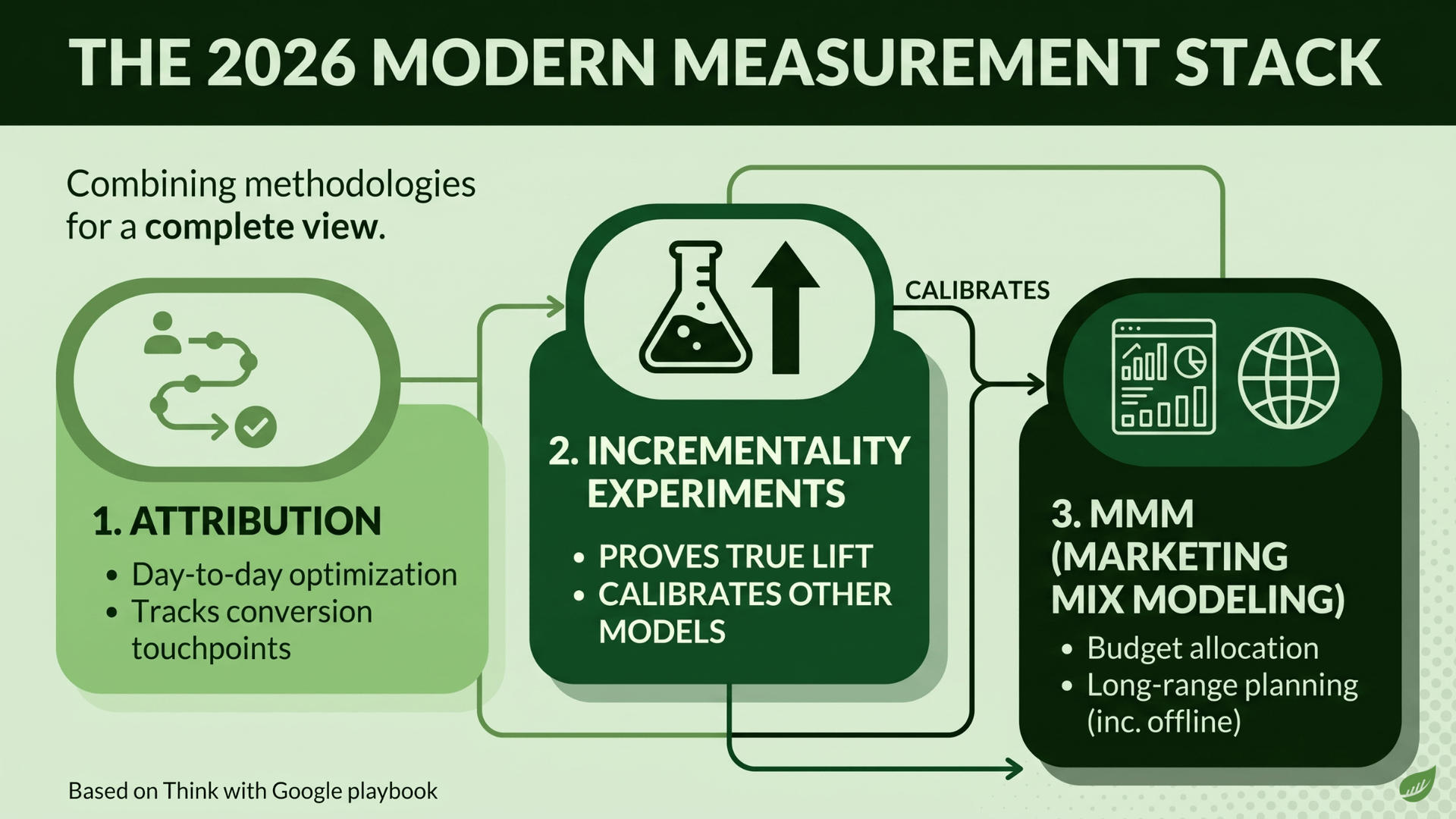
Measurement is the second failure point because channel-only views miss how touchpoints influence one another. A single-channel measurement approach cannot tell us whether paid media created demand or just harvested it. Think with Google states that the future of measurement hinges on integrating three critical elements into a single framework (Google, 2025a):
- Marketing Mix Modeling (MMM). Evaluates how different channels contribute to long-term growth and helps guide broad budget allocation.
- Incrementality testing. Proves true causal lift by determining whether a specific campaign actually drove new conversions.
- Attribution. Tracks the specific touchpoints that directly preceded a conversion to enable day-to-day channel optimization.
Without a unified framework, it becomes impossible to tell if your paid media campaigns are actually driving net-new growth.
What Is the Recommended Measurement Stack in 2026?
The recommended 2026 measurement stack combines attribution, incrementality experiments, and marketing mix modeling, each covering a blind spot the others leave open. Google's Modern Measurement playbook describes using these three approaches together across maturity stages, including calibrating attribution and MMM using incrementality experiments.
| Method | What it answers | Best used for | Limitation |
|---|---|---|---|
| Attribution | Which touchpoints preceded conversions | Day-to-day optimization across channels | Correlation, not causation |
| Incrementality experiments | Did this spend cause added conversions | Proving true lift and calibrating other models | Requires disciplined test design |
| Marketing mix modeling (MMM) | How channels contribute over time, including offline | Budget allocation and long-range planning | Slower, aggregate view |
Source: Think with Google Modern Measurement playbook.
Incrementality is also becoming more practical. Google's May 2025 product update states that the company is making incrementality testing more accessible with lower spend thresholds, alongside cross-channel measurement enhancements in Google Analytics to measure the customer journey and marketing ROI (Google, 2025b).
Platform tooling is closely following the buyer. Google Analytics documentation now outlines a roadmap toward a fully unified future for cross-channel measurement, including the ability to import cost and impression data from Meta, TikTok, Snap, Pinterest, and Reddit (Google Analytics Help, n.d.).
If implementing this three-pronged measurement stack feels overwhelming, BusySeed can help you design customized frameworks that prove the true causal lift of your campaigns.
How Does AI Change the Integrated Journey?
AI changes the journey by adding new touchpoints rather than removing existing ones, which significantly raises the bar for integration. IAB positions AI as a tool used alongside other online services, not a replacement for them, and reports that (IAB, 2025):
- Rapid Shopper Adoption: Nearly 40% of U.S. shoppers now use AI when shopping online.
- Massive Economic Impact: AI is expected to influence more than $260B in global e-commerce during the holiday season alone.
AWS reports that customers who use Amazon's AI shopping assistant, Rufus, are 60% more likely to complete a purchase, and that more than 250 million customers used the tool this year (Amazon Web Services, 2025).
When an AI assistant sits inside the journey, it becomes another surface a message must reach and stay consistent on, right alongside your organic search and social media marketing efforts.
Looking ahead, trust becomes the primary currency in any modern marketing strategy. Staying visible and cited across AI assistants ties directly to cross-platform GEO visibility. Gartner highlights this shift with two key insights (Gartner, 2026):
- Agentic AI Expansion: By 2028, 60% of brands will use agentic AI to facilitate streamlined one-to-one interactions, shifting away from channel-based approaches.
- The Need for Transparency: 78% of consumers say explicit labeling of AI-generated content is very important or the most important factor in maintaining trust.
How Do You Build an Integrated Marketing Strategy? An Eight-Step Checklist
Follow these steps to move from channel silos to a coordinated marketing strategy that reflects how buyers actually behave.
- Map the multi-touch journey and buying group. Document every interaction mode and every stakeholder. Ground this in the reality that buyers use around ten interaction modes (McKinsey, 2024) and that 73% of purchases involve three or more departments (Forrester, 2026), and adjust your marketing strategy accordingly.
- Prioritize self-serve clarity. Because 61% of B2B buyers prefer a rep-free experience (Gartner, 2025), ensure the information buyers find on their own is consistent, as 69% report website-to-seller inconsistencies.
- Fix data fragmentation. Close the gap behind the finding that only 24% of companies have a 360-degree view and only 26% are satisfied with data unification (Google, 2025a; Salesforce, 2026). Decide whether CRM plus a warehouse covers the need or a CDP is warranted.
- Build cross-channel measurement foundations. Link ad platforms to analytics and align conversions with real business goals, following the cross-channel measurement guidance that supports imports from Meta, TikTok, Snap, Pinterest, and Reddit (Google Analytics Help, n.d.).
- Add causal proof with incrementality. Take advantage of lower spend thresholds for incrementality testing, and calibrate attribution and MMM accordingly (Google, 2025b).
- Design media mixes for compounding impact. Plan traditional and digital together to capture the over 50% higher brand lifts that coordinated planning can unlock (American Marketing Association, 2025).
- Orchestrate behavior-based messaging. Replace blasts with triggered flows across email, SMS, and push, given automation's $2.01 versus $0.10 revenue per send advantage (Omnisend, 2026).
- Build trust and governance for AI touchpoints. Treat AI assistants as a channel, since 40% of shoppers already use AI (IAB, 2025), and honor the 78% of consumers who expect clear labeling of AI-generated content (Gartner, 2026).
Which Channels Should You Integrate First?
We must integrate the channels buyers already use most heavily, then connect them with data before adding more. For e-commerce and lead-gen models, prioritizing the website, search, and owned messaging early on is essential. McKinsey notes that in B2B organizations offering these models (McKinsey, 2024):
- E-Commerce Leadership: E-commerce is now the top revenue-generating channel, accounting for more than a third of total revenue.
- In-Person Decline: In-person revenue has declined by 5 percentage points year-over-year.
A practical starting sequence connects different parts of the funnel:
- The Discovery Layer: SEO and digital marketing, plus paid media.
- The Conversion Layer: The email marketing customer journey and site experience.
- The Amplification Layer: Social media marketing then amplifies and validates your message.
This is crucial, as more than half of younger buyers rely on external sources, including social media, when making decisions (Forrester, 2024).
A strong social media marketing presence ensures you are part of that external validation process before they even reach your website. If you need a partner with deep expertise across every part of the funnel, explore our full suite of digital marketing services at BusySeed to see how we can bring these channels together for your brand.
How Do You Prevent Inconsistent Messaging Across Channels?
We prevent inconsistency by unifying data and establishing a single source of truth before scaling channels, not after. The 69% of B2B buyers reporting website-to-seller inconsistencies are describing exactly what happens when channels are managed as separate fiefdoms (Gartner, 2025).
To fix this, ensure every team (from paid media to sales) reads from the same customer view by implementing:
- Shared messaging documentation
- A single approved fact base
- Cross-channel measurement
Since a majority of buyers actively avoid suppliers who send irrelevant outreach, maintaining relevance throughout the email marketing customer journey and overall brand consistency are two sides of the same coin.
The Bottom Line
In 2026, buyers move across search, social, email, ads, websites, and AI assistants as one continuous experience. Across the board, the research is consistent:
- Brand Metrics Lift: Coordinated media planning significantly elevates brand awareness and consideration (American Marketing Association, 2025).
- Customer Spend Multiplies: Omnichannel behavior directly drives higher spend per customer (SymphonyAI, 2025).
- Automation Wins: Behavior-based messaging vastly outperforms scheduled email blasts (Omnisend, 2026).
- Measurement Evolves: Integrated, cross-channel measurement is where the industry is universally heading (Google, 2025a).
Single-channel strategies break down not because any one channel is weak, but because buyers are everywhere and expect channels to agree.
If you want a partner that can build this data foundation front-to-back, measure accurately across channels, and orchestrate campaigns around real signals, BusySeed is ready. We can pressure-test your current setup, spanning everything from SEO and digital marketing to your retention flows, and help you execute a truly coordinated marketing strategy. Let's build your higher-converting, fully integrated funnel together.
Frequently Asked Questions
1. What should organizations expect from integrated digital marketing services?
Integrated digital marketing services coordinate SEO and digital marketing, paid media, social media marketing, and lifecycle email under one strategy and one measurement framework. The value shows up as consistency and compounding, not just more activity. Research on 1,083 campaigns shows coordinated media planning can drive over 50% higher brand lift (American Marketing Association, 2025), which is the kind of outcome integration targets.
2. How do email marketing software enterprise rates relate to results?
Rates vary by provider and volume, so the research here does not set a price. What it does show is where the return lives: automated, behavior-based emails delivered at $2.01 per send versus $0.10 for scheduled sends (Omnisend, 2026). When evaluating enterprise rates for email marketing software, automation and data integration capabilities deserve significant weight, as they drive revenue differences.
3. How should a company evaluate top advertising companies in NYC and beyond?
When typing "top advertising companies NYC" into your search bar, look past channel checklists and ask how a potential partner unifies data and measures across channels. Given that only 24% of companies have a 360-degree customer view (Google, 2025a), any agency claiming to be a leader in this space should demonstrate how it links attribution, incrementality, and MMM into a single framework.
4. What are top-rated strategies for cross-platform GEO visibility?
The top-rated strategies treat AI assistants as a real channel and prioritize consistent, trustworthy, well-labeled content. With nearly 40% of shoppers using AI (IAB, 2025) and 78% of consumers valuing explicit AI labeling (Gartner, 2026), visibility now depends on being citable and credible across assistants, not just ranking in classic search.
5. How do ecommerce and digital marketing fit into an integrated plan?
Ecommerce and digital marketing work best when the storefront, discovery, and lifecycle messaging share one data spine. Moving customers to omnichannel behavior produced a 16% lift in spend per customer (SymphonyAI, 2025), and AI-assisted shoppers were 60% more likely to purchase (Amazon Web Services, 2025). Integration turns those individual gains into a repeatable system.
Works Cited
- American Marketing Association. Want a 50% Lift in Brand Metrics? Optimize Campaigns by Pairing Traditional and Digital Media Effectively. American Marketing Association, 2025.
- Amazon Web Services. How Rufus Scales Conversational Shopping Experiences to Millions of Amazon Customers with Amazon Bedrock. Amazon Web Services, 2025.
- Forrester. Three Realities About B2B Buying Networks. Forrester, 2026.
- Forrester. Business Wire Press Release. Forrester, 2024.
- Gartner. Gartner Predicts 60% of Brands Will Use Agentic AI to Deliver Streamlined One-to-One Interactions by 2028. Gartner, 2026.
- Gartner. Gartner Sales Survey Finds 61% of B2B Buyers Prefer a Rep-Free Buying Experience. Gartner, 2025.
- Google. Rethink ROI When Accuracy Matters: Integrated, AI-Backed Tools Measure Up. Google, 2025a.
- Google. Google AI Ad Campaign Measurement Update. Google, 2025b.
- Google. Modern Measurement Playbook. Google, 2024.
- Google Analytics Help. Cross-Channel Measurement. Google, n.d.
- IAB. When AI Guides the Shopping Journey. IAB, 2025.
- McKinsey. Five Fundamental Truths: How B2B Winners Keep Growing. McKinsey, 2024.
- Omnisend. Omnisend Ecommerce Study: US Orders Jumped 14.7% in 2025; Top 5% of Brands Drove Majority of Growth. PR Newswire, 2026.
- Salesforce. Tenth State of Marketing. Salesforce, 2026.
- SymphonyAI. Ecommerce 2025: The new era of grocery innovation. SymphonyAI, 2025.