TL;DR
- 43% of US consumers named rising prices their top concern, and more than 60% said they had already changed or expected to change their spending habits because of recent tariff announcements (McKinsey, 2025).
- 88% of people say trust is important or a dealbreaker when choosing a brand that matches quality and value (Edelman, 2025).
- 8 in 10 online purchase journeys involve multiple touchpoints, so visibility must span multiple channels (Google, 2025).
- 97% of consumers read reviews for local businesses, and 47% won't use a business with fewer than 20 reviews (BrightLocal, 2026b).
- AI-referred traffic converted 42% better than non-AI traffic in March 2026, making AI discovery a real revenue surface (Adobe, 2026).
When money feels tight, people slow down. They research longer, compare harder, and validate every choice before they commit.
Brand visibility is the sustained presence a company maintains across search, AI answers, social media, and review surfaces, keeping it credible and top of mind throughout the longer decision-making process.
In cautious markets, visibility does the quiet work of reassurance: it keeps a brand in the conversation while buyers gather proof. This guide explains how consistent presence supports local lead generation, paid search advertising, and B2C leads, and it shows what to prioritize when every purchase gets a second look.
Why Do Cautious Buyers Make Visibility More Important, Not Less?
Cautious buyers spend more time validating before they act, meaning a brand must appear at more moments throughout a longer decision-making process.
The economic backdrop explains this caution. According to McKinsey, consumer behavior is shifting rapidly in response to current events (McKinsey, 2025):
- Rising prices: 43% of US consumers named this as their top concern.
- Tariff awareness: 91% of consumers said they heard about tariffs in the news or discussed them.
- Tariff concerns: 29% specifically cited tariff policies as a primary worry.
- Behavioral shifts: More than 60% said they had already changed, or expected to change, their spending habits because of those tariff announcements.
That hesitation shows up directly in comparison behavior. 68% of consumers always or often compare prices between online retailers before buying, and 76% are willing to wait for sales or promotions to buy at a lower cost (Ipsos, 2025).
When buyers wait and compare, the brands that remain visible throughout that period are the ones still standing when the wallet finally opens.
There is a hard cost to disappearing. A study of 365 US brands across 22 CPG categories found that brands that paused their ad campaign for at least a year saw average year-over-year market share declines, with the sharpest drops among small brands and those already losing ground (WARC, 2023).
Silence also breeds doubt. 53% of people assume a brand that stays quiet about what it is doing is doing nothing or hiding something (Edelman, 2025). In a nervous market, absence is not neutral. It reads as a red flag.
To ensure your brand doesn't go dark when it matters most, partner with BusySeed to maintain a strategic, always-on paid search presence.
How Does Trust Become a Purchase Decision When Buyers Are Careful?
Trust is now a purchase criterion that carries the same weight as price and quality.
88% of people rate trust as important or a deal-breaker, at the same level as offering the best quality (88) and good value for the money (88). Trust in brands people already use also scores far higher than institutions, at 80 versus 54 for government and 55 for media (Edelman, 2025).
For careful buyers, trust is not a feeling a brand asserts. It is something they assemble from concrete evidence, including:
- Reviews: What other customers are actually saying.
- Third-party validation: External credibility and endorsements.
- Consistent presence: Being reliably visible across multiple touchpoints.
- Responsive service: How well a brand interacts with and supports its buyers.
That is why visibility and trust are linked. Every extra touchpoint where a brand shows up credibly adds another brick to the case a buyer is building during their decision-making process.
Which Touchpoints Does the Extended Decision Journey Actually Include?
The extended decision journey spans multiple touchpoints at once, and skipping any of them creates a gap where a competitor can win the validation moment.
Think with Google reports that 8 in 10 online purchase journeys involve multiple touchpoints, according to an analysis of 22,523 US consumer journeys between January and September 2024.
Discovery keeps fragmenting too: Google Lens handles over 20 billion visual searches monthly, and 1 in 4 Lens searches has commercial intent (Google, 2025).
For B2B, the journey is longer still. B2B customers now use an average of 10 interaction channels in their buying journey, double the five they used in 2016 (McKinsey, 2024).
And they increasingly want to move without a salesperson. 61% of B2B buyers prefer an overall rep-free buying experience, and 73% actively avoid suppliers who send irrelevant outreach (Gartner, 2025). If buyers self-educate before they ever talk to a company, its visible presence has to do the persuading in advance.
At BusySeed, we help teams map these fragmented journeys, ensuring your content meets buyers at every critical touchpoint to generate high-quality B2C leads and B2B opportunities.
What Trust Signals Matter Most When Buyers Are Cautious?
Reviews are the dominant validation layer, especially for local and service purchases, and both freshness and volume have measurable thresholds.
97% of consumers read reviews for local businesses, and 41% now always read reviews when browsing, up from 29% the prior year. When evaluating these reviews, buyers apply strict thresholds (BrightLocal, 2026b):
- Recency: 74% of consumers only care about reviews written in the last three months.
- Volume: 47% will not use a business that has fewer than 20 reviews.
- Rating: 31% will only use a business rated 4.5 stars or higher.
Recency matters as much as volume. A wall of glowing reviews from two years ago quietly ages out of relevance for most buyers during their decision-making process. This means review generation has to be a continuous habit, not a one-time push.
How Do You Show Up When Discovery Happens Inside AI Tools?
AI has become a measurable channel for discovery and validation, and brands need to be both recommendable and verifiable within it.
Traffic from AI sources to US retail sites is growing rapidly and performing exceptionally well. According to Adobe (2026), this traffic has become a highly valuable revenue surface:
- Massive Growth: AI-referred traffic grew 393% year over year in the first quarter of 2026, following a 693% jump in November and December 2025.
- Higher Conversions: In March 2026, AI-referred visitors converted 42% better than non-AI traffic.
- Deeper Engagement: These visitors showed a 12% higher engagement rate, spent 48% longer per visit, and browsed 13% more pages.
- Strong Trust: 66% of people believe AI tools provide accurate results.
AI also acts as an upper-funnel recommender. When a conversational assistant recommends a brand to someone with no recent engagement, same-name Google searches rose 4.3 percentage points. Visits to the brand's own site rose by 2.4 percentage points, and visits to retailer pages rose by 1.0 percentage point, compared with matched placebos (arXiv, 2026). An AI mention nudges real behavior on the open web.
For local buying, AI recommendations are surging. AI use for local business recommendations rose from 6% in 2025 to 45% today (BrightLocal, 2026a). When searching, consumers are actively relying on these tools:
- ChatGPT: Used by 31% of buyers for local recommendations in the last 12 months.
- Google AI Mode: Used by 23% of buyers over the same period.
But buyers do not stop at the AI answer. They actively verify the information before making a choice (BrightLocal, 2026a):
- Review checking: 97% of AI users sometimes double-check AI recommendations against real reviews.
- Fact-checking: 88% fact-check sources in some way.
AI recommends, then the buyer verifies with reviews. A brand needs to win in both moments to maintain a reliable local lead-generation pipeline.
Navigating this dual landscape of AI recommendations and human verification is complex, but our experts at BusySeed can build an optimization strategy to help you dominate both surfaces.
Why Is Competition for Attention So Intense Right Now?
Competition is intense because digital advertising is large, growing, and concentrated in the exact channels buyers use to validate.
US internet advertising revenue reached $294.6 billion (up 13.9% year over year), heavily concentrated in the exact channels buyers use to validate (IAB and PwC, 2026). This spend breaks down as follows:
- Social media: $117.7 billion (32.6% growth)
- Search advertising: $114.2 billion (11.0% growth, making up 38.8% of the total)
- Commerce media: $63.4 billion (18.0% growth)
More spending means a noisier shelf. When rivals pour money into paid search advertising and social advertising, staying visible is how a brand keeps its share of attention.
Visibility is tied directly to outcomes. The ARF's Consumers and Brands in Times of Uncertainty report advises brands to keep their share of voice near their share of market to avoid losing ground and frames a downturn as an opportunity to gain excess share of voice while competitors pull back (ARF, 2025).
How Should You Compare Channels By Their Role in the Journey?
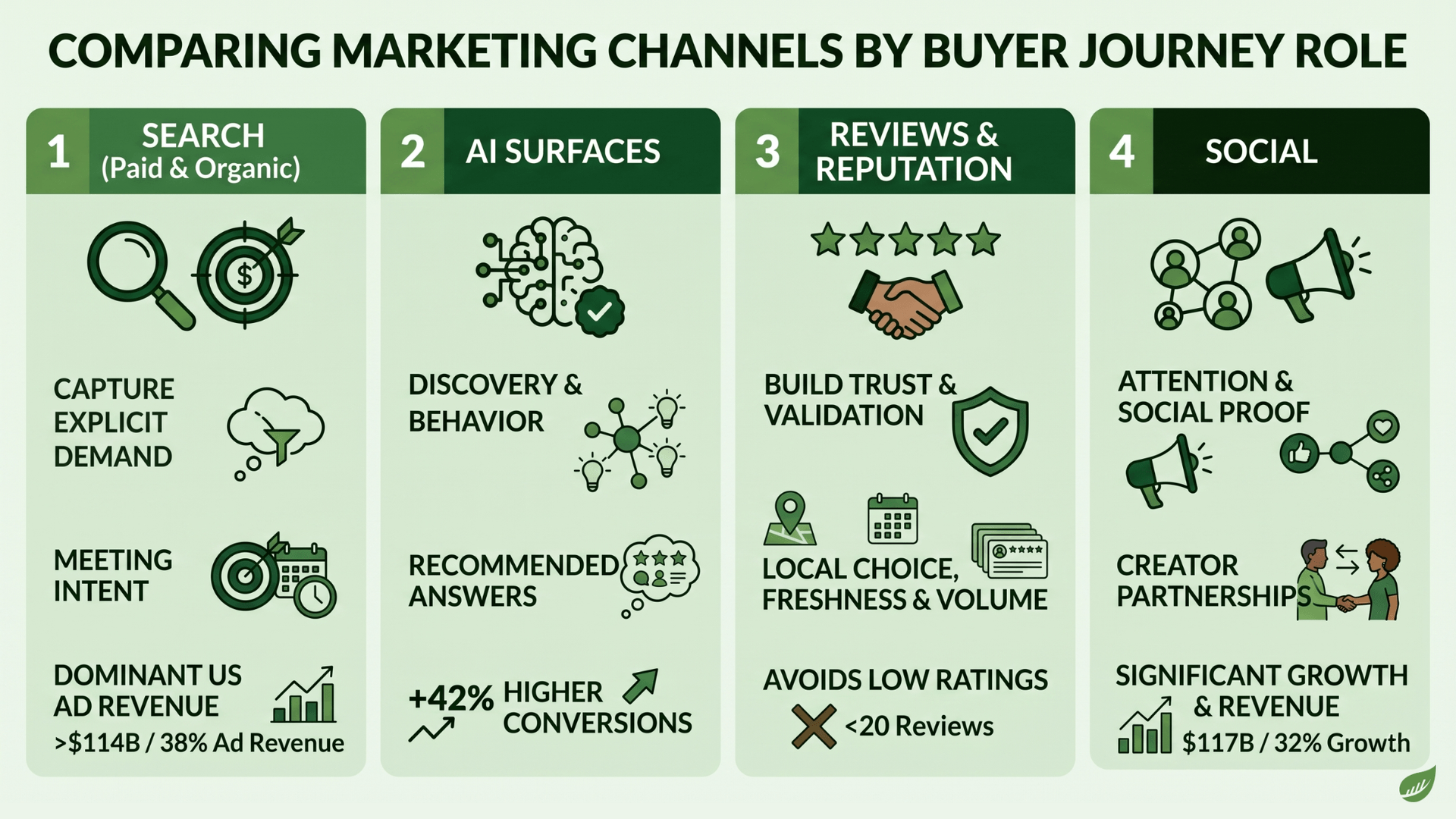
Different channels do different jobs, so comparing them by role prevents overspending on one surface while leaving a validation gap on another. The table below outlines the practical role, best use, and evidence for each.
| Channel | Primary role | Best used for | Supporting evidence |
|---|---|---|---|
| Search (paid and organic) | Captures explicit demand | Meeting buyers at the moment of intent, measurable via impression share and query data | Search was $114.2B and 38.8% of US ad revenue in 2025 (IAB and PwC) |
| AI surfaces | Discovery plus downstream behavior | Getting recommended, then verified, in AI answers | AI traffic converted 42% better than non-AI in March 2026 (Adobe) |
| Reviews and reputation | Validation layer | Local services where freshness and volume decide the choice | 47% avoid businesses with under 20 reviews (BrightLocal) |
| Social | Attention and proof | Reach, creator partnerships, and retargeting distribution | Social reached $117.7B in 2025, up 32.6% (IAB and PwC) |
What Does An Ad Campaign For Brand Defense Actually Protect?
An ad campaign built for brand defense protects the demand a company has already earned in paid search advertising by ensuring it appears first when someone searches for it by name.
That is where prominence metrics come in. The two major search platforms define absolute top impression share in highly similar ways:
- Google: The impressions an ad received in the very first ad position among top ads, divided by the estimated eligible impressions among top ads (Google, n.d.).
- Microsoft: The estimated percentage of times an ad was in the first position of all available impressions (Microsoft, n.d.).
Crucially, absolute top impression share is not the average position. Position tells a brand where it ranked when it showed, while impression share tells it how often it showed among all eligible impressions.
Confuse the two, and a brand will misread its own visibility. A high absolute top impression share on branded terms means competitors aren't intercepting buyers who came looking for that brand, which is the core of defensive visibility.
If you are unsure how your current ad campaign measures up, the team at BusySeed can run a comprehensive audit of your performance metrics to lock down your defensive strategy.
Case Study: Establishing Brand Visibility In a Saturated Market
A local wedding and event client came to us with no history of paid advertising, relying entirely on referrals and organic search.
Their visibility lived inside local word of mouth, which made growth beyond their existing audience slow and hard to scale in a crowded field.
For their first-ever paid campaign launched in March 2025, the approach centered on achieving a 46.81% absolute top impression share and building a repeatable model to generate consistent, high-quality B2C leads.
Key Takeaway: For any brand entering a saturated market, a first paid presence aimed directly at the moments buyers use to validate turns invisible word-of-mouth into a scalable engine for demand.
An 8-Step Visibility Playbook for Cautious Markets
Use this checklist to turn visibility into an operational plan rather than a vague ambition. Each step ties back to the evidence above.
- Quantify current visibility by channel. Measure branded search impression share, non-brand impression share, review coverage, AI referral traffic, and social reach so you know your starting line before spending a dollar.
- Map the validation points for the extended journey. Since 8 in 10 journeys involve multiple touchpoints, list every moment a buyer checks you out and confirm that you appear at each touchpoint (Google, 2025).
- Protect the trust signals buyers consult with caution. Prioritize review freshness and volume against the BrightLocal 2026 thresholds: aim for at least 20 reviews, maintain a 4.5-star rating or higher, and ensure reviews are within the last three months.
- Build for AI discovery and the verification loop. Plan for a pattern in which AI recommends and users verify with reviews, since 97% of AI users double-check against real reviews (BrightLocal, 2026a).
- Run prominence metrics correctly. Use the official definition of absolute top impression share and never treat it as average position.
- Decide your spend posture. Choose defensive visibility to protect branded demand and local presence, or offensive visibility to grab share of voice while competitors retreat, as the ARF report advises.
- Track outcomes beyond raw lead counts. Benchmark quality, conversion rates for B2C leads, revenue per visit, and funnel signals, using Adobe as a reference for AI vs. non-AI performance deltas.
- Keep the presence continuous. Because going dark correlates with a decline in market share, sustain the always-on layer and pulse the flexible campaigns around it (WARC, 2023).
Your Next Best Move
When buyers hesitate, absence becomes a red flag. The brands that win in cautious markets do not pull back; they optimize. They ensure their top impression share remains strong in paid search advertising, maintain a steady stream of fresh reviews for local lead generation, and structure their content so it is easily verified by both AI models and cautious consumers.
Visibility is not just about spending more money. It is about appearing credibly at the exact moments your buyers seek reassurance during their decision-making process.
If you want a partner who can pressure-test your current visibility strategy and prioritize your highest ROI channels, let's talk. BusySeed can audit your current presence, build a highly defensive ad campaign, and turn fragmented touchpoints into a unified, measurable growth engine. Connect with us at BusySeed to secure your share of voice today. We are ready to help.
Frequently Asked Questions
1. What should you look for in a top advertising company recommendation?
Look for agencies that treat visibility as a full-journey system rather than a single channel, since 8 in 10 online journeys involve multiple touchpoints (Google, 2025). For example, if you type "Top advertising companies NYC" into your search engine during an economic shift, you will see plenty of options, but you need to vet them carefully. The best partners connect paid search advertising, social, reviews, and AI discovery, and they report on prominence metrics, such as absolute top impression share, rather than vanity numbers. Ask how any agency measures incremental lift across channels before signing on.
2. What should a strong digital marketing team prioritize for local lead generation?
A strong team prioritizes the surfaces cautious local buyers actually check: fresh reviews, a complete search presence, and appearance inside AI recommendations. Reviews carry outsized weight, since 47% of consumers avoid businesses with fewer than 20 reviews (BrightLocal, 2026b). Effective local lead generation pairs that reputation layer with paid search advertising so a brand both earns trust and captures high-intent B2C leads.
3. Which digital marketing services help build trust and defend brand demand?
The services that build trust cover the moments when buyers validate: review generation and management, search presence, AI discovery optimization, and retargeting. If you are looking for the best digital marketing agency in NYC to protect your market share, ensure they defend branded search so competitors cannot intercept demand your brand has already earned. Trust now equals price and quality as purchase criteria, with 88% calling it important or a deal-breaker (Edelman, 2025).
4. What tools help evaluate content trust signals and support trust building in SEO?
The best tools for evaluating content trust signals include review platforms and analytics that track freshness, volume, and star ratings against survey thresholds (BrightLocal, 2026b). Likewise, the best tools for building trust in SEO pair impression share reporting from Google Ads and Microsoft Advertising with AI referral tracking, since 88% of AI users fact-check sources and citations that need to hold up under scrutiny before making a choice (BrightLocal, 2026a).
5. How much of an ad campaign budget should be spent defending the brand versus chasing new demand?
Balance depends on a brand's position, but the ARF report's guiding principle is to keep share of voice near share of market to avoid losing ground. Reserve part of every ad campaign for defensive branded search, then deploy the rest offensively when competitors cut back and attention gets cheaper. Because brands that go dark tend to lose market share, the one budget line to avoid cutting to zero is the always-on visibility layer (WARC, 2023).
Works Cited
- Adobe. AI Traffic Grows, but Retail Sites Lag in AI Search Visibility. April 2026.
- Advertising Research Foundation (ARF). Consumers and Brands in Times of Uncertainty. 2025.
- arXiv. From Prompt to Purchase: How AI Brand Recommendations Move Consumers on the Open Web. June 2026.
- BrightLocal. Half of Consumers Are Asking AI for Business Recommendations. 2026a.
- BrightLocal. Local Consumer Review Survey 2026. 2026b.
- Edelman. 2025 Edelman Trust Barometer Special Report: Brand Trust, From We to Me. 2025.
- Gartner. Gartner Sales Survey Finds 61% of B2B Buyers Prefer a Rep-Free Buying Experience. 2025.
- Google. Retail Never Stands Still. Here's How Marketers Can Keep Pace. Think with Google, 2025.
- Google. About Top and Absolute Top Metrics. Google Ads Help, n.d.
- IAB and PwC. Internet Advertising Revenue Report, Full Year 2025. 2026.
- Ipsos. Getting Value for Their Money Is Key for Online Shoppers. 2025.
- McKinsey. The State of the US Consumer 2025. 2025.
- McKinsey. Five Fundamental Truths: How B2B Winners Keep Growing. B2B Pulse 2024.
- Microsoft. What Do the Report Columns Mean?. Microsoft Learn, n.d.
- WARC. When Brands Go Dark: A Replication and Extension. 2023.