
TL;DR
- Email keeps its lead in owned-channel ROI. Email returns an average of $36 per dollar, and 30% of marketing leaders report returns of $36 to $50 per $1 spent (Litmus, 2025a).
- Search is a high-spend, high-impact demand-capture channel. US search ad revenue grew to $114.2 billion in 2025, up 11.0% year over year (IAB and PwC, 2026).
- Paid social is scaling fast. US social advertising revenue reached $117.7 billion in 2025, a 32.6% jump (IAB and PwC, 2026).
- Organic search still does the heavy lifting. Despite the rise of AI Overviews, AI search accounts for less than 1% of referral traffic, while organic remains the primary driver of conversions (BrightEdge, 2025b).
- Integrated data beats single-channel effort. Customer data used in multichannel campaigns yields 23% more impact (Data & Marketing Association, 2025b).
Sustainable growth in 2026 comes from a marketing strategy that pairs channels that capture existing demand with channels that build durable, owned assets.
A high-ROI marketing strategy operates as a cohesive system that connects the following components:
- Paid media channels
- Email marketing
- Social media marketing
- SEO marketing
By connecting these elements, each channel reinforces the others instead of competing for the same budget.
Email alone drives an average ROI of $36 per dollar spent, while search and social remain the channels marketers rate as most effective for return. This guide explains where measurable returns actually lie, how to compare channels fairly, and how to combine them.
If you want an expert team to build and manage this system for you, BusySeed designs integrated campaigns that turn these high-ROI channels into a predictable revenue engine.
Which Channels Have the Highest Measurable ROI in 2026?
Email is the channel with the strongest, most consistently documented ROI. Search and social are the channels marketers themselves rate as most effective for return.
Litmus reports that email drives an average of $36 for every dollar spent (Litmus, 2025a). The distribution behind that average is just as telling. In Litmus survey data (Litmus, 2025b):
- 35% of leaders receive $10 to $36 back per $1
- 30% receive $36 to $50
- 5% receive more than $50
Search and social sit alongside email at the top. Nielsen found that marketers continue to view social media, search, online-mobile video, and online-mobile display as the most effective channels for ROI (Nielsen, 2024).
That perception is backed by spending behavior. Gartner reports that paid search increased its share of the total digital spend from 13.6% to 13.9% in 2025. They described search as a high-spend, high-impact channel for conversion and pre-purchase touchpoints (Gartner, 2025).
Everything else in the mix should be evaluated as ROI-relevant rather than crowned as the single highest performer. Commerce media, local search, and content are measurable and can compound, but the cleanest, best-sourced ROI story still runs through email, search, and social. That is why a serious marketing strategy treats these three as the spine and builds outward.
Why Does Email Marketing Still Anchor a High-ROI Strategy?
Email marketing anchors ROI because it is an owned channel. Brands reach an audience they already control without paying an auction fee for each impression.
Beyond the $36 average return, the measurement discipline around email is improving. Litmus reports that only 21% of marketing leaders now skip ROI measurement, down from 36% in 2023. This means more teams can prove email's contribution rather than assume it (Litmus, 2025b).
Engagement benchmarks reinforce the case. The DMA's 2024 dataset showed the following improvements (Data & Marketing Association, 2025a):
- Delivery rates rose to 98% (99.2% for B2C)
- Open rates increased to 35.9%
- Unique click rates reached 2.3%
Those numbers hold only if deliverability is protected, which is where compliance and technical hygiene come into play.
For US senders, CAN-SPAM requires that businesses honor opt-out requests within 10 business days (Federal Trade Commission, n.d.-a). On the technical side, Gmail specifies that one-click unsubscribe must be implemented through List-Unsubscribe headers per RFC 8058, since mailto and body links alone do not meet the requirement (Google, n.d.).
Skipping these steps quietly erodes the exact ROI advantage that makes email worth prioritizing. Protecting that advantage requires constant technical upkeep. If you need help locking down your deliverability and compliance, the team at BusySeed can audit your email infrastructure and safeguard your highest-converting channel.
Is Paid Search Worth the Budget Share It Commands?
Paid search earns its share of the budget by capturing demand at the moment of intent. This is why it remains one of the most reliable paid media channels.
The scale is substantial. US search ad revenue grew to $114.2 billion in 2025, up from $102.9 billion in 2024, and search now accounts for 38.8% of internet ad revenue (IAB and PwC, 2026).
Search also wins for content-led programs. The Content Marketing Institute reports that SEM and PPC produced the best results for content marketing for 61% of B2B marketers. This puts it ahead of (Content Marketing Institute, 2024):
- Social media ads (49%)
- Sponsorships (48%)
- Digital display (35%)
Query intent is the reason. Someone typing a commercial search is closer to a decision than someone scrolling a feed. Unlike SEO marketing, which builds organic authority over months, paid search offers immediate visibility, cementing its status as a top paid media channel.
How Big Is Paid Social, and Where Does It Fit?
Paid social is now the largest single digital ad category by revenue, which makes social media marketing a core demand-creation engine.
US social advertising revenue reached $117.7 billion in 2025, an increase of $29.0 billion, or 32.6%, year over year (IAB and PwC, 2026). That growth reflects how much creative-led prospecting and retargeting now run through Meta, TikTok, and LinkedIn.
Social media marketing serves a different job than search:
- Search captures people already looking.
- Social media creates demand and keeps a brand present between purchase moments.
Because it runs on feeds rather than queries, the signal is passive, so incrementality testing matters more here than in search. Any paid influencer or incentivized program also carries a compliance obligation: the FTC's revised Endorsement Guides require that disclosures for material connections be clear and conspicuous (Federal Trade Commission, n.d.-b).
Does SEO Marketing Still Pay Off in an AI Overview World?
SEO marketing still pays off because organic search remains the dominant driver of traffic and conversions, even as AI summaries change the results page.
The clearest evidence is that, from January through August 2025, AI search accounted for less than 1% of referral traffic, while organic search remained the primary driver and delivered the majority of conversions (BrightEdge, 2025b).
Google Search itself is not shrinking either. SparkToro and Datos found that Google search grew by more than 20% in 2024 and received roughly 373 times as many searches as ChatGPT (SparkToro, 2025).
The real shift is behavioral. Pew found that when an AI summary appeared, users clicked (Pew Research Center, 2025):
- A traditional search result in 8% of visits versus 15% without a summary.
- A link inside the AI summary in only 1% of visits.
AI summaries appeared in about one-fifth of searches, specifically, 18% of searches in Pew's March 2025 dataset (Pew Research Center, 2025). BrightEdge measured the same pressure at scale, reporting that since May 2024, total search impressions have risen by more than 49% while CTR has declined by nearly 30% as people consumed answers within the Overview (BrightEdge, 2025a).
The takeaway for SEO marketing is to shift the KPI mix from sessions-only to revenue outcomes and to structure content to earn citations. Prioritize bottom-funnel pages and write clear, self-contained claims.
Navigating this shift from traditional SEO to AI-driven visibility requires a precise content strategy. BusySeed can help you structure your digital assets so your brand remains the primary answer when high-intent prospects search.
Are AI Traffic Sources Meaningful Yet?
Generative AI traffic is growing quickly but is still small relative to search, and its quality is notably high.
Adobe reports that traffic to US retail websites from generative AI sources increased by 1,200% between July 2024 and February 2025 (Adobe, 2025). Even so, that traffic starts from a tiny base, consistent with BrightEdge's finding that AI search accounts for less than 1% of referrals (BrightEdge, 2025b).
Where AI referrals do land, they behave well. Adobe found AI-referred retail visitors show (Adobe, 2025):
- 8% higher engagement
- View 12% more pages per visit
- Have a 23% lower bounce rate than non-AI sources
Treat AI visibility as an emerging, high-quality channel worth monitoring, not a line item to fund at the expense of search.
Where Do Commerce Media and Local Search Fit?
Commerce media and local search are ROI-relevant channels that serve specific business models: commerce media for e-commerce and shopper marketing, and local search for multi-location and local services. Integrating these specialized networks into your broader marketing strategy ensures you don't miss out on high-intent buyers.
US commerce media revenue increased to $63.4 billion in 2025, up 18.0% from $53.7 billion in 2024 (IAB and PwC, 2026). Gartner notes that retail media networks have surpassed video and streaming to become a key channel for targeted reach and engagement (Gartner, 2025).
Local search is crucial because consumer behavior is both frequent and highly unforgiving:
- High Search Frequency: According to SOCi, 80% of US consumers search online for local businesses at least weekly, with 32% doing so daily (SOCi, 2024a).
- Placement is Everything: Google Business Profiles featured in the Local Pack receive 126% more traffic and 93% more actions compared to businesses ranked 4 through 10 (SOCi, 2024b).
- Accuracy Protects Revenue: Basic profile hygiene is non-negotiable. If a consumer finds a store closed after seeing it listed as open online, 47% will immediately look for a competing business nearby (SOCi, 2024a).
One efficiency lever worth mentioning in e-commerce is onsite search. Constructor found that while searchers make up 24% of online shoppers, they drive 44% of e-commerce revenue and convert at 2.5 times the rate of browse-only shoppers (Constructor, n.d.). Improving the search experience we already own can lift returns without new ad spend.
How Should You Compare Channels Honestly?
Compare channels based on ROI measurability, sustainability, and operating constraints, rather than headline ROI alone. This applies across all paid media channels, as well as staples like email marketing.
A channel with a fast payback but no compounding value plays a different role in a marketing strategy than one that builds an owned audience over time. For instance, the compounding brand value of social media marketing often looks very different than the direct attribution of paid search. The table below organizes the highest-priority channels against those dimensions using the evidence in this guide.
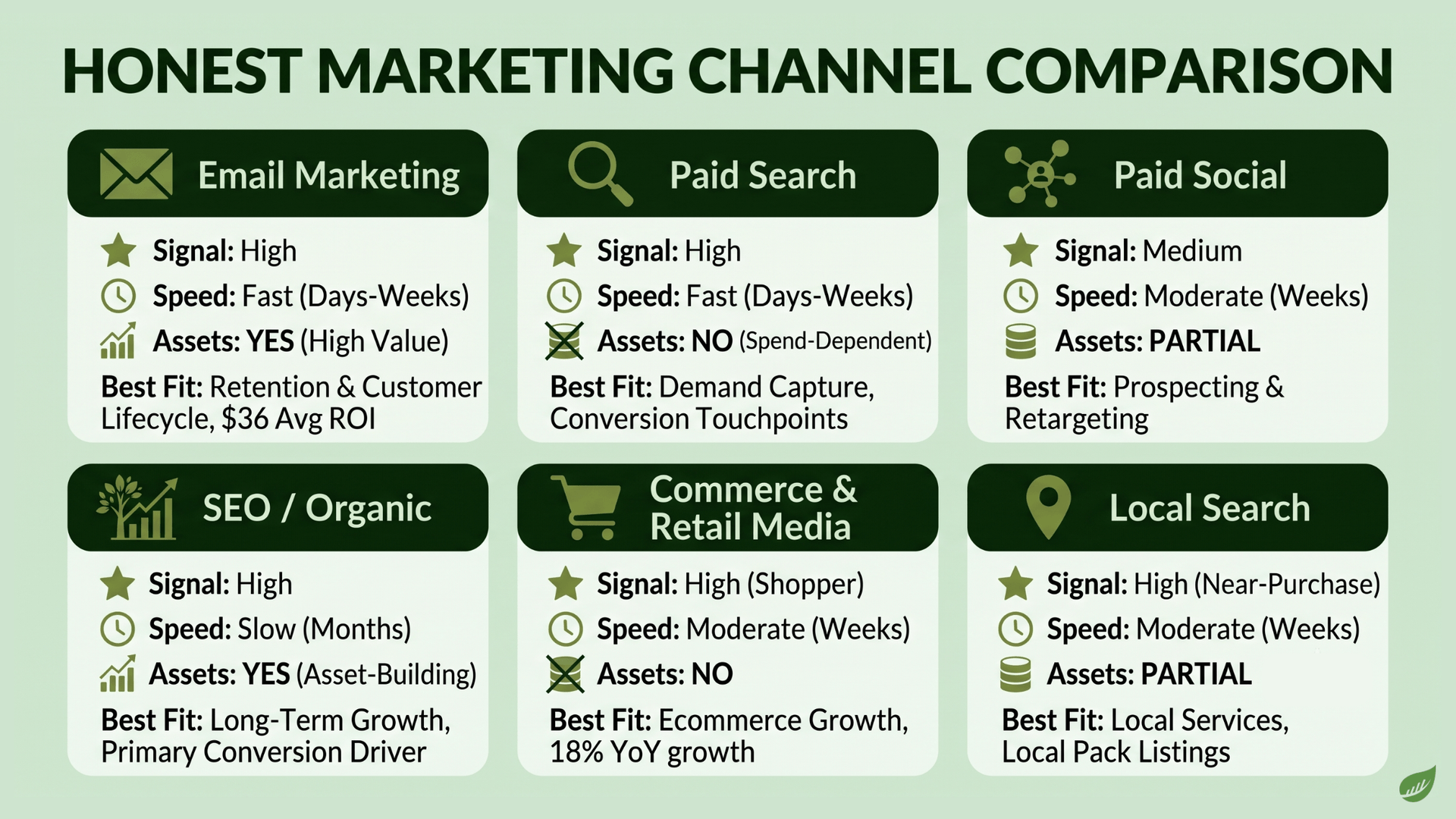
| Channel | Signal / Intent | Time to Payback | Compounding Value | Grows Owned Audience | Best-Fit Role |
|---|---|---|---|---|---|
| Email marketing | High (opt-in, first-party) | Days to weeks | High | Yes | Retention, lifecycle, $36 avg ROI |
| Paid search | High (query intent) | Days to weeks | Low (spend-dependent) | No | Demand capture, conversion touchpoints |
| Paid social | Medium (passive feed) | Weeks | Low to medium | Partial | Prospecting, retargeting, largest ad category |
| SEO / organic | High (query intent) | Months | High (asset-building) | Partial | Primary conversion driver |
| Commerce / retail media | High (shopper intent) | Weeks | Low to medium | No | Ecommerce, 18% YoY growth |
| Local search | High (near-purchase) | Weeks | Medium | Partial | Local services, Local Pack lift |
A measurement reality frames all of this in 2026. Google reversed its plan to phase out third-party cookies in Chrome, moving to a user-choice approach after earlier introducing Tracking Protection that restricted third-party cookies by default for 1% of users on January 4, 2024 (Search Engine Land, 2024; Google for Developers, n.d.).
Attribution is still imperfect, so blend platform data with business outcomes and test for incremental lift.
Why Do Integrated Systems Outperform Single Channels?
Integrated, data-driven systems outperform single channels because customer data compounds across them. The DMA reports that customer data-driven campaigns generate (Data & Marketing Association, 2025b):
- 14% higher ROI
- 21% more effects per campaign
- 23% more effects when used in integrated multi-channel campaigns
That is the core argument for an omnichannel marketing strategy: the same first-party data that improves email targeting also sharpens paid social audiences and informs which SEO marketing initiatives and pages deserve investment.
Content distribution shows the same pattern. CMI found B2B marketers rate the following as the most effective distribution channels (Content Marketing Institute, 2024):
- In-person events (52%)
- Webinars (51%)
- Email and organic social (42% each)
- Blogs (41%)
- Newsletters (37%)
No single channel carries the load; the effect comes from how they connect. Connecting these channels seamlessly is exactly what we do at BusySeed. We help brands unify their first-party data to ensure their email, search, and social campaigns work together to multiply revenue. Explore our services today to see how we can turn your disconnected channels into a unified ROI machine.
An 8-Step Channel Prioritization Checklist for 2026
- Map every channel to a job. Assign demand capture to search and commerce media, and demand creation to social media marketing and content.
- Protect email deliverability first. Authenticate with SPF, DKIM, and DMARC, and implement List-Unsubscribe headers per RFC 8058.
- Confirm compliance early. Honor opt-outs within the CAN-SPAM 10-business-day window and keep influencer disclosures clear and conspicuous.
- Tiered paid search by intent. Separate brand, non-brand, and competitor campaigns, then split high-intent commercial queries from informational ones.
- Build a paid social testing system. Move from concepts to variants to winners, and keep prospecting separate from retargeting.
- Reframe SEO marketing KPIs. Prioritize bottom-of-funnel pages, structure content for citations, and shift from sessions-only to revenue outcomes, given AI Overview click declines.
- Fix local and on-site search hygiene. Lock Google Business Profile hours and categories, and improve onsite search that converts at 2.5 times the rate of browse-only shoppers.
- Unify data and test for lift. Connect first-party data across channels to capture 23% more effects from integrated campaigns and measure incrementality alongside attributed conversions.
Implementing an 8-step framework across your entire marketing stack can stretch an internal team thin. If you want a partner to execute this checklist from top to bottom, reach out to BusySeed to align your channels for maximum ROI.
Bringing It All Together
High ROI in 2026 isn't about hunting for a single silver-bullet channel. It is about building a cohesive revenue architecture where email, search, and social reinforce one another. Data integration and clear attribution are what separate compounding growth from wasted ad spend. When you pair high-intent demand capture with durable, owned assets, you create a comprehensive marketing strategy and a resilient engine that can weather algorithm changes and budget pressures alike.
If you want a partner who can implement this front-to-back and prove the lift with real numbers, let's talk. BusySeed can audit your current channel mix, fix your deliverability, and build an integrated marketing strategy that drives measurable outcomes.
Ready to maximize your ROI? Start building your high-performance growth engine with BusySeed today.
Frequently Asked Questions
1. What digital marketing services should a growing company invest in first?
Start with the channels that have the clearest, best-documented returns: email marketing for owned-audience ROI, paid search for demand capture, and SEO marketing for compounding organic value. Email alone returns an average of $36 per dollar, and organic search remains the primary driver of conversions. Layer in paid social once a creative testing system and reliable attribution are in place.
2. How do email marketing software rates relate to the ROI a business can expect?
Pricing varies by provider, especially when you start comparing enterprise rates for email marketing software, but the ROI benchmark is a useful floor for evaluating cost. With email averaging $36 back per dollar and 30% of leaders reporting $36 to $50 in return, the platform cost is usually small relative to the revenue if deliverability and lifecycle flows are set up correctly. Judge software on how well it supports authentication, segmentation, and revenue attribution rather than headline price alone.
3. How should a business choose a digital marketing agency?
Whether you are looking for a global partner or searching for the best digital marketing agency in NYC, look for an agency that treats channels as an integrated system rather than isolated line items, because customer data used across channels generates 23% more effects. Ask how they measure incrementality under imperfect attribution and how they adapt SEO to AI Overviews.
4. What content marketing tools help small businesses prove ROI?
When reviewing the top content marketing tools for small businesses, focus on platforms that tie content to measurable outcomes across the channels where content works. CMI found that SEM and PPC delivered the best content results for 61% of B2B marketers, followed by social media ads. Prioritize distribution and measurement tooling over volume-focused production, and structure content to earn citations in AI summaries.
5. What should a privacy-conscious business look for in an AI-assisted email marketing service?
If you are searching for recommended AI email marketing services for a privacy-conscious business, choose platforms that lean on first-party, opt-in data and meet current deliverability standards, since Google's reversal on third-party cookies makes owned data more valuable, not less. Any AI-assisted email program should still honor the CAN-SPAM opt-out window and implement RFC 8058 one-click unsubscribe.
Works Cited
- Adobe. Adobe Analytics: Traffic to US Retail Websites from Generative AI Sources Jumps 1,200%. Adobe Blog, 2025.
- BrightEdge. AI Overviews One Year Review Research Paper and Deep Dive. BrightEdge, 2025a.
- BrightEdge. AI Search Visits Surging in 2025, Industry Report. BrightEdge, 2025b.
- Constructor. Beyond Relevance Report. Constructor, n.d.
- Content Marketing Institute. B2B Content Marketing Trends Research 2025. Content Marketing Institute, 2024.
- Data & Marketing Association. Email Benchmarking Report 2025. Data & Marketing Association, 2025a.
- Data & Marketing Association. The Value of Customer Data Report 2025. Data & Marketing Association, 2025b.
- Federal Trade Commission. CAN-SPAM Act: A Compliance Guide for Business. Federal Trade Commission, n.d.-a.
- Federal Trade Commission. Endorsements, Influencers, and Reviews. Federal Trade Commission, n.d.-b.
- Gartner. Gartner Survey Finds Digital Channels Account for 61.1% of Total Marketing Spend. Gartner, 2025.
- Google. Email Sender Guidelines FAQ. Google, n.d.
- Google for Developers. Third-Party Cookies. Google for Developers, n.d.
- IAB and PwC. Internet Ad Revenue Report Full Year 2025. IAB and PwC, 2026.
- Litmus. Email Marketing ROI. Litmus, 2025a.
- Litmus. Infographic: The ROI of Email Marketing. Litmus, 2025b.
- Nielsen. Nielsen Releases Its 2024 Annual Marketing Report. Nielsen, 2024.
- Pew Research Center. Google Users Are Less Likely to Click on Links When an AI Summary Appears in the Results. Pew Research Center, 2025.
- Search Engine Land. Google Won't Phase Out Third-Party Cookies in Chrome as Previously Planned. Search Engine Land, 2024.
- SOCi. Consumer Behavior Index 2024. SOCi, 2024a.
- SOCi. Top Takeaways from the 2024 SOCi Local Visibility Index (LVI). SOCi, 2024b.
- SparkToro. New Research: Google Search Grew 20%+ in 2024; Receives 373X More Searches Than ChatGPT. SparkToro, 2025.