
TL;DR
- Marketing budgets are effectively flat, moving from 7.7% of company revenue in 2025 to 7.8% in 2026 (Gartner, 2025a; Gartner, 2026).
- 56% of CMOs say they lack the budget to deliver their 2026 strategy, which makes efficiency the real growth lever (Gartner, 2026).
- Organizations that invest more in martech than in working media see an 18% greater sales lift and 7% greater revenue growth (Deloitte, 2025).
- 60% of B2B buyers now use AI tools during the purchase, and 63% of those buyers validate AI answers with Google Search (Google and NRG, 2025).
A marketing budget is the share of company revenue set aside to fund demand, brand, and measurement work, and in 2026, that share is barely moving. When the top-line number stays flat, growth comes from:
- Implementing a smarter ad spend allocation.
- Executing a disciplined paid media strategy.
- Building a marketing strategy around measurement rather than raw spending.
This guide walks through the numbers, the levers, and a working checklist for improving B2B lead generation efficiency without cutting the programs that actually drive pipeline. The short version: most companies do not need a bigger budget than they have. They need a better allocation of the one they already have. This is exactly what we do at BusySeed: we help brands audit their existing channels and redirect spend toward the campaigns that actually convert.
Why Is Efficiency the Growth Lever When Marketing Budget Stays Flat?
Efficiency is the growth lever because the budget itself is not growing. Marketing budgets remained flat at 7.7% of overall company revenue in 2025 (Gartner, 2025a), and the 2026 survey moved that figure up by just 0.1 percentage point to 7.8% (Gartner, 2026). That is not a rounding error worth celebrating. It is a signal that CFOs are done funding growth by simply spending more.
The pressure shows up in how marketing leaders describe their own constraints:
- In 2025, 59% of CMOs reported insufficient budget to execute their strategy (Gartner, 2025a).
- In 2026, 56% said their organization lacks the budget required to deliver the plan, and 54% reported insufficient resources overall (Gartner, 2026).
When more than half of your peers say the money is short, the winning move is not lobbying for more. It is reallocating what you have toward the channels and systems that consistently produce measurable outcomes.
That reframing matters because the reflexive response to a flat budget is a broad cut. Trimming every line by ten percent feels fair and disciplined. It also quietly kills the upper-funnel and measurement work that makes the rest of the budget efficient. A smarter ad spend allocation starts by asking which dollars compound and which ones simply repeat.
Where Does the Marketing Budget Actually Go Today?
The marketing budget today is heavily concentrated on paid media and digital channels, which is exactly where efficiency gains are found. Paid media accounts for 30.6% of marketing budgets, or about 2.4% of company revenue (Gartner, 2025a). Paid media had already grown to 27.9% of the budget in 2024 (Gartner, 2024), indicating a steady upward trend.
Digital dominates the mix. Here is how the spend breaks down (Gartner, 2025b):
- Digital channels account for 61.1% of total marketing spend in 2025, with paid online channels making up 69% of that digital total.
- Paid search remains the leading digital channel, its share rising from 13.6% to 13.9% of total digital spend year over year.
- Digital display grew 17 percentage points to 12.5% of digital spend, while social advertising held steady at 12.2%.
Knowing where the money already sits tells you where your ad spend allocation has the most leverage. If nearly a third of the budget is paid media and two-thirds of digital dollars are paid, then small improvements in paid media strategy and measurement move real money.
If you are not sure where your digital dollars are leaking, the team at BusySeed can run a comprehensive media audit to pinpoint exactly which campaigns are wasting your marketing budget and which ones need more fuel. Contact us today to get started.
How Does the Channel Mix Compare Across Digital and Offline?
A well-rounded paid media strategy has consistently split budgets between digital and offline, with digital taking the larger and growing share. For context, digital accounted for 57.1% of paid media budgets in 2024, up from 54.9% in 2023 (Gartner, 2024), and that gap has continued to widen.
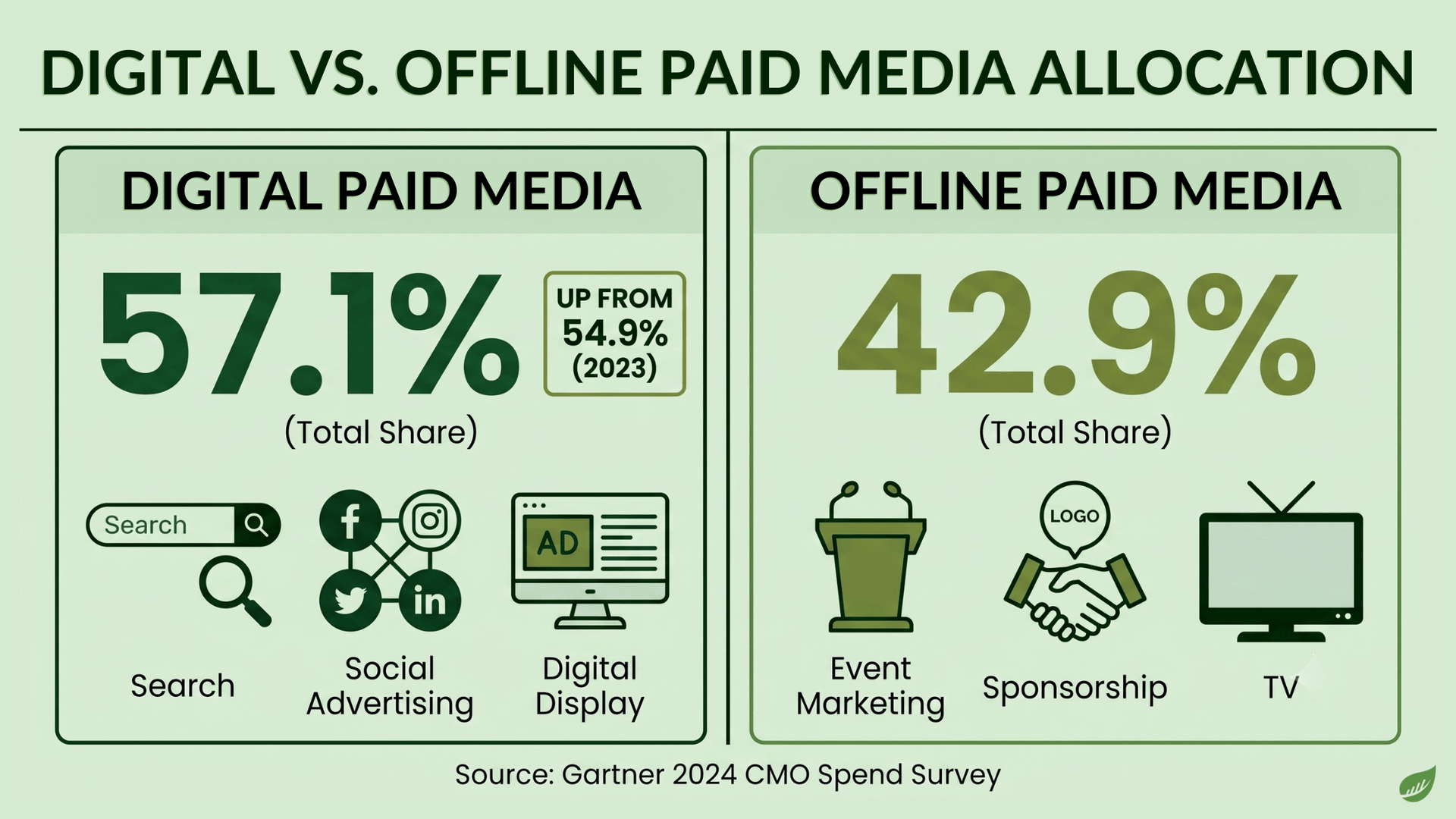
| Channel type | Channel | Share of budget (2024) |
|---|---|---|
| Digital paid media | Search | 13.6% (of digital spend) |
| Digital paid media | Social advertising | 12.2% (of digital spend) |
| Digital paid media | Digital display | 10.7% (of digital spend) |
| Offline paid media | Event marketing | 17.1% (of offline spend) |
| Offline paid media | Sponsorship | 16.4% (of offline spend) |
| Offline paid media | TV | 16.0% (of offline spend) |
Source: Gartner 2024 CMO Spend Survey.
Offline channels still hold large individual shares, which is precisely why they are so often the first targets for cuts. But event marketing, sponsorship, and TV often do brand work that acquisition metrics undercount. Before cutting them, it helps to understand what they contribute to buyer familiarity, because that familiarity has an outsized effect on B2B outcomes.
Why Can Cutting Upper-Funnel Spend Backfire?
Cutting upper-funnel spend can backfire because brand familiarity drives vendor selection more than most attribution reports reveal. Buyers were more than 20 times more likely to choose a vendor that everyone in the buying group had heard of on day one (LinkedIn and Bain, 2025). That is not a marginal edge. It is the difference between being on the shortlist and never being considered.
The mechanism sits inside how B2B groups decide (Gartner, 2025c):
- B2B buying groups range from 5 to 16 people across as many as four functions.
- 74% of teams exhibit unhealthy conflict during decision-making.
- Groups that reach consensus are 2.5 times more likely to report that the deal was high quality.
A brand every member already recognizes reduces friction inside a group that is otherwise built to argue. Familiarity is the shortcut to consensus.
So when a flat budget forces a choice, gutting the brand work that seeds that familiarity trades a short-term efficiency gain for a longer-term demand shortfall. A durable marketing strategy protects the top of the funnel and finds efficiency elsewhere.
How Has AI Changed the B2B Research Journey?
AI has fundamentally changed the landscape for B2B lead generation by inserting itself early into the research journey and shifting Google Search into a validation role (Google and NRG, 2025). The shift is highly measurable:
- 60% of B2B buyers now use AI tools during the purchase process.
- 84% of those buyers say these tools actively speed up their process.
But buyers do not simply trust the machine. Among those who used AI tools, 63% turn to Google Search to validate or cross-check what the AI told them (Google and NRG, 2025).
That two-step pattern reshapes where the budget earns its keep. A brand needs to be discoverable inside AI-driven answers and defensible when the buyer double-checks on Google. If content is invisible to AI engines, the brand misses the first touch. If search presence is weak, it fails the validation test. Both matter, and they favor an integrated paid media strategy over channel silos.
What Are the Practical Levers to Stretch a Marketing Budget?
The practical levers to stretch a budget and future-proof your marketing strategy are reallocation toward capability, a retention bias, multi-channel coordination, and privacy-resilient measurement. Each one improves output without a bigger input.
- Invest in capability, not just working media.
- Organizations investing more in martech than in working media see an 18% greater sales lift and 7% greater revenue growth than those doing the reverse (Deloitte, 2025).
- At least 61% of marketing budgets are based on enterprise-level revenues, prior budgets, or prior spend (Deloitte, 2025).
Translation: The inputs are sticky, so the advantage comes from reallocating within the budget toward systems that raise conversion rates and shorten time to iterate.
- Bias toward retention when acquisition weakens. Customer retention efforts deliver 50% higher performance as acquisition success continues to wane (Deloitte, 2024). When new-logo acquisition becomes more expensive, balancing your B2B lead generation efforts with existing-customer expansion becomes the more cost-effective path to revenue.
- Coordinate channels to reach buying groups. A single-channel campaign targeting one persona wastes reach across a group of 5 to 16 decision-makers. Synchronizing platforms so the same positioning reaches multiple functions is how wasted impressions get cut, and cost per lead comes down.
Proof in practice: When channels and targeting are correctly synchronized, the efficiency gains are immediate. BusySeed recently partnered with an executive search technology firm to audit and refine its B2B ad targeting. By fixing their targeting parameters to precisely reach the right buying groups rather than wasting spend on broad, unqualified impressions, we drove their cost per lead (CPL) down to a highly efficient $26.84.
How Does a Working-Media-Heavy Budget Compare to a Capability-Heavy One?
A capability-heavy budget outperforms a working-media-heavy one in both sales lift and revenue growth, according to Deloitte evidence (Deloitte, 2025). Here is how the two approaches to ad spend allocation contrast:
- Working-media heavy: More dollars go toward ad placements than martech, data, and analytics, which ultimately yields just baseline performance.
- Capability-heavy: By investing more in martech, data, analytics, and automation than in media, companies document an 18% greater sales lift and 7% greater revenue growth.
The point is not to starve the media budget. It is that a dollar moved into measurement, automation, and conversion tooling often returns more than the same dollar spent on additional impressions.
Why Is Measurement the Constraint on Efficient Reallocation?
Measurement is the constraint on efficient reallocation because the budget cannot be confidently shifted toward what cannot be seen clearly. To make matters more challenging, signal loss is making user-level tracking less reliable (IAB, 2024):
- 95% of data and advertising decision makers expect continued legislation and signal loss.
- Roughly two-thirds foresee additional state privacy laws that reduce their ability to personalize.
The cookie picture is more nuanced than the headlines suggested. In an April 2025 update, Google said it would maintain its current approach to third-party cookie choice in Chrome and would not roll out a new standalone prompt (Google, 2025).
That is not so much a reprieve as an unsettled status quo. The durable response is to lean on first-party measurement, modeled measurement where appropriate, and incrementality discipline rather than assuming perfect tracking.
What Attribution Model Should You Use in GA4?
Choosing a GA4 attribution model that reflects a multi-touch reality and documenting the choice are the core tasks. Google Analytics defines attribution as assigning credit for key events across touchpoints and offers three models in Attribution reports (Google, n.d.-a):
- Data-driven attribution
- Paid and organic last click
- Google paid channels last click
Data-driven attribution uses machine learning to evaluate both converting and non-converting paths and is specific to each advertiser and each key event.
For most multi-channel B2B programs, data-driven attribution better matches how buying groups actually engage across LinkedIn, search, and content. The discipline that matters most is consistency: pick the model, document it, and defend budget decisions against the same yardstick every quarter.
Setting up these precise attribution models can be technically complex, but BusySeed specializes in building privacy-resilient tracking foundations that give you total confidence in your ROI.
How Do You Reduce Conversion Measurement Loss Under Privacy Limits?
Conversion measurement loss can be reduced by adding first-party and server-side signals where each platform recommends it. Here is how the major platforms handle it:
- Google Ads: Enhanced conversions accept user-provided data from website tags, Data Manager, and API connections. Google is combining enhanced conversions for web into a single on/off setting starting April 2026 (Google, n.d.-b). Google requires confirmation of compliance with its enhanced conversion customer data policies before they are enabled, so implementation should be routed through legal review.
- LinkedIn: The Insight Tag is a JavaScript tag that tracks ad-driven visitor activity and matches visitors to member accounts using LinkedIn cookies. LinkedIn's conversion tracking guide offers multiple data sources and deduplicates between the Conversions API and the Insight Tag to avoid double-counting (LinkedIn, n.d.). They also warn against installing the Insight Tag on pages that collect or contain sensitive data, stating plainly that this does not constitute legal advice and that counsel should be consulted.
- TikTok: For web conversions, TikTok recommends pairing the Events API with the Pixel and using event deduplication for a more reliable connection (TikTok, 2025).
How Do LinkedIn Conversion Tracking Options Compare?
LinkedIn conversion tracking options differ in reliability and setup, with server-side and CRM sources adding resilience against browser-side loss. The table below summarizes the choices from LinkedIn Help.
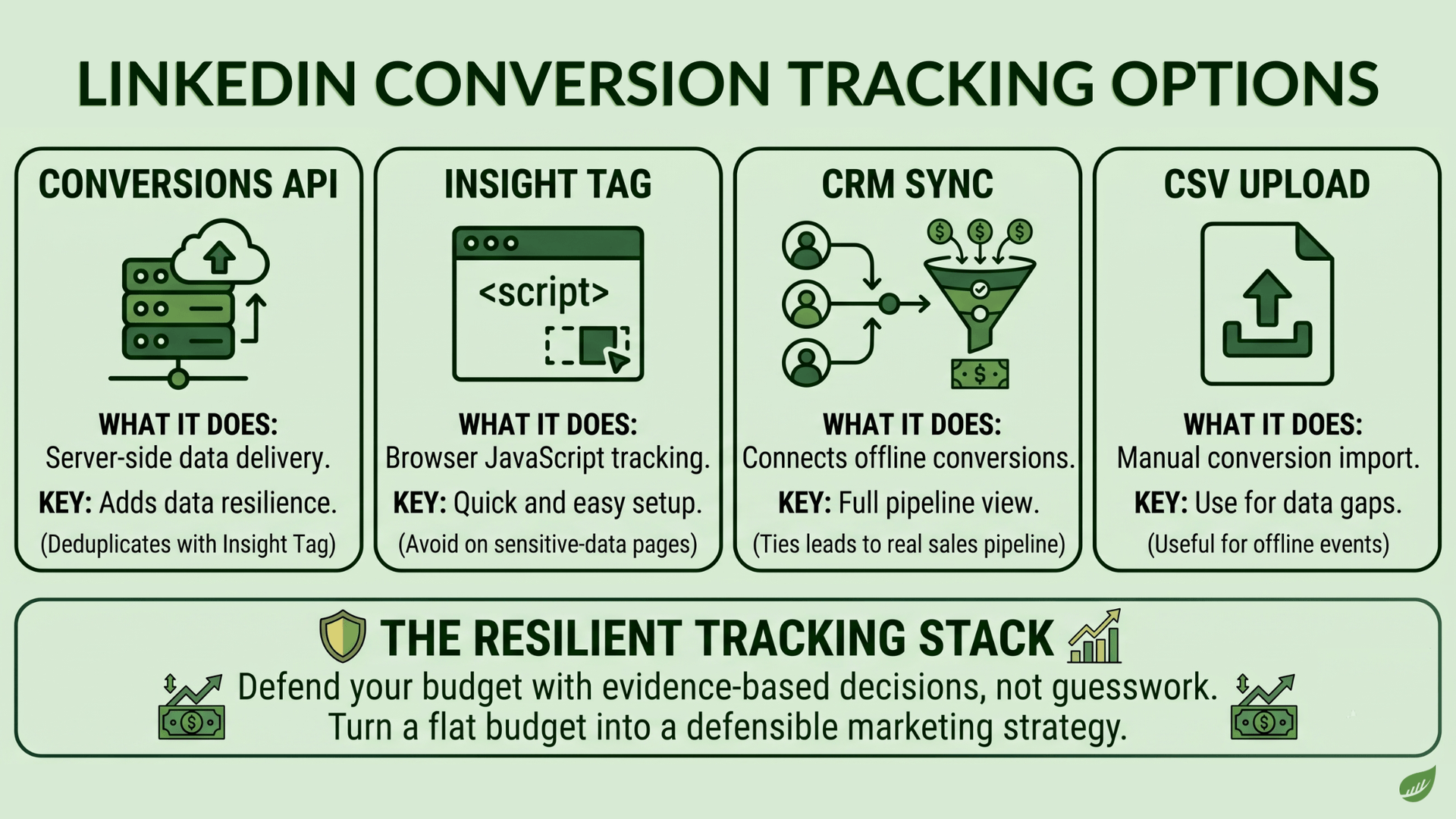
| Data source | What it does | Note |
|---|---|---|
| Conversions API | Server-side event delivery | Deduplicates with Insight Tag |
| Insight Tag | Browser JavaScript tracking | Avoid on sensitive-data pages |
| CRM Sync | Connects offline conversions | Ties lead to a real pipeline |
| CSV upload | Manual conversion import | Useful for offline events |
The takeaway for budget defense: a resilient tracking stack enables reallocation of spend with evidence rather than guesswork. That is what turns a flat budget into a defensible marketing strategy.
An 8-Step Checklist to Stretch Your Marketing Budget
Use this numbered sequence to move from a flat budget to a defensible, efficient allocation that supports your overarching marketing strategy.
- Set your constraint and baseline. Benchmark against the current marketing budget norms of 7.7% of revenue in 2025 and 7.8% in 2026 (Gartner, 2025a; Gartner, 2026) to ground expectations.
- Confirm your measurement foundation first. Configure GA4 attribution reporting and choose a model before reallocating a dollar, using the options in Google Analytics Help.
- Reduce conversion measurement loss where permitted. Implement enhanced conversions, follow Google's customer data policies, and plan for the April 2026 settings change (Google, n.d.-b). Route it through legal review.
- Make conversion definitions consistent. For URL-based conversions, Google Ads documentation explains that the "Count" setting "One" is best for leads (Google, n.d.-b). Decide lead versus sale up front.
- Align channel roles to the modern research journey. Plan for AI-assisted research and Google validation, since 60% of buyers use AI and 63% validate on Google Search (Google and NRG, 2025).
- Market to buying groups, not one persona. Account for group sizes of five to 16 people and manage consensus risk (Gartner, 2025c).
- Build multi-channel reinforcement where it lowers waste. Synchronize LinkedIn and Google Ads positioning to reach more of the buying group with consistent messaging.
- Add signal-resilient tracking where platforms recommend it. For TikTok web conversions, pair the Events API with the Pixel and deduplicate, per TikTok.
Feeling overwhelmed by these technical setups? Connect with BusySeed to handle the heavy lifting and ensure your systems are seamlessly integrated for peak B2B lead-generation efficiency.
When Should You Shift Budget Between Paid Social and Paid Search?
Budget should shift toward paid search when buyers are actively validating, and toward paid social when the goal is to build the familiarity that drives group consensus.
- Since 63% of AI-assisted B2B buyers cross-check answers on Google Search, paid search captures high-intent moments late in the journey (Google and NRG, 2025).
- Paid social, meanwhile, does the upper-funnel work that makes vendors more than 20 times more likely to be chosen when everyone in the group recognizes them (LinkedIn and Bain, 2025).
The efficient answer for your paid media strategy is rarely all-or-nothing. It is a coordinated split where each channel plays its role.
The Bottom Line: Reallocation Is the New Growth Engine
Flat budgets do not mean flat growth; they just demand a sharper approach. By prioritizing measurement, aligning your paid media strategy with how B2B buyers actually research, and shifting dollars from raw impressions to capable martech, you turn financial constraints into a competitive advantage. The goal is not simply to save money. It is to build a marketing strategy that consistently converts without relying on endless budget increases.
If you type a query like "Top advertising companies NYC" into a search engine, you will find plenty of agencies focused on broad brand awareness. But if you want a partner that can actually audit your current spend, fix your tracking foundation, and stretch your marketing budget further without sacrificing pipeline, let's talk. BusySeed can help you implement smarter ad spend allocation to drive real, measurable B2B lead generation. Let's build your most efficient funnel yet. Start here.
Frequently asked questions
1. What digital marketing services help most when the budget is flat?
The services that help most when budgets are flat are measurement setup, conversion tracking, and a coordinated paid media strategy because they increase output without increasing spend. Capability-heavy investment produced 18% greater sales lift and 7% greater revenue growth than media-heavy investment (Deloitte, 2025). Fixing attribution and conversion signals first, then rethinking your ad spend allocation, is the more defensible sequence.
2. How can companies compare marketing agencies on efficiency, not just reach?
Whether you are evaluating marketing agencies in New York City or global partners, companies should look for agencies that can integrate measurement discipline and multi-channel coordination into a broader marketing strategy, rather than focusing solely on raw reach. Any agency should be able to show the attribution model and tracking stack behind its results and how it plans to reach buying groups rather than individual personas.
3. How should efficiency, not just reach, factor into vendor selection?
Efficiency should factor into vendor selection by asking how a partner measures incrementality under privacy constraints and how it plans to reach buying groups instead of individuals. Given that 95% of decision-makers expect continued signal loss (IAB, 2024), the right partner should talk about first-party and server-side measurement, not just impressions.
4. What reduces financial risk tied to outdated SEO practices?
When seeking the best SEO alternatives to reduce financial risk, diversifying into AI-driven discovery, paid search validation, and multi-channel coordination ensures that no single ranking dependency controls the pipeline. With 60% of B2B buyers using AI tools and 63% validating on Google Search (Google and NRG, 2025), visibility inside AI answers is now a distinct discipline from traditional search optimization for effective B2B lead generation.
5. What should a guide to modern SEO and budget efficiency prioritize?
The best guides for mitigating the costs of outdated SEO practices should prioritize sources that account for AI-assisted research, buying-group dynamics, and privacy-driven signal loss, as documented above, rather than relying solely on legacy ranking tactics. This guide is built on current industry research and platform documentation on those shifts, with every figure sourced below.
Works Cited
- Deloitte. The CMO Survey, Fall 2024. Deloitte, 2024.
- Deloitte. 2025 Marketing Investment Trends. Deloitte, 2025.
- Gartner. 2026 CMO Spend Survey. Gartner, 2026.
- Gartner. 2025 CMO Spend Survey Reveals Marketing Budgets Have Flatlined. Gartner, 2025a.
- Gartner. Digital Channels Account for 61.1% of Total Marketing Spend. Gartner, 2025b.
- Gartner. 74% of B2B Buyer Teams Demonstrate Unhealthy Conflict During the Decision Process. Gartner, 2025c.
- Gartner. 2024 CMO Spend Survey. Gartner, 2024.
- Google. Google's April 2025 Update on Third-Party Cookies. Google, 2025.
- Google. Google Analytics Help: Attribution. Google Analytics. (Google, n.d.-a).
- Google. Google Ads Help: Enhanced Conversions. Google Ads (Google, n.d.-b).
- Google and NRG. B2B Buyer Journey, October 2025. Google and NRG, 2025.
- IAB. State of Data 2024. IAB, 2024.
- LinkedIn. LinkedIn Conversion Tracking Guide. LinkedIn Help (LinkedIn, n.d.).
- LinkedIn and Bain. B2B Buyer Familiarity Research. LinkedIn, 2025.
- TikTok. TikTok Events API. TikTok, 2025.