TL;DR
- Nearly 40% of U.S. shoppers now use AI when shopping, and 80% use it to research and compare, so your paid ads must create demand, not just capture it (IAB, 2026; Microsoft Advertising, 2026).
- U.S. internet ad revenue reached $294.6B in 2025, with social up 32.6% and digital video up 25.4%, meaning upper-funnel inventory is expanding fastest (IAB and PwC, 2026).
- Only 32% of marketers measure spend holistically, which is why retention and awareness get chronically underfunded (Nielsen, 2025).
- Intent alignment yields outlier results: our Santa Barbara catering client achieved a nearly 19% CTR and a 7.95% conversion rate, versus benchmarks of 6.89% and 3.87% (WordStream, 2024).
- The June 15, 2026, Consent Mode change can make conversion campaigns appear to be failing when they're only under-measured. Fix your tagging first.
Why Intent-Driven Paid Media Strategy is the Future of Advertising
A paid media strategy is a plan for buying advertising across platforms so that each ad campaign matches the buyer's intent at a specific stage of their decision, from first curiosity to repeat purchase.
In 2026, the brands winning at paid ads aren't the ones with the biggest budgets. They're the ones whose campaign structure mirrors how people actually decide, and whose measurement survives the privacy changes coming this year. That's the whole game.
Here's the uncomfortable part. Most "full-funnel" programs we audit don't fail in the creative. They fail at the handoffs.
This happens where:
- Awareness audiences bleed into conversion campaigns.
- Smart Bidding trains on the wrong signals.
- A broken consent setup makes your best-performing paid search advertising look like it's losing money.
If you are tired of campaigns that look good on paper but fail to generate revenue, the team at BusySeed can audit your handoffs and fix the hidden leaks in your pipeline.
This guide walks through each stage, the plays that fit, and the measurement architecture that keeps the whole thing honest. Let us start with a number that reframes everything.
Why Does Buyer-Journey Alignment Matter More in 2026 Than It Did Two Years Ago?
Nearly 40% of U.S. shoppers now use AI when shopping, and AI is expected to influence more than $260B in global e-commerce (IAB, 2026).
That single shift changes where and how you have to show up. People are researching and comparing before they ever type your brand name into a search bar.
And it's concentrated at the top and middle. Microsoft Advertising reports that 80% of shoppers use AI to research and compare products, with usage highest at the beginning and middle of the journey (Microsoft Advertising, 2026). So if your paid ads only capture demand that already exists, you're arriving late to a conversation that's mostly finished.
For instance, launching an ad campaign focused purely on bottom-funnel paid search advertising won't work if buyers have already made their choice using AI tools.
The money follows this behavior. U.S. internet ad revenue hit $294.6B in 2025, up 13.9% year over year (IAB and PwC, 2026).
Search still holds the largest share at 38.8% (reaching $114.2B), but social grew fastest among the big categories at 32.6% to reach $117.7B, and digital video was the single fastest-growing format at 25.4%.
What does this mean?
Discovery and consideration inventory is expanding faster than pure demand capture. Your paid media strategy has to buy into that reality, not fight it.
Here's our contrarian take, and plenty of performance marketers will disagree. Stop building your account around channels. Build it around intent. A "Google Ads campaign" isn't a strategy. An awareness-to-retention architecture where each stage has its own conversion actions and bidding rules is a strategy. The channel is just where the intent lives.
The Four Stages, and the Intent Each One Actually Serves
Before the playbook, one mental model. The journey isn't a clean funnel anymore. It's a set of decision moments you either create or capture. AI has multiplied the validation steps a buyer takes, which means your job is to be present at more of those moments, not to shove everyone through a linear pipe.
To adapt, your paid media strategy must account for these micro-moments, ensuring your paid ads show up exactly when prospects seek validation. Every ad campaign you build should be tied to one of these specific goals.
Here's how the stages break down and what each one is genuinely for.
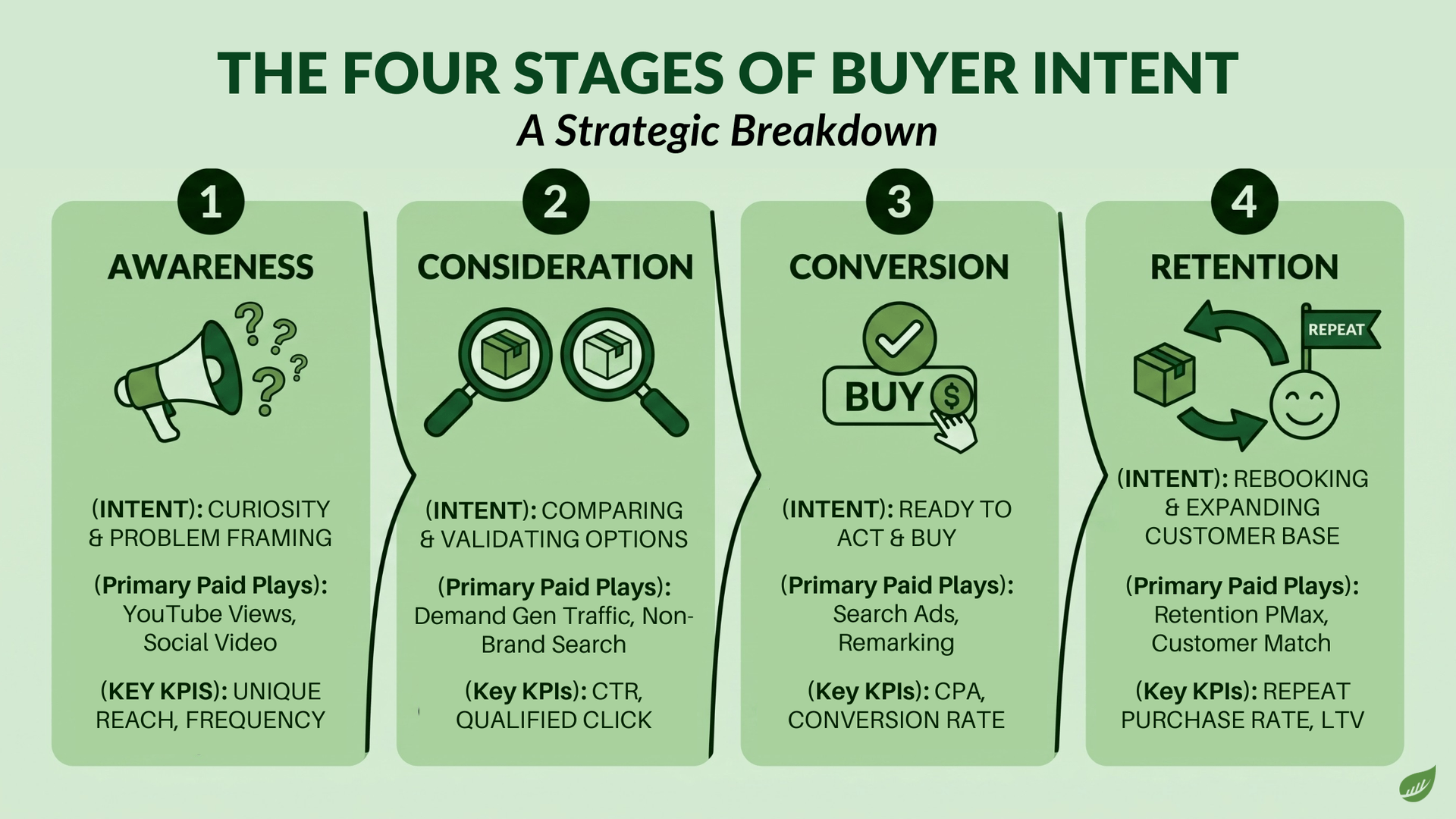
| Stage | Buyer intent | Primary paid plays | KPIs that match the job |
|---|---|---|---|
| Awareness | Low. Curiosity, problem framing, exploration | YouTube reach/views, social video, Demand Gen reach setups | Unique reach, frequency, view rate, engaged visits, and branded search lift |
| Consideration | Medium. Compare, validate, self-qualify | Demand Gen for traffic/leads, non-brand Search, Microsoft in-market audiences | CTR, engaged sessions, cost per qualified click, lead-to-MQL rate |
| Conversion | High. Ready to act | Search, Performance Max, recency-tuned remarketing | CPA/CPL, conversion rate, cost per qualified lead, high-intent impression share |
| Retention | Post-purchase. Rebook, expand | PMax retention mode, Customer Match, CRM-sync audiences | Repeat purchase rate, blended MER, LTV:CAC, incremental lift |
Notice the KPI column. If you're judging an awareness campaign by CPA, you'll kill the thing doing its job. That mismatch is the quiet budget killer in most accounts.
What Does Awareness-Stage Paid Advertising Look Like When AI Owns Discovery?
Awareness-stage paid advertising creates memory and frames the problem before a buyer is ready to act. It uses reach-and-view formats like YouTube and Demand Gen rather than direct-response bidding.
You are optimizing for signal creation, not immediate CPA. Get that straight before you spend a dollar here.
Google has consolidated most of the visual, mid- and upper-funnel inventory under Demand Gen. Video Action Campaigns began upgrading to Demand Gen starting in Q2 2025 (Google, 2024).
In 2026, Google announced that Display Ads are migrating into Demand Gen too (Google, 2026b).
That matters because your awareness buys now share an engine with your consideration buys. This makes clean audience and conversion-action separation more important, not less.
A few tactics that separate a real awareness program from accidental display waste:
- Build three to five problem-aware creative angles for your ad campaign and rotate them weekly. You are testing which framing of the problem earns attention, not which offer converts.
- Constrain by geo, time, and device from day one if you are local or service-based. We have seen awareness budgets quietly evaporate into irrelevant impressions two states away because nobody set a radius.
- Treat video view, then site visit, then engaged session as your measurement chain. This keeps one-second bounces out of your consideration audiences, which is where most people poison their own retargeting pools without realizing it.
That said, awareness isn't a fix for a weak offer. If your landing experience is thin or your differentiation is fuzzy, more reach just means more people learning you are forgettable, faster.
How Should You Structure Consideration-Stage Campaigns So Buyers Self-Qualify?
Consideration-stage campaigns help buyers compare, validate, and self-qualify. They do this by pairing intent-rich Search and Demand Gen traffic with landing pages built for a specific decision cluster.
This is where AI is most active, so whether you are using social video or paid search advertising, your paid ads need to answer the exact questions a shopper is already asking an AI assistant.
The plays that map here are non-brand Search targeting comparison-style query families ("options", "cost", "reviews", "near me"), Demand Gen for traffic and leads, and Microsoft in-market audiences when you do not have enough remarketing volume yet.
Microsoft defines in-market audiences as segments built from real intent signals like searches, clicks, and page views. This makes them a useful shortcut for reaching people mid-decision when your own data is thin (Microsoft, 2026).
But the tactic that actually moves the needle is landing page structure. Build one page per consideration cluster.
For a catering client, that means separate pages for wedding catering, corporate catering, and holiday parties. Each needs proof (menus, packages, pricing anchors), friction reducers (an availability checker, a sample quote range), and a soft conversion like a downloadable menu.
And here is the part teams skip, then wonder why their bidding gets weird. Separate your conversion actions by stage inside the platform. A menu download is a consideration signal. A quote request or tasting booking is a conversion signal.
If you feed both into a single bidding target, Smart Bidding will happily chase cheap, low-intent micro-conversions and starve your actual pipeline. We have fixed accounts where this one change doubled qualified lead volume without adding a cent to the budget.
This separation is critical in any paid media strategy aiming for long-term efficiency. If mapping out these distinct conversion actions and building cluster-specific landing pages feels technically complex, our team at BusySeed specializes in architecting consideration structures that naturally qualify your buyers.
How Do You Capture High-Intent Buyers Efficiently at the Conversion Stage?
Conversion-stage paid search advertising captures ready-to-act demand using Search and Performance Max. It relies on tight negative keywords and recency-tuned remarketing to keep spend on the buyers closest to a decision.
The intent signals here are unmistakable:
- Brand and service searches
- Quote requests
- Availability checks
- Return visits
- Call clicks
Two structural moves matter most.
- First, build an intent ladder in Search. Top-of-funnel queries ("catering ideas", "how much does catering cost") route to consideration landing pages. Bottom-of-funnel queries ("catering quote Santa Barbara", "wedding caterer availability") route to conversion pages with short forms and call routing. Same account, different destinations, matched to where the person actually is.
- Second, run negative keywords aggressively. Performance Max and broad match Search will drift into research traffic if you let them. This quietly reclassifies your conversion budget as expensive mid-funnel exploration. Negatives are the fence that keeps your high-intent Google Ads campaigns high-intent.
Google has also made lifecycle optimization explicit in-product. Customer Lifecycle goals let you prioritize new customer acquisition versus retention and re-engagement across Search, Performance Max, Shopping, and Demand Gen (Google, 2026a).
Use new-customer acquisition when budget is tight, and you need genuinely incremental buyers. Use retention when you have real repeat-purchase cycles.
Performance Max now reports on this directly, including a customer acquisition cost column. You can finally see whether PMax is finding new people or just harvesting your existing demand (Google, 2025).
This is exactly where intent alignment pays off in hard numbers. We took a Santa Barbara catering company that had lived on referrals and word of mouth and turned Google Ads into a consistent lead channel.
The ad campaign hit a click-through rate of nearly 19%, against a stated event-industry average of 6.89%. It also achieved a 7.95% conversion rate versus a 3.87% benchmark. For context on how standout that CTR is, WordStream's 2024 Google Ads benchmarks put the overall average CTR across industries at 6.42%. Roughly 19% is genuinely rare, even allowing for category variance (WordStream, 2024).
The lesson wasn't "run Google Ads". It was only when a time-sensitive, local offer became predictable that a pipeline was created when three things lined up:
- Keywords were segmented by intent
- Landing pages were built for fast qualification
- Conversion tracking was tight enough to train the bidding
Miss any one of those and the whole thing wobbles. This precision is what separates a high-performing paid media strategy from one that merely spends money.
Why Is Retention the Stage Everyone Underfunds, and How Do You Fix It?
Retention-stage paid advertising increases customer lifetime value and smooths demand volatility using Performance Max retention modes, Customer Match, and CRM-synced audiences targeting lapsed and high-LTV customers.
It is also the stage that consistently looks weakest in last-click reporting, even when it is the most profitable.
Why does it look weak? Because measurement is fragmented.
Only 32% of marketers say they measure media spend holistically across digital and traditional (Nielsen, 2025). Retention campaigns tend to influence purchases that get credited elsewhere, so they get defunded by people staring at the wrong dashboard.
Here is how this strategy compares across business types:
- General Seasonal Businesses: The highest-ROI retention play is timed re-engagement to capture recurring demand.
- Event-Based Clients: This specifically means retargeting 11 to 13 months after a major booking with new menu launches, referral offers, and corporate rebooking packages.
You are not chasing a cold audience. You are showing up right as the need recurs, using data you already own through Customer Match. This approach is particularly effective when integrated into a broader paid media strategy that values long-term customer relationships over short-term conversions.
Launching a targeted ad campaign for your existing customer base is often cheaper and yields higher returns than acquiring new buyers with standard paid ads. Retaining high-LTV customers requires precise timing and flawless data integration. BusySeed helps brands build automated, CRM-synced retention campaigns that reliably capture recurring demand.
The Tracking Shift That Will Quietly Wreck Your Journey Reporting in 2026
Here's the thing almost nobody has priced in yet. Starting June 15, 2026, Google Analytics will use Consent Mode within Google Ads as the single control for Ads data.
If your Consent Mode isn't correctly passing ad_storage, your conversion-stage campaigns, particularly your paid search advertising, can suddenly look like they are failing when they are actually just under-measured.
Play that out. Your lower-funnel numbers drop. Someone panics and shifts budget upward into awareness, where CPAs "look" cheaper because they were never measured against real conversions in the first place.
Now you are overspending on the top of the funnel and starving the bottom, all because of a tagging problem.
The FTC has spent years documenting how consumer data gets collected and monetized, and the regulatory drift is all one direction: toward consent-forward, first-party architecture (Federal Trade Commission, 2024). Build for that now.
Our fix is a three-layer measurement stack, which is the only way we trust for full-journey budget decisions:
- Platform conversion reporting for fast optimization feedback. Quick, but incomplete and increasingly consent-dependent.
- CRM-qualified outcomes for lead quality, pipeline, and booked revenue. This is where you catch bidding that's chasing junk.
- Incrementality validation through geo tests and holdouts. This tells you what your paid ads actually caused versus what would've happened anyway.
Not every brand needs all three at full rigor. But if you are allocating across four stages, you need at least a lightweight version of each, or you are guessing.
This comprehensive approach ensures that our paid media strategy remains effective even as privacy regulations evolve. Stop guessing with your data. Let BusySeed stand up your three-layer measurement stack so you can protect your performance and maintain full compliance. Click here to schedule your free strategy session with us.
A Full-Journey Paid Media Checklist You Can Run This Quarter
- Map every existing ad campaign to a single stage. If a campaign spans two different stages, split it immediately.
- Create distinct conversion actions per stage. Use soft signals for consideration and hard signals for conversion, ensuring your bidding algorithm optimizes for the right one.
- Build one landing page per consideration cluster. Equip each page with clear proof, a friction reducer, and a soft conversion point.
- Construct your Search intent ladder. Route top-of-funnel queries and bottom-of-funnel queries to entirely different pages based on exactly what the user is searching for.
- Layer negative keywords aggressively. Apply them to your conversion campaigns and PMax to effectively block research-stage drift.
- Set Customer lifecycle goals where they apply. Choose between new-customer acquisition or retention based on your actual, proven purchase cycle.
- Audit Consent Mode before June 15, 2026. Confirm that your ad_storage parameters are passing correctly so you do not lose critical data.
- Stand up the three-layer measurement stack. At an absolute minimum, connect your platform reporting directly to your CRM.
- Build timed re-engagement audiences. Use Customer Match for any seasonal or repeat-purchase business to capture recurring demand exactly when it happens.
- Review KPIs by stage and rebalance monthly. Never rely on a single blended CPA across the whole account to judge success.
If you want a partner to build and run this end-to-end, our paid media team at BusySeed does exactly this kind of intent-aligned architecture work.
The Bottom Line
In 2026, paid media success isn't about who spends the most; it's about who aligns their spending with actual buyer intent. From awareness programs that frame the problem to conversion campaigns that capture ready-to-act demand, every stage requires distinct rules, landing pages, and measurement stacks. With privacy shifts like Consent Mode taking effect this year, this tight architecture is a necessity, not a luxury.
If you want an expert to pressure-test your plan, build a resilient measurement stack, and prioritize the highest-ROI moves, let's talk. BusySeed will audit your current setup, build a practical full-funnel roadmap, and orchestrate the handoffs that matter most. Connect with us to build your faster, cleaner, higher-converting paid media engine today.
Frequently Asked Questions
1. What digital marketing services should I prioritize for a local business with a small budget?
For a budget-constrained local business, prioritize digital marketing services that address intent misalignment and measurement fragmentation. Concentrate your spend on high-intent paid search advertising first, using tightly segmented keywords and conversion-focused landing pages. Expand into consideration stages only once your core tracking is stable, and you can clearly attribute leads to revenue.
2. What should I look for when evaluating the top advertising companies NYC has to offer?
When searching for the best digital marketing agency in NYC for full-funnel execution, prioritize partners that combine deep platform expertise with intent-aligned architecture. Look for agencies like BusySeed that specialize in building stage-separated conversion actions, negative keyword ladders, and CRM-synced measurement stacks to demonstrate real pipeline growth, not just last-click vanity conversions.
3. What are the best AI solutions for targeted advertising in 2026?
The best AI solutions are the intent-driven audience and bidding systems built directly into major platforms. Tools like Google's Demand Gen and Microsoft's in-market audiences are incredibly powerful because they build segments from real search and click behaviors. To get the strongest results, pair these AI tools with clean, stage-separated conversion data so the algorithm optimizes toward real pipeline.
4. What are the best ethical AI tools for paid media right now?
The top ethical AI tools are those that balance high performance with absolute transparency and consent compliance. Google's Consent Mode and Customer Match using first-party data are foundational because they respect user privacy while still enabling highly effective targeting. Always ensure any AI tool you use provides clear documentation of how data is collected and complies with FTC guidelines.
5. How should I split my budget to fix an underperforming full-funnel campaign?
Full-funnel programs usually fail at the handoffs between stages, not in the creative. Start by funding conversion campaigns to full impression share on your highest-intent terms. Once those are capped by demand, allocate the remaining budget upstream to awareness and consideration to generate future intent. Fix your plumbing first, separate conversion actions by stage, and verify your consent tracking before pouring more money into new top-of-funnel paid ads.
Works Cited
- Federal Trade Commission. FTC Staff Report Finds Large Social Media and Video Streaming Companies Have Engaged in Vast Surveillance. FTC Newsroom, 12 Sept. 2024.
- Google. Customer Lifecycle Goals. Google Ads Help, 2026a.
- Google. Google Display Ads Are Migrating to Demand Gen. Google Ads & Commerce Blog, 2026b.
- Google. More Goals and Image Controls Coming to Performance Max. Google Business, 2025.
- Google. Upgrade to Demand Gen. Google Ads & Commerce Blog, 2024.
- Interactive Advertising Bureau (IAB). When AI Guides the Shopping Journey. IAB Insights, 2026.
- IAB and PwC. Internet Ad Revenue Report: Full Year 2025. April 2026.
- Microsoft Advertising. When Discovery Becomes Decision: How AI Search Is Redefining Customer Intent. Microsoft Advertising Blog, April 2026.
- Microsoft. In-Market Audiences. Microsoft Advertising Help, 2026.
- Nielsen. 2025 Annual Marketing Report: Looking at the Power of Data-Driven Marketing. 2025.
- WordStream. Google Ads Benchmarks 2024. May 2024.