
TL;DR
- AI use in marketing activities nearly doubled from 2024 to 2026, rising from 13.1% to 24.2%, while generative AI use in marketing grew from 7.0% to 22.4% (Duke Fuqua, 2026).
- Tool access is not the bottleneck. Martech utilization sits at just 49%, meaning most teams underuse the stack they already pay for (Gartner, 2025a).
- Speed-to-lead is leaking revenue. In a study of 114 companies, more than 99% failed to respond within 5 minutes, and the average time to reply to a personalized email was 11 hours and 54 minutes (Workato, 2026).
- AI agents are not automatic wins. 45% of martech leaders say vendor-offered AI agents fail to meet promised business performance (Gartner, 2025b).
- Smarter measurement is mainstreaming. Google released Meridian as an open-source marketing mix model, and the IAB published incrementality guidance to move budgets on causal evidence (Google, 2025a; IAB, 2025a).
AI in marketing is the practical application of artificial intelligence to marketing decisions. From budget allocation to creative selection to lead routing, it helps teams make better calls and not just faster ones.
In 2026, adoption is broad, but value is uneven. The difference between the two comes down to workflow design, clean data, and honest measurement.
This piece walks industry practitioners through where AI tools for marketing genuinely raise decision quality, how AI integration should be sequenced, and where AI content creation and operational efficiency deliver returns without eroding brand authenticity or breaking privacy rules.
What Does It Mean To Market Smarter With AI Rather Than Just Faster?
Marketing smarter with AI means using it to improve the quality of decisions, not only the speed of output. Faster produces more emails, more variations, and more assets.
Smarter changes which budget gets allocated where, which creative ships, which lead gets routed first, and which offer a returning customer sees. The distinction matters because volume without better decisions creates noise, and noise is easy for anyone reviewing campaign performance to spot.
The true value of AI in marketing becomes clear when you look at the adoption numbers. AI use in marketing activities nearly doubled between 2024 and 2026, and generative AI use more than tripled over the same period, according to The CMO Survey (Duke Fuqua, 2026).
Nearly nine in ten respondents say their organizations regularly use AI. Furthermore, 23% report scaling an agentic AI system within the enterprise, and an additional 39% are experimenting with AI agents (McKinsey, 2025a).
Yet 27% of CMOs still report limited or no adoption of generative AI in marketing campaigns, per Gartner (Gartner, 2025c). Broad use, uneven value. At BusySeed, we help brands bridge this gap by aligning AI integration with actual business outcomes rather than vanity metrics.
Why Is The Smarter Gap Usually About Data And Workflow, Not Tools?
The smarter gap is usually a data, measurement, or workflow problem rather than a tool-access problem. Most teams already have the software, yet they struggle to deploy their AI tools effectively for marketing.
The 2025 Gartner Marketing Technology Survey reports martech utilization at 49%, meaning roughly half of purchased capabilities go unused (Gartner, 2025a). Adding AI on top of an underused stack rarely fixes decision quality.
Two more signals reinforce this:
- Marketing automation replacement fell from 31.1% in 2024 to 19.4% in 2025, per the 2025 MarTech Replacement Survey (MarTech, 2026). This suggests teams are settling into the tools they own rather than chasing new ones.
- AI agents are not automatically delivering, as 45% of martech leaders with agents in pilots or production say vendor capabilities fall short of expectations (Gartner, 2025b).
The lesson for experts is clear: AI integration succeeds when it changes actions inside redesigned workflows, not when it produces more slides or drafts.
Whether you are trying to fix these processes in-house or vetting the best digital marketing agency in NYC for support, BusySeed can provide the exact strategic roadmap you need to turn an underused martech stack into a true revenue engine.
Where Does AI Make Marketing Genuinely Smarter In 2026?
AI makes marketing smarter in four areas where it improves decisions rather than just accelerating tasks:
- Customer insight and personalization
- Operations and speed-to-lead
- Creative and targeting
- Measurement
Each area has recent data showing both the opportunity and the maturity gap.
1. How Does AI Improve Customer Insight And Real-Time Personalization?
AI improves personalization by closing the distance between static segmentation and journeys that respond to what a customer just did.
The demand signal is strong. 88% of consumers say they are more likely to buy when brands personalize in real time, and 35% say significantly more likely, per Twilio's summary of its 2025 State of Customer Engagement findings (Twilio, 2025).
The maturity gap is wide. While 66% of organizations globally are piloting or using generative AI in marketing and CX operations, per Adobe's 2025 AI and Digital Trends report (Adobe, 2025), their capabilities lag behind:
- Only 31% can update offers in real time to reflect a customer's most recent browsing and purchase.
- 39% personalize the web experience as customers browse.
- Only 26% say journeys and activation systems are always on.
- Just 20% report always-on retention journeys.
The smarter unlock here depends on identity resolution, data unification, and event-driven activation, not on generating more content. That distinction is why AI content creation alone will not move retention numbers. BusySeed specializes in building these exact event-driven architectures, ensuring your personalization efforts actually convert.
2. How Does AI Protect Revenue Through Speed-To-Lead And Workflow Automation?
AI protects revenue by preventing leakage: missed leads, broken handoffs, and stale follow-up logic that quietly drain the pipeline. The clearest example is response time.
According to the 2026 Workato Lead Response Time Study of 114 companies (Workato, 2026):
- More than 99% of the companies did not respond to leads within five minutes.
- The average time to deliver a personalized email response was 11 hours and 54 minutes.
That is a decision-quality failure disguised as a speed problem, and it is exactly where thoughtful automation pays off.
Automation also lifts returns when applied to real workflows. An analysis of 153 campaigns found that automation increases marketing ROI by 32% (DMA, 2025).
This is where operational efficiency becomes strategic. It allows you to:
- Direct leads instantly.
- Keep follow-up logic current.
- Reallocate human effort toward strategy, creative direction, and experimentation.
Achieving this level of operational efficiency means your team spends less time on manual data entry and more time closing deals.
Want to automate these handoffs without losing the human touch? Reach out to us at BusySeed so that we can build and refine your speed-to-lead workflows.
3. How Does AI Improve Creativity and Targeting Without Making Everything Generic?
AI improves creativity when paired with governance and measurement, because asset volume alone does not create an advantage.
More than half of marketers already use generative AI for creative content and audience targeting, based on a survey of 125 US ad industry executives cited by the IAB (IAB, 2025b). Video is moving even faster, with 86% of buyers using or planning to use generative AI to build video ad creative, per the IAB's report on the widening AI gap (IAB, 2026b).
Platform tooling is expanding too. Meta says its Muse Image capability is coming soon for advertisers through Advantage+ creative, according to Meta's newsroom (Meta, 2026). However, relying solely on AI content creation without a strategic filter risks producing high volumes of generic messaging that fail to capture your unique voice.
When everyone runs the same models, differentiation comes from brand governance, creative testing, and incrementality loops rather than raw output. AI should create where variation and quality assurance add value, and only assist where a human sets the strategic direction and voice. That is how AI content creation remains distinctive rather than blending into a sea of identical prompts.
4. How Does AI Make Measurement Smarter Through MMM And Incrementality?
AI makes measurement smarter by shifting budget decisions toward causal evidence rather than relying solely on last-click or platform-reported attribution.
Google released Meridian broadly on January 29, 2025, as an open-source marketing mix model (Google, 2025a), with a public Meridian codebase on GitHub for teams that want to implement it directly.
Standards are catching up. The IAB published incrementality guidance describing experiments, model-based counterfactuals, econometric models, and hybrid proxies (IAB, 2025a). Furthermore, its State of Data 2026 report frames the shift as an AI-powered transformation in measurement (IAB, 2026a).
For experts, marketing smarter in 2026 often means shifting spend based on incrementality and MMM, then feeding those results back into the AI tools for marketing that allocate the next round.
How Do AI Overviews Change SEO Strategy And Reporting?
AI Overviews are changing SEO by introducing new visibility surfaces where citations no longer reliably drive clicks, forcing a rethink of both strategy and reporting.
Google announced AI Overviews as new ways to connect to the web on August 15, 2024 (Google, 2024), and stated on August 6, 2025, that it is sending slightly more quality clicks to websites than a year ago, defining quality clicks as those where users do not quickly click back (Google, 2025c).
As AI content creation scales across the web, independent research complicates the picture. A preprint from August 2026 found that clicks to sources cited in AI Overviews were very rare, occurring in about 1% of visits (arXiv, 2026).
Google has responded with new reporting and controls to navigate this:
- It launched Search Console reporting for generative AI features on June 3, 2026 (Google, 2026a).
- It documented a generative AI performance report that shows impressions for these capabilities (Google, n.d.).
- It introduced a Search Console control to determine whether a site can appear in, and help ground responses in, generative AI Search features (Google, 2026b).
Smarter SEO in 2026 means measuring visibility within these surfaces and making deliberate choices about participation, formatting, and brand authority signals.
What Governance And Compliance Risks Come With AI In Marketing?
The main governance risks in AI in marketing are deceptive claims, fake reviews and testimonials, copyright uncertainty, and state privacy obligations.
Here is how the landscape is shifting:
- Deceptive Claims: The FTC announced a crackdown on deceptive AI claims and schemes, stating there is no AI exemption from the laws on the books (FTC, 2024a).
- Fake Reviews: The FTC's Consumer Reviews and Testimonials Rule took effect on October 21, 2024 (FTC, 2024b) and is codified as 16 CFR Part 465 (Cornell Legal Information Institute, 2024).
- Copyright Uncertainty: The US Copyright Office maintains its AI guidance hub (US Copyright Office, 2025a) and has published Copyright and Artificial Intelligence, Part 2: Copyrightability (US Copyright Office, 2025b).
- State Privacy Obligations: The IAPP notes that additional state requirements came online as 2026 began (IAPP, 2026b).
Any operational guidance on reviews, profiling, or copyrightability should be reviewed by qualified counsel for the states where a business operates, since this is not legal advice.
One useful trust angle is content provenance. The C2PA Content Credentials standard verifies the origin and history of digital content (C2PA, 2024a). As the C2PA specifications explain, it does not judge whether content is true, only whether provenance data is well-formed and tamper-evident, which is a practical way to signal authenticity in AI-assisted creative (C2PA, 2024b).
Which Measurement Approach Should Guide AI-Driven Budget Decisions?
The right measurement approach depends on the decision being made, and combining methods beats relying on any single one. The table below compares the main options using the sources referenced above.
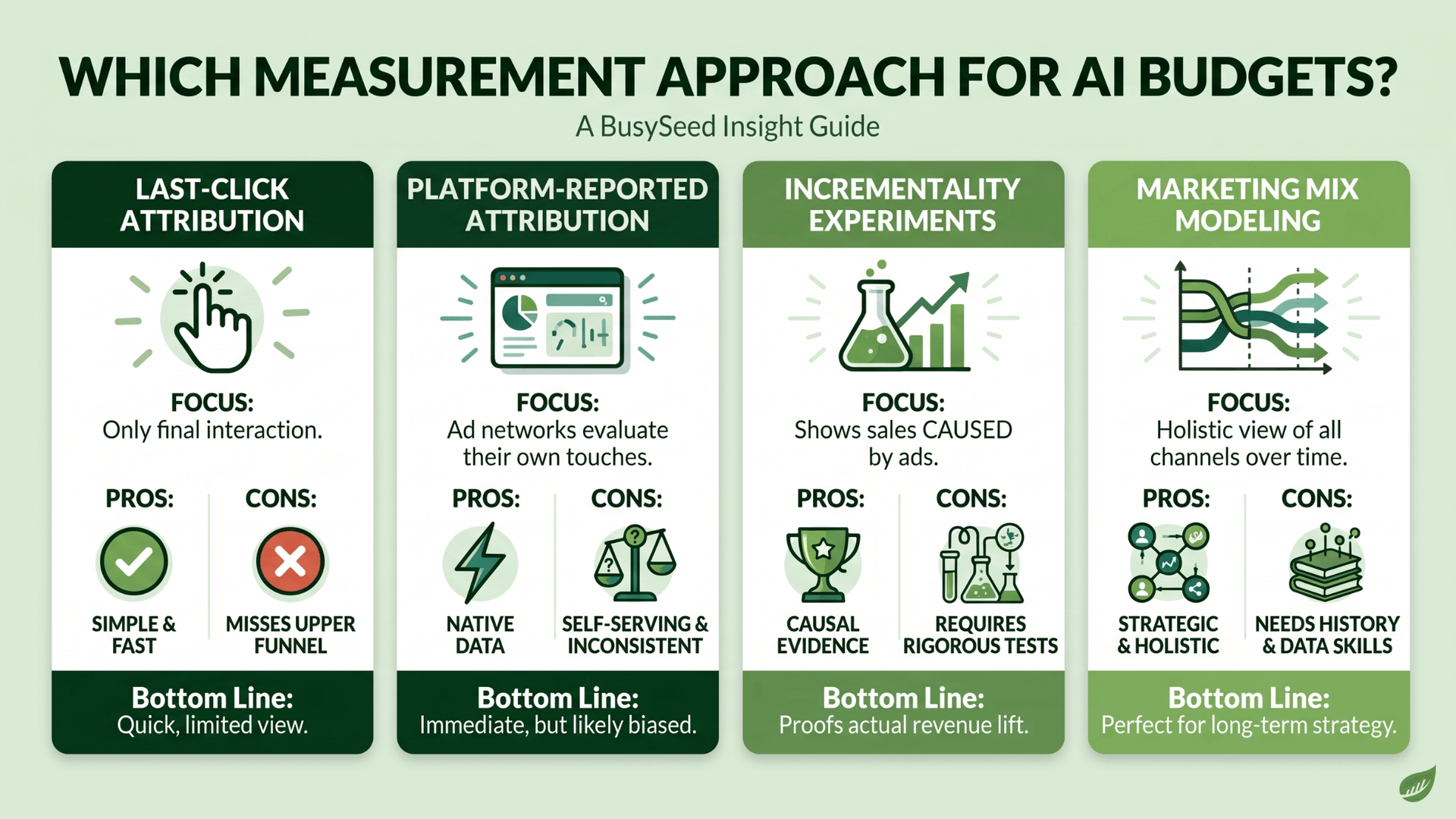
| Approach | What It Answers | Strength | Limitation |
|---|---|---|---|
| Last-click attribution | Which final touch preceded conversion | Simple, always available | Ignores upper-funnel and assist channels |
| Platform-reported attribution | How a single platform values its own touches | Native, fast | Self-reported and inconsistent across walled gardens |
| Incrementality experiments | Whether spend caused lift (IAB, 2025a) | Causal evidence | Requires test design and holdouts |
| Marketing mix modeling | How channels contribute over time, via Meridian | Cross-channel, privacy-durable | Needs history and modeling skill |
For teams running paid budgets, pairing incrementality tests with MMM is how AI-informed allocation stays honest.
The Market Smarter Integration Checklist
Use this ordered checklist to ensure a smooth AI integration that improves decisions and respects governance. It is anchored to McKinsey's scaling practices and the NIST AI Risk Management Framework.
- Define value outcomes and decision points. Name the decisions AI should improve, such as budget allocation, creative selection, offer strategy, and lead routing, since McKinsey ties tracked KPIs and embedded processes to real value capture (McKinsey, 2025b).
- Map risks and governance before scaling. Use the NIST AI RMF 1.0 (NIST, 2024a) and the NIST GenAI Profile (NIST, 2024b) to address data handling, privacy, brand safety, and human review.
- Audit data readiness for personalization and measurement. Check identity, event capture, taxonomy, and clean conversion signals, since Adobe links always-on journey gaps to data readiness hurdles (Adobe, 2025).
- Prioritize a small set of high-impact use cases. Start with speed-to-lead, lifecycle personalization, creative testing, and MMM or incrementality, given the uneven adoption Gartner documents (Gartner, 2025c).
- Design human-in-the-loop workflows. Define who approves what, escalation paths, brand voice guardrails, and audit logs, consistent with the NIST AI RMF (NIST, 2024a).
- Instrument measurement with causal methods. Run incrementality tests and MMM for budget shifts using IAB guidance and Meridian rather than platform attribution alone.
- Redesign workflows before scaling. A successful AI integration avoids AI bolt-ons that increase content volume without improving decision quality, following the workflow-redesign practices outlined by McKinsey (McKinsey, 2025b).
- Verify content provenance. Apply C2PA Content Credentials (C2PA, 2024a) to AI-assisted assets to make their origin tamper-evident.
- Route legal review early. Validate any reviews, profiling, or copyright claims against FTC and state privacy sources before publishing.
Navigating this checklist can be complex, but BusySeed has the experience to guide your AI integration safely and profitably from step one.
The Bottom Line on Marketing Smarter
AI in marketing isn't about seeing how many variations you can generate per minute; it is about making fundamentally better decisions across your entire funnel. Clean data, redesigned workflows, and honest incrementality testing are what separate the brands that capture real value from those that just make noise.
If you are tired of tools that promise the world but fail to deliver a pipeline, it is time to rethink your foundation. Whether you are competing locally or globally, standing out among marketing agencies in New York City, or scaling an enterprise stack, BusySeed can help. We audit your workflows, integrate AI tools for marketing that actually drive revenue, and build a system where operational efficiency meets measurable growth.
Ready to stop guessing and start scaling? Reach out to BusySeed to build your smarter, higher-converting marketing engine today.
Frequently Asked Questions
1. What should marketers look for in digital marketing services that use AI responsibly?
Look for services that pair AI tools for marketing with specific decisions and measure impact using causal methods, not just time saved. Ask how they handle human review, brand voice guardrails, and audit logs, ideally mapped to the NIST AI RMF (NIST, 2024a). A responsible partner will also flag FTC and state privacy considerations before running campaigns, since the FTC has made clear that there is no AI exemption from existing law (FTC, 2024a).
2. How do marketing agencies compare on AI adoption?
Marketing agencies operate within a broader industry trend: 9 in 10 US marketing agencies use generative AI, and about half use agentic AI for execution (Forrester, 2026). Adoption itself is table stakes for AI in marketing, so the meaningful comparison is how an agency uses AI to improve decisions and measurement. Judge an agency by whether it can prove incrementality and pipeline impact, not by how many assets it can generate.
3. What are the best AI tools for ethical lead qualification?
The best AI tools for ethical lead qualification are ones that improve speed and accuracy while keeping a human in the loop and respecting consent. Speed matters because more than 99% of companies miss the five-minute response window (Workato, 2026), but qualification logic must avoid unfair profiling under state privacy rules tracked by the IAPP (IAPP, 2026a). Prioritize tools with audit logs, transparent scoring, and clean opt-out handling.
4. What are the best AI automation tools that prioritize privacy?
The best AI automation tools that prioritize privacy give teams control over data access, clear auditability, and alignment with recognized governance frameworks. These tools don't just protect data; they also boost operational efficiency by streamlining its safe processing. Favor tools that support first-party data models, configurable policies, versioning, and approvals that map to the NIST AI RMF functions (NIST, 2024a). Because additional state privacy requirements came online as 2026 began (IAPP, 2026b), confirm that the tool supports profiling opt-outs and automated decision-making disclosures for the relevant operating states.
5. Should a business opt in or out of having its content ground AI search answers?
That is a deliberate strategic choice, and Google now gives site owners control in Search Console (Google, 2026b) to decide whether their content can appear in and help ground generative AI Search features. Weigh the visibility of citation against the finding that clicks to cited sources are very rare, about 1% of visits (arXiv, 2026). Measure the outcome using Google's generative AI performance report (Google, 2026a) before committing to a permanent stance.
Works Cited
- Adobe. 2025 AI and Digital Trends: Data and Insights. Adobe, 2025.
- arXiv. Clicks to Sources Cited in AI Overviews. arXiv, 2026.
- C2PA. Content Credentials Explainer, v2.2. C2PA, 2024a.
- C2PA. Specifications Index. C2PA, 2024b.
- Cornell Legal Information Institute. 16 CFR Part 465. Cornell Legal Information Institute, 2024.
- Data & Marketing Association (DMA). The Value of Automation Report 2025. DMA, 2025.
- Duke Fuqua. The CMO Survey: Highlights and Insights Report 2026. Duke Fuqua, 2026.
- Forrester. Nine in 10 US Marketing Agencies Use AI to Cut Costs and Expense. Forrester, 2026.
- FTC. FTC Announces Crackdown on Deceptive AI Claims and Schemes. FTC, 2024a.
- FTC. Consumer Reviews and Testimonials Rule: Questions and Answers. FTC, 2024b.
- Gartner. Marketing Technology and Emerging Trends. Gartner, 2025a.
- Gartner. 45 Percent of Martech Leaders Say Existing Vendor-Offered AI Agents Fail to Meet Expectations. Gartner, 2025b.
- Gartner. Over a Quarter of Marketing Organizations Have Limited or No Adoption of GenAI for Marketing Campaigns. Gartner, 2025c.
- Google. Gen AI Performance Reports. Google, 2026a.
- Google. New Controls for Website Owners. Google, 2026b.
- Google. Meridian Marketing Mix Model Open to Everyone. Google, 2025a.
- Google. Meridian GitHub Repository. Google, 2025b.
- Google. AI Search Driving More Queries, Higher Quality Clicks. Google, 2025c.
- Google. New Ways to Connect to the Web with AI Overviews. Google, 2024.
- Google. Generative AI Performance Report. Google, n.d.
- IAB. State of Data 2026 Report. IAB, 2026a.
- IAB. The AI Gap Widens. IAB, 2026b.
- IAB. Guidelines for Incremental Measurement in Commerce Media. IAB, 2025a.
- IAB. AI Adoption is Surging in Advertising. IAB, 2025b.
- IAPP. US State Privacy Legislation Tracker. IAPP, 2026a.
- IAPP. New Year, New Rules: US State Privacy Requirements Coming Online as 2026 Begins. IAPP, 2026b.
- MarTech. 2025 MarTech Replacement Survey. MarTech, 2026.
- McKinsey. The State of AI in 2025. McKinsey, 2025a.
- McKinsey. The State of AI: How Organizations Are Rewiring to Capture Value. McKinsey, 2025b.
- Meta. Introducing Muse Image. Meta, 2026.
- NIST. NIST AI RMF 1.0. NIST, 2024a.
- NIST. NIST GenAI Profile. NIST, 2024b.
- Twilio. 2025 State of Customer Engagement. Twilio, 2025.
- US Copyright Office. AI Guidance Hub. US Copyright Office, 2025a.
- US Copyright Office. Copyright and Artificial Intelligence, Part 2: Copyrightability. US Copyright Office, 2025b.
- Workato. Lead Response Time Study. Workato, 2026.