
TL;DR
- Marketing automation in 2026 requires orchestrating a unified buyer journey rather than piling on new software, especially as the martech landscape now stands at over 15,505 tools (Chiefmartec, 2026).
- With 61% of B2B buyers preferring a completely rep-free experience, your website and automated content act as your primary sales engine (Gartner, 2025a).
- Marketing budgets have flatlined at an average of 7.7% of company revenue, shifting the strategic focus strictly to operational efficiency and system integration (Gartner, 2025b).
- A properly integrated 5-layer marketing system delivers a +32% increase in marketing ROI and significantly improves the effectiveness of performance marketing (DMA, 2025).
Partnering With a Top NYC Marketing Automation Agency in 2026
A marketing automation agency in 2026 is a partner that engineers your buyer journey into a single connected system, where discovery, education, nurturing, and conversion run as a single, governed workflow rather than a pile of disconnected campaigns.
That distinction matters more this year than any clever ad or viral hook. Because budgets are flat, buyers want to serve themselves, and the tool graveyard keeps growing, the teams pulling ahead aren't the ones buying more software. They're the ones connecting what they already have.
This guide walks through why the system now beats the tactic and how to build one that actually converts. If you are looking for a team that specializes in this exact orchestration, discover how BusySeed can transform your disconnected campaigns into a unified revenue engine.
Let us be blunt about the shift. Conversion in 2026 is an orchestration outcome, not a traffic problem. If you're still measuring success by sessions and impressions, you're solving last decade's puzzle.
Why Has the "System" Replaced the Single Tactic as the Thing That Matters?
The system replaced the tactic because the buyer took over the buying process, and no single channel can control a journey it no longer owns. 61% of B2B buyers now prefer a rep-free buying experience, according to a Gartner survey of 632 buyers conducted in late 2024 (Gartner, 2025a).
Forrester goes further, predicting that more than half of $1M+ B2B transactions will be processed through digital self-serve channels like websites and marketplaces (Forrester, 2024).
Read those two numbers together, and the implication is uncomfortable. Your website and lifecycle content are now the primary salesperson for a majority of your pipeline. That's a big job to hand to assets that most teams treat as afterthoughts.
Here's the part the industry doesn't like hearing: buying more martech won't save you. The 2026 marketing technology landscape grew only 0.79% to 15,505 products, with heavy churn (1,488 tools added, 1,367 removed) (Chiefmartec, 2026). We've hit peak sprawl.
The competitive edge moved from acquisition to integration. Marketing is now systems design (data, orchestration, governance), and the winners treat it that way. A marketing automation agency that understands this shift will focus on workflow automation tools that unify disparate systems rather than adding more isolated solutions.
And the money pressure is real. Marketing budgets flatlined at 7.7% of company revenue in Gartner's 2025 CMO Spend Survey, and 59% of CMOs report insufficient budget (Gartner, 2025b).
When you can't outspend the problem, you have to out-engineer it. That's the whole story of 2026 in one sentence. The key to operational efficiency lies in creating a seamless system in which every touchpoint is connected, reducing waste and maximizing the impact of existing resources.
Is Conversion Really a Trust Problem Instead of a Traffic Problem?
Yes, and the data is embarrassing for most brands. Buyer expectations are rising far faster than execution, which means the gap between what people expect and what you deliver is now where deals leak out.
78% of consumers expect connected digital and physical experiences, but only 45% of brands actually meet that expectation, per Adobe's 2025 Digital Trends Report (Adobe, 2025). That is a 33-point delivery gap sitting between you and revenue.
Trust breaks in specific, measurable ways. Gartner found that 69% of B2B buyers report inconsistencies between a supplier's website and what its sellers say (Gartner, 2025a).
Think about what that does to a self-serve buyer. They read one story on your site, hear a different one from a rep, and quietly disqualify you. No angry email. No exit survey. Just gone.
Data handling compounds it. 88% of consumers expect responsible, secure data handling, but only 49% of organizations meet that expectation (Adobe, 2025).
So the trust deficit runs from the first click all the way through how you treat someone's information after they convert. You can drive all the traffic you want. If the story fractures across touchpoints, you are filling a leaky bucket faster.
That said, this isn't a fix for a weak product. No amount of orchestration will save an offer nobody wants. Consistency amplifies whatever you already are, for better or worse.
Strategic AI integration leveraging AI tools for marketing can help maintain this consistency by ensuring that messaging remains uniform across all channels and touchpoints, but only if the underlying product and value proposition are strong.
What Does an Integrated Marketing Engine Actually Look Like?
An integrated marketing engine is a five-layer system that turns scattered touchpoints into one governed workflow:
- A lifecycle map
- An activation-ready data foundation
- Orchestration workflows
- Conversion experiences built for humans and AI
- A governance layer
Each layer feeds the next. Skip one, and the whole thing wobbles. We will walk through all five, because this is the part most "thought leadership" hand-waves past.
Layer 1: Map The Lifecycle As States, Not Channels
Stop building channel plans. Start building a lifecycle map. Model the buyer journey as a series of states with clear entry and exit criteria: Anonymous, Known, Engaged, Sales-Ready, Customer, and Expansion.
A prospect isn't "in the email nurture". They're in a state, and email is just one mechanism moving them to the next one.
Tie each state to one or two primary KPIs and one or two primary mechanisms. Moving someone from Known to Engaged, for example, might be measured by qualified returning visits plus an email or SMS opt-in, driven by intent capture and an education sequence.
When you define states this way, your whole team suddenly agrees on what "progress" means. That alignment alone is worth the exercise. This approach is fundamental to operational efficiency, as it eliminates redundant efforts and ensures that every marketing action is purposeful and measurable.
Layer 2: Build A Data Foundation You Can Actually Activate
Prioritize activation-grade data over dashboard-grade data. There is a difference, and most teams collect the wrong kind.
Activation-grade data (event streams from web and product, CRM records, support signals, transactions) can trigger a workflow in real time. Dashboard-grade data just makes a pretty chart nobody acts on.
The industry has a data problem, and it is not the collection. It is used. 97% of organizations collect diverse data, but only 24% actually use it to transform customer experiences (IBM Institute for Business Value, 2025).
Salesforce's own research backs the pain point: only 31% of marketers are fully satisfied with their ability to unify customer data sources (Salesforce, 2025).
So the bottleneck was never the data. It was unification and activation. Fix that before you buy another tool. A marketing automation agency can help bridge this gap by implementing workflow automation tools that ensure data is not only collected but also actionable, driving real-time decisions and personalized interactions.
Layer 3: Orchestration Workflows, Where Revenue Predictability Lives
This is where the system earns its keep. Orchestration workflows automatically connect discovery to decision, so a buyer's signal in one place triggers the right response elsewhere. Three worth building first:
- The intent-to-education router: High-intent page views trigger comparison content, proof, and a calculator, then offer a demo or self-serve checkout. The buyer educates themselves at their own pace, and you meet them with the exact asset at the moment that matters.
- The sales-content synchronization loop: When a rep updates a deal stage or logs an objection, the system auto-injects the next-best asset and reroutes the nurture branch. This is how you kill that 69% website-versus-seller inconsistency Gartner flagged (Gartner, 2025a).
- Relevance guardrails: Suppression rules stop irrelevant outreach before it happens. This one is non-negotiable because 73% of B2B buyers actively avoid suppliers who send irrelevant outreach (Gartner, 2025a). Not every mistimed email is neutral. It is negative.
Good workflow automation tools make these loops possible without a full engineering team, and a strong marketing automation agency spends most of its time here rather than on ad creative.
These tools are essential for achieving operational efficiency, as they automate repetitive tasks, reduce human error, and ensure that marketing efforts are both timely and relevant.
By leveraging AI tools for marketing, agencies can further enhance these workflows, making them more adaptive and responsive to real-time data. If you need an expert to architect these specific routers and guardrails, the team at BusySeed has the technical depth to connect your discovery phases directly to your decision points seamlessly.
Layer 4: Conversion Experiences for Humans and Machines
Here is a genuinely 2026 idea that many marketers still ignore. You now have a third audience: machines acting on behalf of humans.
Chiefmartec's 2026 landscape analysis explicitly calls out agents and answer engines as a new class of visitor you have to design for. AI assistants read your site, compare your claims, and recommend you (or don't) to their human (Chiefmartec, 2026).
Practically, that means structured product and service data, up-to-date policies, a real proof library, and claims that stay consistent everywhere. It also means an AI concierge or chat that can answer, qualify, and route without hallucinating.
This isn't speculative demand. Adobe reported a 1,950% year-over-year jump in retail site traffic from chatbot interactions on Cyber Monday 2024 (Adobe, 2025).
Buyers are already arriving through machine intermediaries. The question is whether your content is legible to them. Comprehensive AI integration in marketing is no longer optional; it is a necessity to ensure your content is accessible and actionable for both human and machine audiences.
Layer 5: Governance and Trust As A Conversion Lever
Governance isn't legal overhead you tolerate. It is a conversion lever, especially given that 88% of data-handling expectations.
Anchor your AI use to the NIST Generative AI Profile for risk management (NIST, 2025). Follow the FTC's guidance on endorsements and reviews, which matters more every quarter as AI-generated content and review fraud rise.
And plan for continued cookie volatility. Google's Privacy Sandbox update confirms Chrome is keeping a user-choice approach to third-party cookies, so keep investing in first-party and consented data (Privacy Sandbox, 2025). That is the only foundation that survives the next platform mood swing.
Does Automation Actually Improve Performance, or Just Save Time?
It does both, but the performance lift is the part people underrate. A DMA analysis of award campaigns (153 automation-using campaigns pulled from a database of 1,720) found that automation delivered a +32% increase in marketing ROI and a +50% boost in performance marketing effectiveness (DMA, 2025).
Automation stopped being a cost-center tool. It became a performance multiplier, but only when it is connected to data and lifecycle design. Bolt it onto chaos, and you just automate the chaos.
The efficiency story is real, too, and it is usually where the value shows up first. Gartner found that GenAI ROI initially appears as time efficiency (49%) and cost efficiency (40%) (Gartner, 2025b).
Ops wins before growth miracles. Anyone promising you an overnight revenue explosion from AI is selling something. The honest path is operational efficiency first, compounding into growth as the system matures.
Here is our mildly contrarian take: most teams are deploying AI in exactly the wrong place. They pile it on top-of-funnel content generation, where it is cheap and visible, and ignore the middle and bottom, where the money actually is.
Adobe's automation gap data proves the point. Organizations report they are not fully automated for the following (Adobe, 2025):
- Personalized recommendations (74%)
- Customer support (76%)
- Retention (80%)
- Reactivating dormant customers (83%)
The biggest revenue unlock isn't another blog post. It is automating routing, personalization, sales assist, and retention triggers. That is where the neglected upside sits.
By focusing AI tools for marketing on these high-impact areas, businesses can achieve significant gains in both efficiency and effectiveness, driving better outcomes with fewer resources.
Isn't AI Integration Too Expensive and Complex for Mid-Market Teams?
Not anymore, and the numbers make the old objection obsolete. AI integration is now operationally accessible because model costs have collapsed.
Stanford's 2025 AI Index reports that the cost to query a GPT-3.5-level model dropped from $20.00 per million tokens in November 2022 to $0.07 per million tokens by October 2024 (Stanford HAI, 2025). That is roughly a 280x decrease in under two years.
So the bottleneck moved. It is no longer the model cost. It is data readiness, workflow design, and governance that this five-layer system addresses.
The teams stuck waiting for "AI to get cheaper" are solving a problem that has already solved itself. AI tools for marketing are within reach for almost any budget now. What is scarce is the discipline to connect them to clean data and a real lifecycle map.
A marketing automation agency can provide the expertise needed to navigate these challenges, ensuring that AI integration is both cost-effective and strategically aligned with business goals.
Comparison: Isolated Tactics vs. an Integrated Marketing System
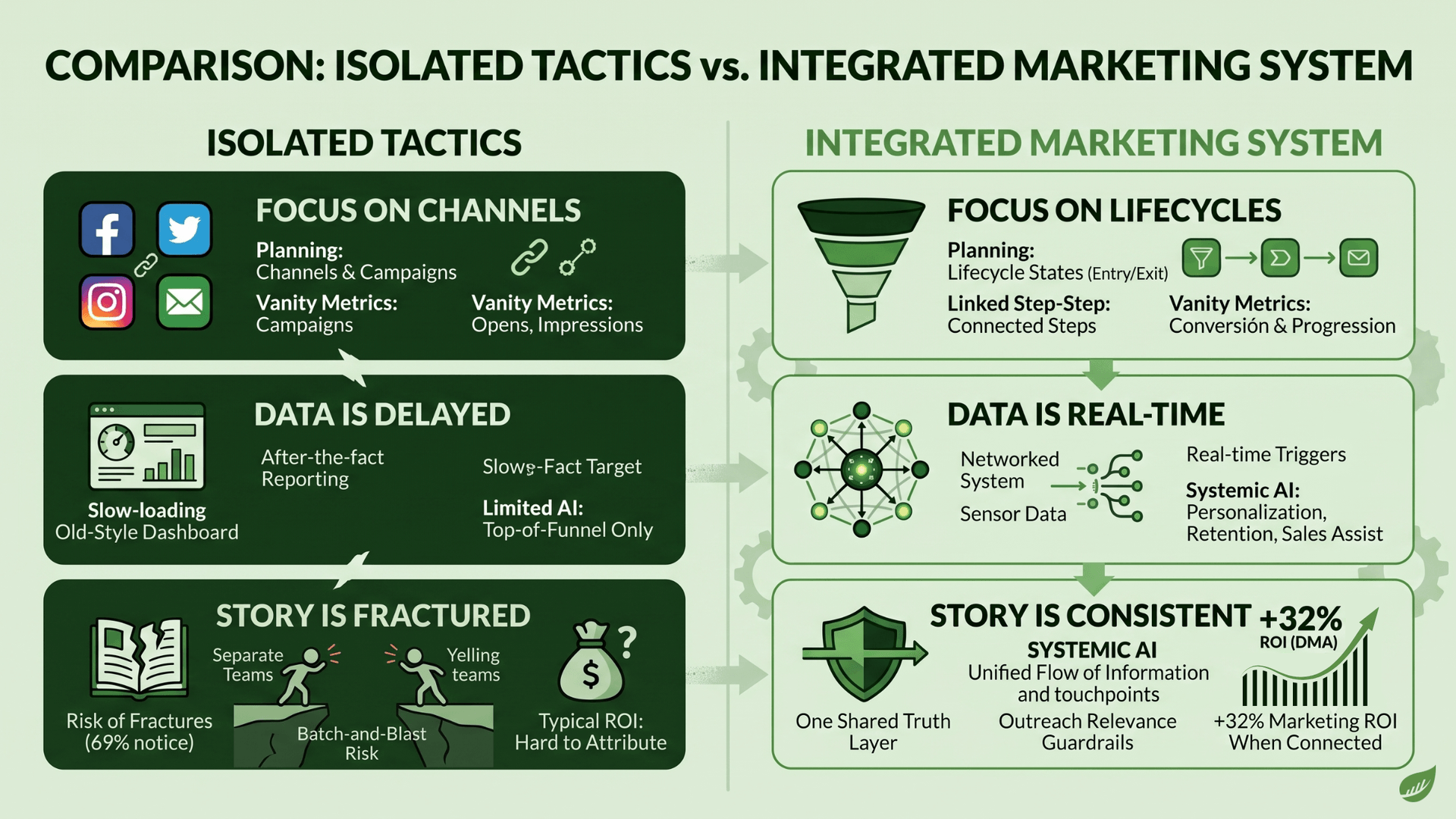
| Dimension | Isolated Tactics | Integrated Marketing System |
|---|---|---|
| Unit of planning | Channels and campaigns | Lifecycle states with entry/exit criteria |
| Primary success metric | Traffic, impressions, opens | State progression and conversion |
| Data role | Dashboard reporting after the fact | Activation-grade triggers in real time |
| AI deployment | Top-of-funnel content only | Routing, personalization, sales assist, retention |
| Story consistency | Fractures across teams (69% of buyers notice) | One shared truth layer across site, sales, and content |
| Outreach relevance | Batch-and-blast risk (73% of buyers avoid) | Suppression rules and relevance guardrails |
| Typical ROI signal | Hard to attribute | +32% marketing ROI (DMA) when connected |
| Machine readability | Ignored | Structured data for agents and answer engines |
What Does This Look Like When It Actually Works?
At BusySeed, our whole thesis is that Marketing + Sales + Tech = Growth, and we have applied that integrated approach across more than 500 businesses. Two examples make the point better than theory.
- ProPricer increased revenue 3x in a single year.
- Palisade Fence Company watched conversion rates climb to 19.85%.
Neither result came from "running ads". They came from engineering the journey end-to-end, connecting the story, signal capture, education, handoff, and retention into a single loop.
The lesson we keep relearning on client work: the number that moves isn't the one you obsess over at the top. It is the friction you remove in the middle.
A 19.85% conversion rate doesn't happen because you found a magic headline. It happens because a buyer never hits a dead end, never gets contradicted, and never waits for an answer a machine could have given instantly.
Not every brand sees the same lift, to be clear. If your data is a mess or your product story is genuinely muddy, the system will expose that before it fixes it. That is a feature, not a bug.
The key to achieving such results lies in the strategic use of workflow automation tools and AI tools for marketing, which streamline processes and enhance the buyer's journey at every stage.
An 8-Step Checklist to Build Your Converting System in 2026
- Draw the lifecycle map first. Define your states (from Anonymous through Expansion) with explicit entry and exit criteria before using a tool.
- Audit your data by activation, not volume. Separate the event streams and CRM signals you can trigger on from the reports you just looked at.
- Fix unification before buying anything. With only 31% of marketers satisfied with data unification, this is almost certainly your real gap.
- Build the intent-to-education router. Connect high-intent page views to proof, comparison content, and a self-serve path.
- Close the sales-content loop. Sync rep updates to nurture branches so your site and your sellers tell one story.
- Install relevance guardrails. Add suppression rules so you never join the 73% of suppliers buyers actively avoid.
- Make your content machine-readable. Structure product data, policies, and proof so agents and answer engines recommend you accurately.
- Anchor governance to real standards. Use the NIST Generative AI Profile, FTC endorsement guidance, and a first-party data plan as your foundation for trust.
Work top to bottom. Each step makes the next one cheaper and faster. This checklist is designed to enhance operational efficiency by ensuring that every component of your marketing system is optimized for performance and scalability.
Struggling to execute these steps in-house? Partner with BusySeed to map, build, and govern your 2026 marketing system from top to bottom.
Bringing It All Together: Systems Over Tactics
The through-line for 2026 is simple, even if the execution isn't. When budgets stall, self-serve grows, and tools plateau, the teams that win connect their touchpoints into a single governed workflow: a consistent story, captured signal, personalized education, frictionless handoff, and retention on autopilot. Build the system, and conversion stops being something you chase. It becomes something your engine produces.
If you want a partner who builds integrated engines instead of isolated campaigns, let us talk. BusySeed can help you map your lifecycle, unify your data, and implement the right workflow automation tools to drive measurable revenue. We do not just run ads; we engineer your entire buyer journey for peak operational efficiency. Connect with us at BusySeed to rebuild your marketing system from the ground up. We are ready to help.
Frequently Asked Questions
1. What should we look for when hiring a marketing automation agency in 2026?
Look for a partner that leads with systems design, not just campaign volume. The right marketing automation agency starts by mapping your lifecycle states and auditing your data for activation-grade quality. Ask them how they integrate your website, sales team, and retention triggers into a single workflow. Because flat budgets reward integration over acquisition, a strong agency will prioritize workflow automation tools that enhance operational efficiency and drive measurable revenue results.
2. Which AI tools for marketing give the best return without a huge budget?
The best return comes from applying AI to the middle and bottom of the funnel, not just to content generation at the top. Organizations often lack automation for personalized recommendations (74%) and retention (80%), making these the highest-leverage areas to deploy AI tools for marketing. Measure success by state progression rather than vanity metrics. If prospects move from Engaged to Sales-Ready faster with less manual intervention, your system is working. In fact, connected automation can drive a +32% marketing ROI (DMA, 2025) while massively boosting your operational efficiency.
3. How do we find the right partner for digital marketing in NYC?
When evaluating options to find the best digital marketing agency in NYC, start by looking at their approach to systems design rather than just their campaign portfolio. Top marketing agencies in New York City typically offer a comprehensive suite of digital marketing services that go beyond traditional campaign management. These include lifecycle mapping, data unification, orchestration workflows, and AI integration. The ideal agency will demonstrate exactly how it helps businesses achieve operational efficiency through connected workflows rather than isolated tactics.
4. Which AI automation tools and platforms best protect user privacy?
The best AI automation tools that prioritize privacy are those built on first-party, consented data rather than third-party tracking. Look for tools that allow you to activate your own event streams securely, aligning with risk management standards like the NIST Generative AI Profile (NIST, 2025). Additionally, the top-rated platforms for privacy-friendly personalization combine robust data activation capabilities with strong governance features. They provide transparent data handling, enabling businesses to maintain control over customer data while staying compliant with regulations like GDPR and CCPA.
5. Does self-serve buying mean we should cut our sales team?
No, it means you should rewire how sales and marketing share information. With 61% of B2B buyers preferring a rep-free experience (Gartner, 2025a), your reps should enter later and better armed, not disappear. Syncing rep updates to nurture branches directly fixes the 69% inconsistency problem buyers report between websites and sellers. Sales becomes a high-value closer on deals that the system has already qualified. This approach enhances operational efficiency by allowing sales teams to focus strictly on high-value, ready-to-buy interactions.
Works Cited
- Adobe. 2025 Digital Trends Report. Adobe Business, 2025.
- Chiefmartec. 2026 Marketing Technology Landscape Supergraphic: Peak Martech Achieved, Maybe. Chief Marketing Technologist Blog, May 2026.
- DMA. The Value of Automation Report 2025. Data & Marketing Association, 2025.
- Forrester. Predictions 2025: B2B Buying and Selling. Forrester Investor Relations, 2024.
- Gartner. Gartner Sales Survey Finds 61 Percent of B2B Buyers Prefer a Rep-Free Buying Experience. Gartner Newsroom, 25 June 2025a.
- Gartner. 2025 CMO Spend Survey Reveals Marketing Budgets Have Flatlined at Seven Percent of Overall Company Revenue. Gartner Newsroom, 12 May 2025b.
- IBM Institute for Business Value. Salesforce Study: The Data Activation Gap. IBM, 2025.
- NIST. Generative AI Profile. NIST AI, 2025.
- Privacy Sandbox. Privacy Sandbox: Next Steps. Google, 2025.
- Salesforce. Marketing Trends: AI and Data. Salesforce News, 2025.
- Stanford HAI. 2025 AI Index Report: Research and Development. Stanford Institute for Human-Centered Artificial Intelligence, 2025.